Alice Wang - Böcker
Visar alla böcker från författaren Alice Wang. Handla med fri frakt och snabb leverans.
4 produkter
4 produkter
1 577 kr
Skickas inom 10-15 vardagar
Although energy dissipation has improved with each new technology node, because SoCs are integrating tens of million devices on-chip, the energy ex pended per operation has become a critical consideration in digital and ana log integrated circuits. The focus of this book is sub-threshold circuit design, which involves scaling voltages below the device thresholds. In this region, the energy per operation cair be reduced by an order of magnitude compared to conventional operation but at the cost of circuit performance. In many emerging applications such as self-powered RFID, wireless sensors networks, and portable devices (PDAs, medical monitoring, etc. ), the overall battery life time is the primary design metric. Sub-threshold design can also be applied to burst mode applications (e. g. , a cell-phone processor) where the process spends a significant amount of time in the standby mode. The supply voltage can be reduced to the deep sub-threshold region, dramatically saving power in logic and memory. Extremely low-power design was first explored in the 1970s for the design of applications such as wristwatch and calculator circuits. Dr. Eric Vittoz pioneered the design and modeling of weak-inversion circuits. In this book, Eric provides his perspective on the evolution of sub-threshold circuit design. Dr. Eric Vittoz and Dr. Christian Enz introduce key models necessary for the design and optimization of weak inversion circuits. Design using weak inversion has been widely adopted in analog circuits, and Eric introduces the key design considerations.
1 577 kr
Skickas inom 10-15 vardagar
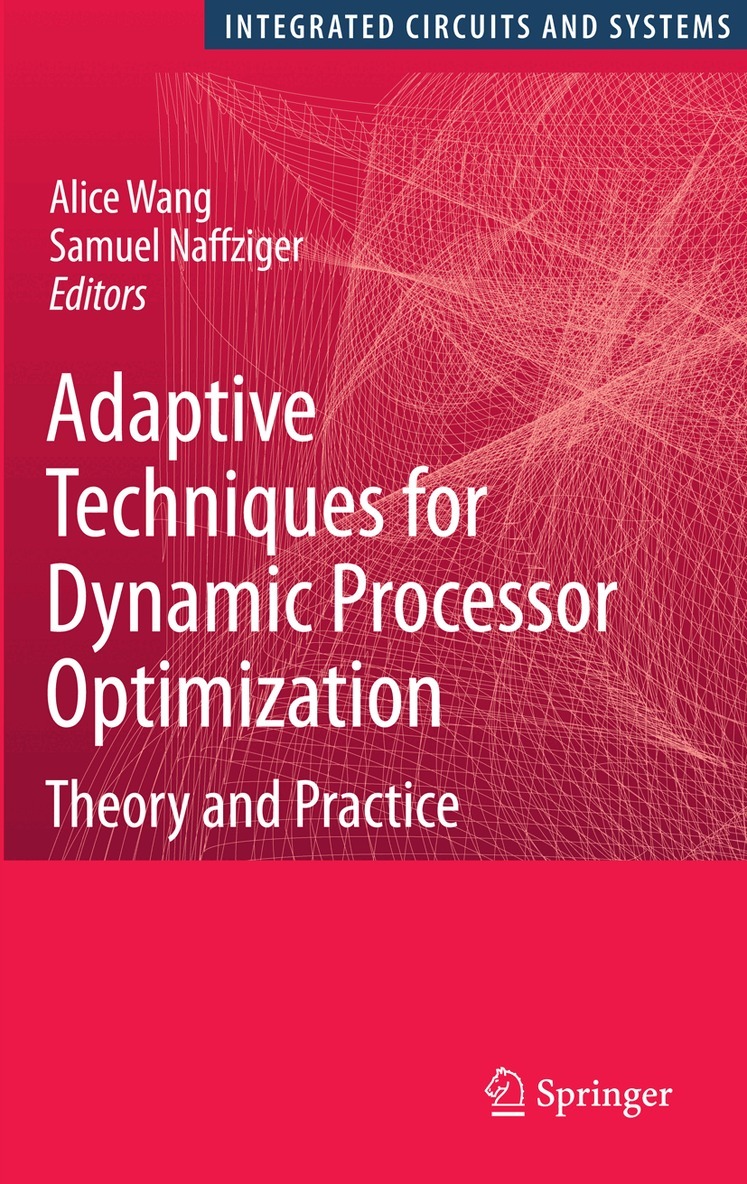
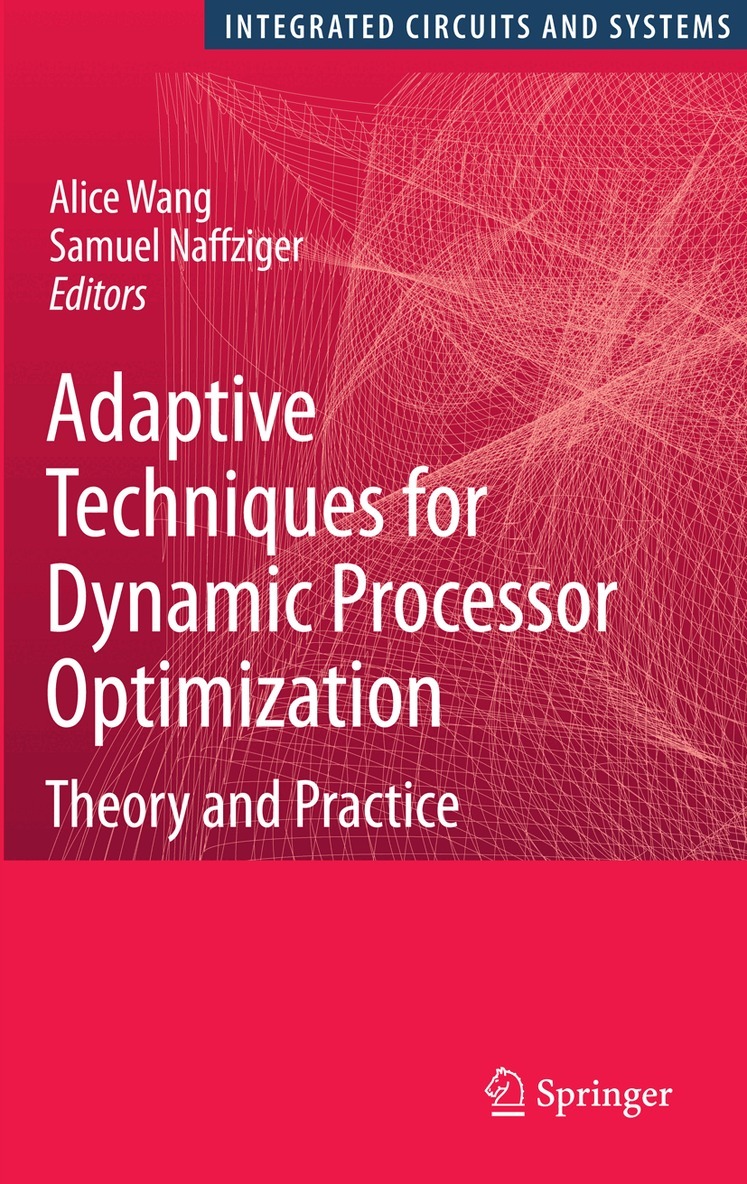
The integrated circuit has evolved tremendously in recent years as Moore’s Law has enabled exponentially more devices and functionality to be packed onto a single piece of silicon. In some ways however, these highly integrated circuits, of which microprocessors are the flagship example, have become victims of their own success. Despite dramatic reductions in the switching energy of the transistors, these reductions have kept pace neither with the increased integration levels nor with the higher switching frequencies. In addition, the atomic dimensions being utilized by these highly integrated processors have given rise to much higher levels of random and systematic variation which undercut the gains from process scaling that would otherwise be realized. So these factors—the increasing impact of variation and the struggle to control power consumption—have given rise to a tremendous amount of innovation in the area of adaptive techniques for dynamic processor optimization. The fundamental premise behind adaptive processor design is the recognition that variations in manufacturing and environment cause a statically configured operating point to be far too inefficient. Inefficient designs waste power and performance and will quickly be surpassed by more adaptive designs, just as it happens in the biological realm. Organisms must adapt to survive, and a similar trend is seen with processors – those that are enabled to adapt to their environment, will be far more competitive.
1 577 kr
Skickas inom 10-15 vardagar
Although energy dissipation has improved with each new technology node, because SoCs are integrating tens of million devices on-chip, the energy ex pended per operation has become a critical consideration in digital and ana log integrated circuits. The focus of this book is sub-threshold circuit design, which involves scaling voltages below the device thresholds. In this region, the energy per operation cair be reduced by an order of magnitude compared to conventional operation but at the cost of circuit performance. In many emerging applications such as self-powered RFID, wireless sensors networks, and portable devices (PDAs, medical monitoring, etc. ), the overall battery life time is the primary design metric. Sub-threshold design can also be applied to burst mode applications (e. g. , a cell-phone processor) where the process spends a significant amount of time in the standby mode. The supply voltage can be reduced to the deep sub-threshold region, dramatically saving power in logic and memory. Extremely low-power design was first explored in the 1970s for the design of applications such as wristwatch and calculator circuits. Dr. Eric Vittoz pioneered the design and modeling of weak-inversion circuits. In this book, Eric provides his perspective on the evolution of sub-threshold circuit design. Dr. Eric Vittoz and Dr. Christian Enz introduce key models necessary for the design and optimization of weak inversion circuits. Design using weak inversion has been widely adopted in analog circuits, and Eric introduces the key design considerations.
1 577 kr
Skickas inom 10-15 vardagar
The integrated circuit has evolved tremendously in recent years as Moore’s Law has enabled exponentially more devices and functionality to be packed onto a single piece of silicon. In some ways however, these highly integrated circuits, of which microprocessors are the flagship example, have become victims of their own success. Despite dramatic reductions in the switching energy of the transistors, these reductions have kept pace neither with the increased integration levels nor with the higher switching frequencies. In addition, the atomic dimensions being utilized by these highly integrated processors have given rise to much higher levels of random and systematic variation which undercut the gains from process scaling that would otherwise be realized. So these factors—the increasing impact of variation and the struggle to control power consumption—have given rise to a tremendous amount of innovation in the area of adaptive techniques for dynamic processor optimization. The fundamental premise behind adaptive processor design is the recognition that variations in manufacturing and environment cause a statically configured operating point to be far too inefficient. Inefficient designs waste power and performance and will quickly be surpassed by more adaptive designs, just as it happens in the biological realm. Organisms must adapt to survive, and a similar trend is seen with processors – those that are enabled to adapt to their environment, will be far more competitive.