Alina Tryfonidou – författare
Visar alla böcker från författaren Alina Tryfonidou. Handla med fri frakt och snabb leverans.
8 produkter
Family in EU Law
Av Marja-Liisa Öberg, Alina Tryfonidou
Inbunden, 2024
1438 kr
Lägg i varukorg
The volume provides a first-ever comprehensive account of the concept and the role of the family in EU law. It explores the family in EU law from four different angles. The first part of the book considers the philosophical and theoretical foundations of the family in the law in general, including …
Impact of Union Citizenship on the EU's Market Freedoms
E-bok, 2016
502 kr
Lägg i varukorg
The book''s aim is to consider the impact that the introduction and development of the status of Union citizenship has had on the interpretation of the EU''s market freedoms. Starting by providing, in its introductory part (part one), a comprehensive and up-to-date analysis of the status of Union …
Impact of Union Citizenship on the EU's Market Freedoms
E-bok, 2016
502 kr
Lägg i varukorg
The book''s aim is to consider the impact that the introduction and development of the status of Union citizenship has had on the interpretation of the EU''s market freedoms. Starting by providing, in its introductory part (part one), a comprehensive and up-to-date analysis of the status of Union …
Impact of Union Citizenship on the EU's Market Freedoms
Häftad, 2018
460 kr
Lägg i varukorg
The book's aim is to consider the impact that the introduction and development of the status of Union citizenship has had on the interpretation of the EU's market freedoms. Starting by providing, in its introductory part (part one), a comprehensive and up-to-date analysis of the status of Union …
Impact of Union Citizenship on the EU's Market Freedoms
Inbunden, 2016
1173 kr
Lägg i varukorg
The book's aim is to consider the impact that the introduction and development of the status of Union citizenship has had on the interpretation of the EU's market freedoms. Starting by providing, in its introductory part (part one), a comprehensive and up-to-date analysis of the status of Union …
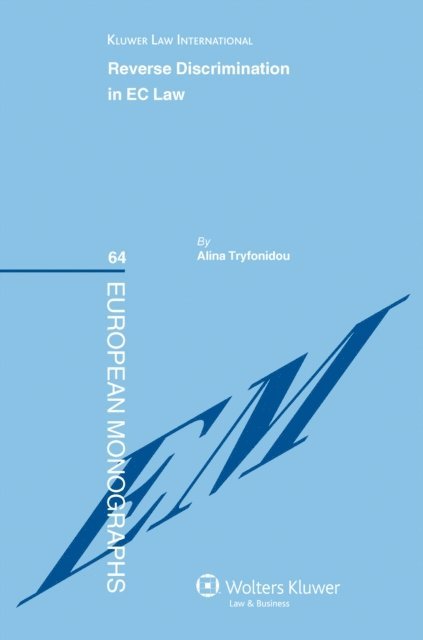
Reverse Discrimination in EC Law
E-bok, 2009
1732 kr
Lägg i varukorg
The spectre of reverse discrimination arises when it can be shown that a group is treated more favourably than another group that is normally favoured, as a consequence of positive action measures. Until recently, EC jurisprudence has consistently rejected allegations that reverse discrimination …