Allen George Debus - Böcker
Visar alla böcker från författaren Allen George Debus. Handla med fri frakt och snabb leverans.
4 produkter
4 produkter
652 kr
Skickas inom 7-10 vardagar
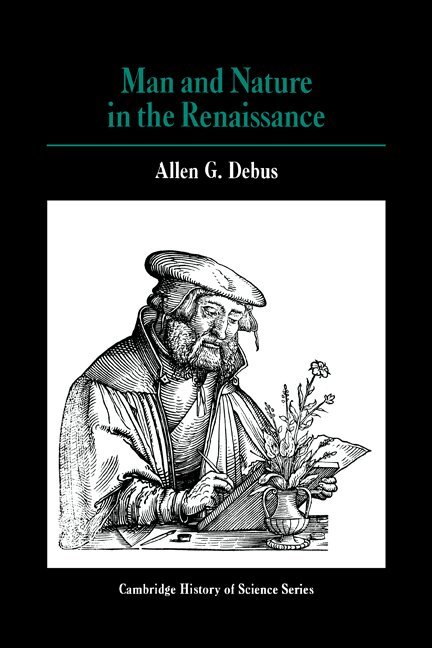
Man and Nature in the Renaissance offers an introduction to science and medicine during the earlier phases of the scientific revolution, from the mid-fifteenth century to the mid-seventeenth century. Renaissance science has frequently been approached in terms of the progress of the exact sciences of mathematics and astronomy, to the neglect of the broader intellectual context of the period. Conversely, those authors who have emphasized the latter frequently play down the importance of the technical scientific developments. In this book, Professor Debus amalgamates these approaches: The exact sciences of the period are discussed in detail, but reference is constantly made to religious and philosophical concepts that play little part in the science of our own time. Thus, the renewed interest in mystical texts and the subsequent impact of alchemy, astrology, and natural magic on the development of modern science and medicine are central to the account. Major themes that are followed throughout the book include the effects of humanism, the search for a new method of science, and the dialogue between proponents of the mystical-occult world view and the mathematical-observational approach to nature.
221 kr
Skickas inom 7-10 vardagar
Man and Nature in the Renaissance offers an introduction to science and medicine during the earlier phases of the scientific revolution, from the mid-fifteenth century to the mid-seventeenth century. Renaissance science has frequently been approached in terms of the progress of the exact sciences of mathematics and astronomy, to the neglect of the broader intellectual context of the period. Conversely, those authors who have emphasized the latter frequently play down the importance of the technical scientific developments. In this book, Professor Debus amalgamates these approaches: The exact sciences of the period are discussed in detail, but reference is constantly made to religious and philosophical concepts that play little part in the science of our own time. Thus, the renewed interest in mystical texts and the subsequent impact of alchemy, astrology, and natural magic on the development of modern science and medicine are central to the account. Major themes that are followed throughout the book include the effects of humanism, the search for a new method of science, and the dialogue between proponents of the mystical-occult world view and the mathematical-observational approach to nature.
The French Paracelsians
The Chemical Challenge to Medical and Scientific Tradition in Early Modern France
Inbunden, Engelska, 1991
1 282 kr
Skickas inom 7-10 vardagar
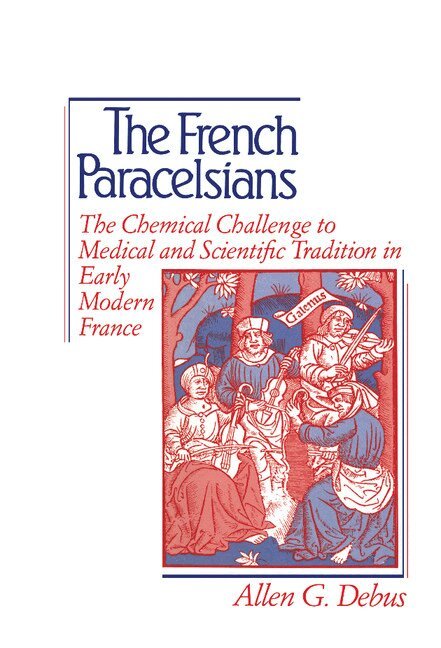
The scientific revolution of the sixteenth and seventeenth centuries is normally characterised in terms of astronomy and the physics of motion. In The French Paracelsians, first published in 1992, Allen Debus narrates an important episode whose contribution to the scientific revolution has been largely ignored: the long-standing contention between Paracelsians and Galenists. Shortly after the medical authority of Galen had been re-established during the Renaissance, Paracelsus, a Swiss-German firebrand, proposed a new approach to natural philosophy and medicine - through chemistry. The resulting debate between Paracelsians and Galenists lasted more than a century, embroiling medical establishments across Europe. In France the debate was particularly bitter, with the Medical Faculty in Paris determined to keep out of all fields of chemistry medicine. Debus elucidates this important polemic, not only in regard to Paracelsian pharmaceutical chemistry and clinical cosmology, but also the development of chemical physiology, and its struggle with seventeenth-century medicine dominated by mechanical philosophy.
The French Paracelsians
The Chemical Challenge to Medical and Scientific Tradition in Early Modern France
Häftad, Engelska, 2002
577 kr
Skickas inom 7-10 vardagar
The scientific revolution of the sixteenth and seventeenth centuries is normally characterised in terms of astronomy and the physics of motion. In The French Paracelsians, first published in 1992, Allen Debus narrates an important episode whose contribution to the scientific revolution has been largely ignored: the long-standing contention between Paracelsians and Galenists. Shortly after the medical authority of Galen had been re-established during the Renaissance, Paracelsus, a Swiss-German firebrand, proposed a new approach to natural philosophy and medicine - through chemistry. The resulting debate between Paracelsians and Galenists lasted more than a century, embroiling medical establishments across Europe. In France the debate was particularly bitter, with the Medical Faculty in Paris determined to keep out of all fields of chemistry medicine. Debus elucidates this important polemic, not only in regard to Paracelsian pharmaceutical chemistry and clinical cosmology, but also the development of chemical physiology, and its struggle with seventeenth-century medicine dominated by mechanical philosophy.