George Basalla - Böcker
Visar alla böcker från författaren George Basalla. Handla med fri frakt och snabb leverans.
8 produkter
8 produkter
555 kr
Skickas inom 5-8 vardagar
This book is a selective and fascinating history of scientific speculation about intelligent extraterrestrial life. From Plutarch to Stephen Hawking, some of the most prominent western scientists have had quite detailed perceptions and misperceptions about alien civilizations: Johannes Kepler, fresh from transforming astronomy with his work on the shape of planetary orbits, was quite sure alien engineers on the moon were excavating circular pits to provide shelter; Christiaan Huygens, the most prominent physical scientist between Galileo and Newton, dismissed Kepler's speculations, but used the laws of probability to prove that "planetarians" on other worlds are much like humans, and had developed a sense of the visual arts; Carl Sagan sees clearly that Huygens is a biological chauvinist, but doesn't see as clearly that he, Sagan, may be a cultural/technological chauvinist when he assumes aliens have highly developed technology like ours, but better. Basalla traces the influence of one speculation on the next, showing an unbroken but twisting chain of ideas passed from one scientist to the next, and from science to popular culture. He even traces the influence of popular culture on science--Sagan always admitted how much E. R. Burroughs' Martian novels influenced his speculations about Mars. Throughout, Basalla weaves his theme that scientific belief in and search for extraterrestrial civilizations is a complex impulse, part secularized-religious, and part anthropomorphic. He questions the common modern scientific reasoning that life converges on intelligence, and intelligence converges on one science valid everywhere. He ends the book by agreeing with Stephen Hawking (usually a safe bet) that intelligence is overrated for survival in the universe, and that we are most likely alone.
1 034 kr
Skickas inom 7-10 vardagar
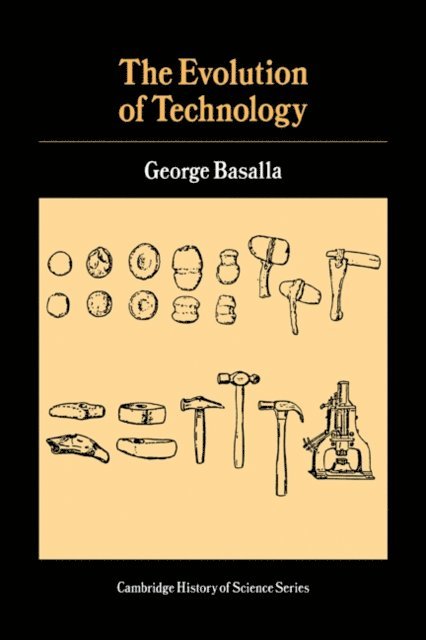
This book presents an evolutionary theory of technological change based upon recent scholarship in the history of technology and upon relevant material drawn from economic history and anthropology. It challenges the popular notion that technology advances by the efforts of a few heroic individuals who produce a series of revolutionary inventions owing little or nothing to the technological past. Therefore, the book's argument is shaped by analogies taken selectively from the theory of organic evolution, and not from the theory and practice of political revolution. Three themes appear, and reappear with variations, throughout the study. The first is diversity: an acknowledgment of the vast numbers of different kinds of made things (artifacts) that have long been available to humanity; the second is necessity: the belief that humans are driven to invent new artifacts in order to meet basic biological requirements such as food, shelter, and defense; and the third is technological evolution: an organic analogy that explains both the emergence of novel artifacts and their subsequent selection by society for incorporation into its material life without invoking either biological necessity or technological progress. Although the book is not intended to provide a strict chronological account of the development of technology, historical examples - including many of the major achievements of Western technology: the waterwheel, the printing press, the steam engine, automobiles and trucks, and the transistor - are used extensively to support its theoretical framework. The Evolution of Techology will be of interest to all readers seeking to learn how and why technology changes, including both students and specialists in the history of technology and science.
297 kr
Skickas inom 7-10 vardagar
Science and the Enlightenment is a general history of eighteenth-century science covering both the physical and life sciences. It places the scientific developments of the century in the cultural context of the Enlightenment and reveals the extent to which scientific ideas permeated the thought of the age. The book takes advantage of topical scholarship, which is rapidly changing our understanding of science during the eighteenth century. In particular it describes how science was organized into fields that were quite different from those we know today. Professor Hankins's work is a much needed addition to the literature on eighteenth-century science. His study is not technical; it will be of interest to all students of the Enlightenment and the history of science, as well as to the general reader with some background in science.
360 kr
Skickas inom 7-10 vardagar
By the 1980s the Soviet scientific establishment had become the largest in the world, but very little of its history was known in the West. What has been needed for many years in order to fill that gap in our knowledge is a history of Russian and Soviet science written for the educated person who would like to read one book on the subject. This book has been written for that reader. The history of Russian and Soviet science is a story of remarkable achievements and frustrating failures. That history is presented here in a comprehensive form, and explained in terms of its social and political context. Major sections include the tsarist period, the impact of the Russian Revolution, the relationship between science and Soviet society, and the strengths and weaknesses of individual scientific disciplines. The book also discusses the changes brought to science in Russia and other republics by the collapse of communism in the late 1980s and early 1990s.
271 kr
Skickas inom 7-10 vardagar
This introduction to the history of science in the seventeenth century examines the so-called 'scientific revolution' in terms of the interplay between two major themes. The Platonic-Pythagorean tradition looked on nature in geometric terms with the conviction that the cosmos was constructed according to the principles of mathematical order, while the mechanical philosophy conceived of nature as a huge machine and sought to explain the hidden mechanisms behind phenomena. Pursuing different goals, these two movements of thought tended to conflict with each other, and more than the obviously mathematical sciences were affected - the influence spread as far as chemistry and the life sciences. As this book demonstrates, the full fruition of the scientific revolution required a resolution of the tension between the two dominant trends.
221 kr
Skickas inom 7-10 vardagar
Man and Nature in the Renaissance offers an introduction to science and medicine during the earlier phases of the scientific revolution, from the mid-fifteenth century to the mid-seventeenth century. Renaissance science has frequently been approached in terms of the progress of the exact sciences of mathematics and astronomy, to the neglect of the broader intellectual context of the period. Conversely, those authors who have emphasized the latter frequently play down the importance of the technical scientific developments. In this book, Professor Debus amalgamates these approaches: The exact sciences of the period are discussed in detail, but reference is constantly made to religious and philosophical concepts that play little part in the science of our own time. Thus, the renewed interest in mystical texts and the subsequent impact of alchemy, astrology, and natural magic on the development of modern science and medicine are central to the account. Major themes that are followed throughout the book include the effects of humanism, the search for a new method of science, and the dialogue between proponents of the mystical-occult world view and the mathematical-observational approach to nature.
347 kr
Skickas inom 7-10 vardagar
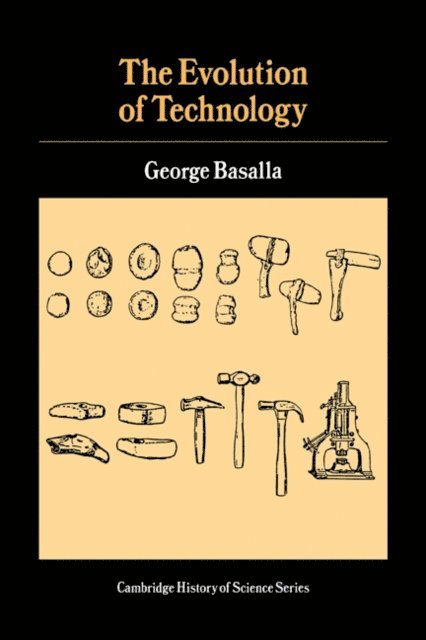
This book presents an evolutionary theory of technological change based upon recent scholarship in the history of technology and upon relevant material drawn from economic history and anthropology. It challenges the popular notion that technology advances by the efforts of a few heroic individuals who produce a series of revolutionary inventions owing little or nothing to the technological past. Therefore, the book's argument is shaped by analogies taken selectively from the theory of organic evolution, and not from the theory and practice of political revolution. Three themes appear, and reappear with variations, throughout the study. The first is diversity: an acknowledgment of the vast numbers of different kinds of made things (artifacts) that have long been available to humanity; the second is necessity: the belief that humans are driven to invent new artifacts in order to meet basic biological requirements such as food, shelter, and defense; and the third is technological evolution: an organic analogy that explains both the emergence of novel artifacts and their subsequent selection by society for incorporation into its material life without invoking either biological necessity or technological progress. Although the book is not intended to provide a strict chronological account of the development of technology, historical examples - including many of the major achievements of Western technology: the waterwheel, the printing press, the steam engine, automobiles and trucks, and the transistor - are used extensively to support its theoretical framework. The Evolution of Techology will be of interest to all readers seeking to learn how and why technology changes, including both students and specialists in the history of technology and science.
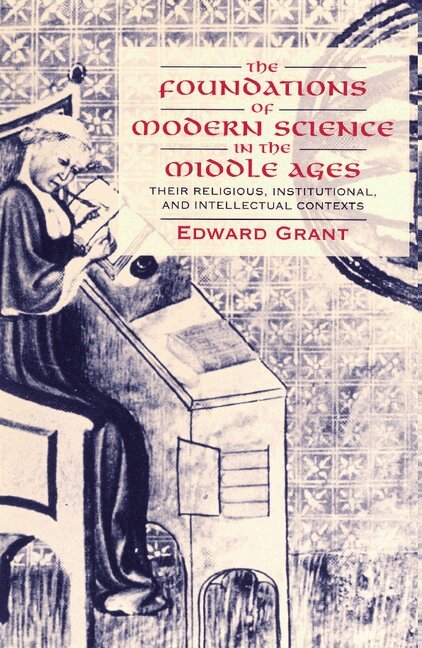
The Foundations of Modern Science in the Middle Ages
Their Religious, Institutional and Intellectual Contexts
Häftad, Engelska, 1996
309 kr
Skickas inom 7-10 vardagar
Contrary to prevailing opinion, the roots of modern science were planted in the ancient and medieval worlds long before the Scientific Revolution of the seventeenth century. Indeed, that revolution would have been inconceivable without the cumulative antecedent efforts of three great civilisations: Greek, Islamic, and Latin. With the scientific riches it derived by translation from Greco-Islamic sources in the twelfth and thirteenth centuries, the Christian Latin civilisation of Western Europe began the last leg of the intellectual journey that culminated in a scientific revolution that transformed the world. The factors that produced this unique achievement are found in the way Christianity developed in the West, and in the invention of the university in 1200. As this 1997 study shows, it is no mere coincidence that the origins of modern science and the modern university occurred simultaneously in Western Europe during the late Middle Ages.