Allen Lynch – författare
Visar alla böcker från författaren Allen Lynch. Handla med fri frakt och snabb leverans.
4 produkter
4 produkter
Europe from the Balkans to the Urals
The Disintegration of Yugoslavia and the Soviet Union
Inbunden, Engelska, 1996
3 049 kr
Skickas inom 5-8 vardagar
The disintegration of Yugoslavia and the USSR in 1991 shed entirely new light upon the character of the two political systems and causes us to re-examine many of the standard interpretations of Soviet and Yugoslav politics. Europe from the Balkans to the Urals is a comparative study of the disintegration of Yugoslavia and the USSR - as multinational, federal communist states - and the reaction to these parallel collapses of European and US foreign policy. Structural similarities in the destabilization of the two states mean that their comparitive study provides great insight into the demise of both.
2 200 kr
Skickas inom 10-15 vardagar
In this book, Allen Lynch challenges the common wisdom that the revolutionary events in Eastern Europe in 1989 and in the Soviet Union in 1991 marked the end of the cold war. Instead, he argues that the cold war was actually resolved by the early 1970s, as evidenced by the tacit acceptance of a divided Germany and Europe. More recent events thus overthrew not the cold war but the post-cold war order in East-West and U.S.-Soviet relations. And–often to their surprise and consternation–leaders of the governments involved must now face formidable new forces created by German unity and nationalism in Eastern Europe and the former Soviet Union, which were contained efficiently–if at times brutally–by the post-cold war order. In its three sections, the book reviews historical, contemporary, and future-oriented themes, respectively. Lynch begins by exploring the deeper logic of the cold war and how it was resolved by the 1970s. He then presents an overview of recent Soviet domestic and foreign policy processes as they affect East-West relations. The concluding section considers the future, with special emphasis on the implications of a disintegrating USSR for U.S. foreign policy.
644 kr
Skickas inom 10-15 vardagar
In this book, Allen Lynch challenges the common wisdom that the revolutionary events in Eastern Europe in 1989 and in the Soviet Union in 1991 marked the end of the cold war. Instead, he argues that the cold war was actually resolved by the early 1970s, as evidenced by the tacit acceptance of a divided Germany and Europe. More recent events thus overthrew not the cold war but the post-cold war order in East-West and U.S.-Soviet relations. And–often to their surprise and consternation–leaders of the governments involved must now face formidable new forces created by German unity and nationalism in Eastern Europe and the former Soviet Union, which were contained efficiently–if at times brutally–by the post-cold war order. In its three sections, the book reviews historical, contemporary, and future-oriented themes, respectively. Lynch begins by exploring the deeper logic of the cold war and how it was resolved by the 1970s. He then presents an overview of recent Soviet domestic and foreign policy processes as they affect East-West relations. The concluding section considers the future, with special emphasis on the implications of a disintegrating USSR for U.S. foreign policy.
Del 55 - Cambridge Russian, Soviet and Post-Soviet Studies
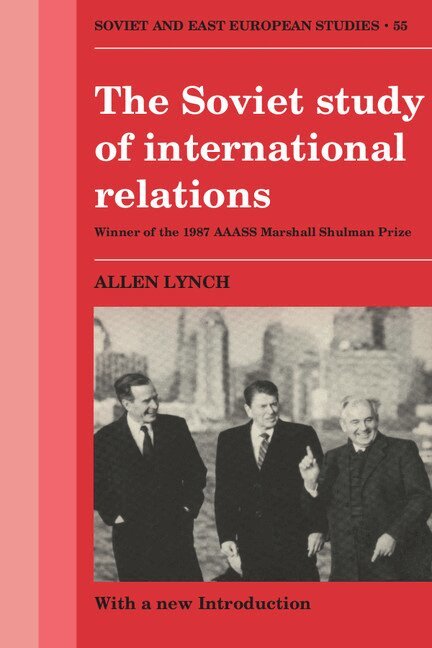
The Soviet Study of International Relations
Häftad, Engelska, 1989
452 kr
Skickas inom 7-10 vardagar
'Dr Lynch's book is an insightful and incisive examination of Soviet theories and concepts of international politics and foreign policy. Not only does he provide a concise exposition of the orthodox Marxist, Leninist and Stalinist foundations of Soviet thinking on international affairs, but he also examines the important departures from that orthodoxy under Khrushchev and Brezhnev. More important, however, he focuses on the intellectual ferment which characterized the infrastructure of the Soviet foreign policy establishment during the past twenty years ... His elegantly written words and powerful expository style enable us to understand better both Soviet thinking and Soviet behaviour in international affairs.' Vernon Aspaturian, Chair of the Shulman Prize Committee, 1987