Allen Oakley – författare
Visar alla böcker från författaren Allen Oakley. Handla med fri frakt och snabb leverans.
16 produkter
Marx's Critique of Political Economy Volume One
Intellectual Sources and Evolution
Av Allen Oakley
Inbunden, 2003
3793 kr
Lägg i varukorg
Volume One analyses the intellectual sources and evolution of Marx's critique of political economy leading up the writing of the main Capital manuscripts (1844-1860).The volume:* Provides a clear illustration of the contents of the texts in a way that enables readers to understand the intellectual …
Marx's Critique of Political Economy Volume Two
Intellectual Sources and Evolution
Av Allen Oakley
Inbunden, 2003
3793 kr
Lägg i varukorg
Volume Two covers the years 1861-1863, when Marx consolidated and refined the arguments of his critique of political economy in his relatively neglected manuscripts Theories of Surplus Value.* Special attention is paid to the nature, scope and limitations of Marx's critique and to the critique of …
Marx's Critique of Political Economy Volume One
Intellectual Sources and Evolution
Av Allen Oakley
E-bok, 2013
883 kr
Lägg i varukorg
Volume One analyses the intellectual sources and evolution of Marx''s critique of political economy leading up the writing of the main Capital manuscripts (1844-1860). The volume: * Provides a clear illustration of the contents of the texts in a way that enables readers to understand the …
Marx's Critique of Political Economy Volume One
Intellectual Sources and Evolution
Av Allen Oakley
E-bok, 2013
883 kr
Lägg i varukorg
Volume One analyses the intellectual sources and evolution of Marx''s critique of political economy leading up the writing of the main Capital manuscripts (1844-1860). The volume: * Provides a clear illustration of the contents of the texts in a way that enables readers to understand the …
Marx's Critique of Political Economy Volume Two
Intellectual Sources and Evolution
Av Allen Oakley
E-bok, 2013
890 kr
Lägg i varukorg
Volume Two covers the years 1861-1863, when Marx consolidated and refined the arguments of his critique of political economy in his relatively neglected manuscripts Theories of Surplus Value. * Special attention is paid to the nature, scope and limitations of Marx''s critique and to the critique of …
Marx's Critique of Political Economy Volume Two
Intellectual Sources and Evolution
Av Allen Oakley
E-bok, 2013
910 kr
Lägg i varukorg
Volume Two covers the years 1861-1863, when Marx consolidated and refined the arguments of his critique of political economy in his relatively neglected manuscripts Theories of Surplus Value. * Special attention is paid to the nature, scope and limitations of Marx''s critique and to the critique of …
Marx's Critique of Political Economy Volume One
Intellectual Sources and Evolution
Av Allen Oakley
Häftad, 2014
750 kr
Lägg i varukorg
Volume One analyses the intellectual sources and evolution of Marx's critique of political economy leading up the writing of the main Capital manuscripts (1844-1860).The volume:* Provides a clear illustration of the contents of the texts in a way that enables readers to understand the intellectual …
Marx's Critique of Political Economy Volume Two
Intellectual Sources and Evolution
Av Allen Oakley
Häftad, 2014
750 kr
Lägg i varukorg
Volume Two covers the years 1861-1863, when Marx consolidated and refined the arguments of his critique of political economy in his relatively neglected manuscripts Theories of Surplus Value.* Special attention is paid to the nature, scope and limitations of Marx's critique and to the critique of …
Making of Marx's Critical Theory
A Bibliographical Analysis
Av Allen Oakley
Inbunden, 2015
1521 kr
Lägg i varukorg
Marx’s written output was massive. Much of it remained unpublished in his own lifetime and there is still no complete edition of the extant works, although most have been published in one form or another. This book, first published in 1983, provides an analytical guide to the complex chronological …
Making of Marx's Critical Theory
A Bibliographical Analysis
Av Allen Oakley
Häftad, 2016
487 kr
Lägg i varukorg
Marx’s written output was massive. Much of it remained unpublished in his own lifetime and there is still no complete edition of the extant works, although most have been published in one form or another. This book, first published in 1983, provides an analytical guide to the complex chronological …
Making of Marx's Critical Theory (RLE Marxism)
A Bibliographical Analysis
Av Allen Oakley
E-bok, 2015
572 kr
Lägg i varukorg
Marx’s written output was massive. Much of it remained unpublished in his own lifetime and there is still no complete edition of the extant works, although most have been published in one form or another. This book, first published in 1983, provides an analytical guide to the complex …
Making of Marx's Critical Theory (RLE Marxism)
A Bibliographical Analysis
Av Allen Oakley
E-bok, 2015
559 kr
Lägg i varukorg
Marx’s written output was massive. Much of it remained unpublished in his own lifetime and there is still no complete edition of the extant works, although most have been published in one form or another. This book, first published in 1983, provides an analytical guide to the complex …
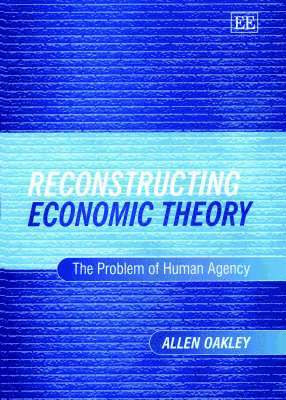
Reconstructing Economic Theory
The Problem of Human Agency
Av Allen Oakley
Inbunden, 2002
2178 kr
Lägg i varukorg
This book applies a critical focus on the extent to which methodological practices in mainstream economic theory impede our understanding of substantive economic phenomena as the products of human action. Economists, in general, work with a concept and representation of the human agent that is …
classical economic man
Human Agency and Methodology in the Political Economy of Adam Smith and J.S. Mill
Av Allen Oakley
Inbunden, 1994
2069 kr
Lägg i varukorg
In Classical Economic Man, Allen Oakley argues that two of the fathers of modern economics espoused methodological strategies which rejected the concept of ‘economic man’ and gave primacy to the human origins of economic phenomena.Adam Smith and J.S. Mill are shown to have been sensitive to the …
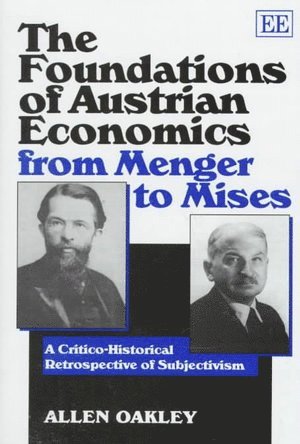
Foundations of Austrian Economics from Menger to Mises
A Critico-Historical Retrospective of Subjectivism
Av Allen Oakley
Inbunden, 1997
2071 kr
Lägg i varukorg
This landmark book presents a critical study of the Austrian subjectivism of Menger and Mises and assesses their contribution in the light of contemporary philosophy of the human sciences.Allen Oakley lays emphasis on the subjectivism of Menger and Mises as the foundation of Austrian economics. By …
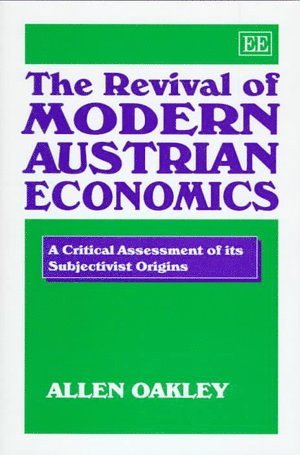
Revival of Modern Austrian Economics
A Critical Assessment of its Subjectivist Origins
Av Allen Oakley
Inbunden, 1999
1942 kr
Lägg i varukorg
This insightful book critically assesses the subjectivist metatheoretical origins of the revival of modern Austrian economics. It examines the ideas of the main contributors to the Austrian school, including von Mises, von Hayek and Lachmann.Allen Oakley analyses the contribution to subjectivist …