Amnon Raz-Krakotzkin - Böcker
Visar alla böcker från författaren Amnon Raz-Krakotzkin. Handla med fri frakt och snabb leverans.
3 produkter
3 produkter
Censor, the Editor, and the Text
The Catholic Church and the Shaping of the Jewish Canon in the Sixteenth Century
Inbunden, Engelska, 2007
910 kr
Skickas inom 10-15 vardagar
In The Censor, the Editor, and the Text, Amnon Raz-Krakotzkin examines the impact of Catholic censorship on the publication and dissemination of Hebrew literature in the early modern period. Hebrew literature made the transition to print in Italian print houses, most of which were owned by Christians. These became lively meeting places for Christian scholars, rabbis, and the many converts from Judaism who were employed as editors and censors.Raz-Krakotzkin examines the principles and practices of ecclesiastical censorship that were established in the second half of the sixteenth century as a part of this process. The book examines the development of censorship as part of the institutionalization of new measures of control over literature in this period, suggesting that we view surveillance of Hebrew literature not only as a measure directed against the Jews but also as a part of the rise of Hebraist discourse and therefore as a means of integrating Jewish literature into the Christian canon.On another level, The Censor, the Editor, and the Text explores the implications of censorship in relation to other agents that participated in the preparation of texts for publishing-authors, publishers, editors, and readers. The censorship imposed upon the Jews had a definite impact on Hebrew literature, but it hardly denied its reading, in fact confirming the right of the Jews to possess and use most of their literature.By bringing together two apparently unrelated issues-the role of censorship in the creation of print culture and the place of Jewish culture in the context of Christian society-Raz-Krakotzkin advances a new outlook on both, allowing each to be examined through the conceptual framework usually reserved for the other.
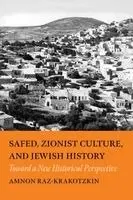
Safed, Zionist Culture, and Jewish History
Toward a New Historical Perspective
Inbunden, Engelska, 2026
2 274 kr
Kommande
Brings the legacy of sixteenth-century Safed into modern scholarship on Zionism to propose a new model of Jewish existence.Sixteenth-century Safed was one of the most important centers of thought and learning in Jewish history, yet Zionist historical narratives, which emphasize the continuity of Jewish presence in Palestine, have consistently downplayed or ignored it. Amnon Raz-Krakotzkin investigates this strange contradiction. His new book argues that Safed articulates a model of early modern Jewish national revival, one closely connected to the land and its material geography, yet radically different from the Zionist model that emerged in the late nineteenth century. While Zionism set out to restore Biblical Jewish sovereignty, rabbinic Safed’s emphasis on the Mishnah proposed a non-sovereign Jewish connection to the land.As much a polemic as a historical and theological analysis, Safed, Zionist Culture, and Jewish History offers a provocative new perspective on questions related to nationalism, Judaism, and Israel.
738 kr
Kommande
Brings the legacy of sixteenth-century Safed into modern scholarship on Zionism to propose a new model of Jewish existence.Sixteenth-century Safed was one of the most important centers of thought and learning in Jewish history, yet Zionist historical narratives, which emphasize the continuity of Jewish presence in Palestine, have consistently downplayed or ignored it. Amnon Raz-Krakotzkin investigates this strange contradiction. His new book argues that Safed articulates a model of early modern Jewish national revival, one closely connected to the land and its material geography, yet radically different from the Zionist model that emerged in the late nineteenth century. While Zionism set out to restore Biblical Jewish sovereignty, rabbinic Safed’s emphasis on the Mishnah proposed a non-sovereign Jewish connection to the land.As much a polemic as a historical and theological analysis, Safed, Zionist Culture, and Jewish History offers a provocative new perspective on questions related to nationalism, Judaism, and Israel.