Amy Holmes-Tagchungdarpa - Böcker
Visar alla böcker från författaren Amy Holmes-Tagchungdarpa. Handla med fri frakt och snabb leverans.
4 produkter
4 produkter
1 892 kr
Kommande
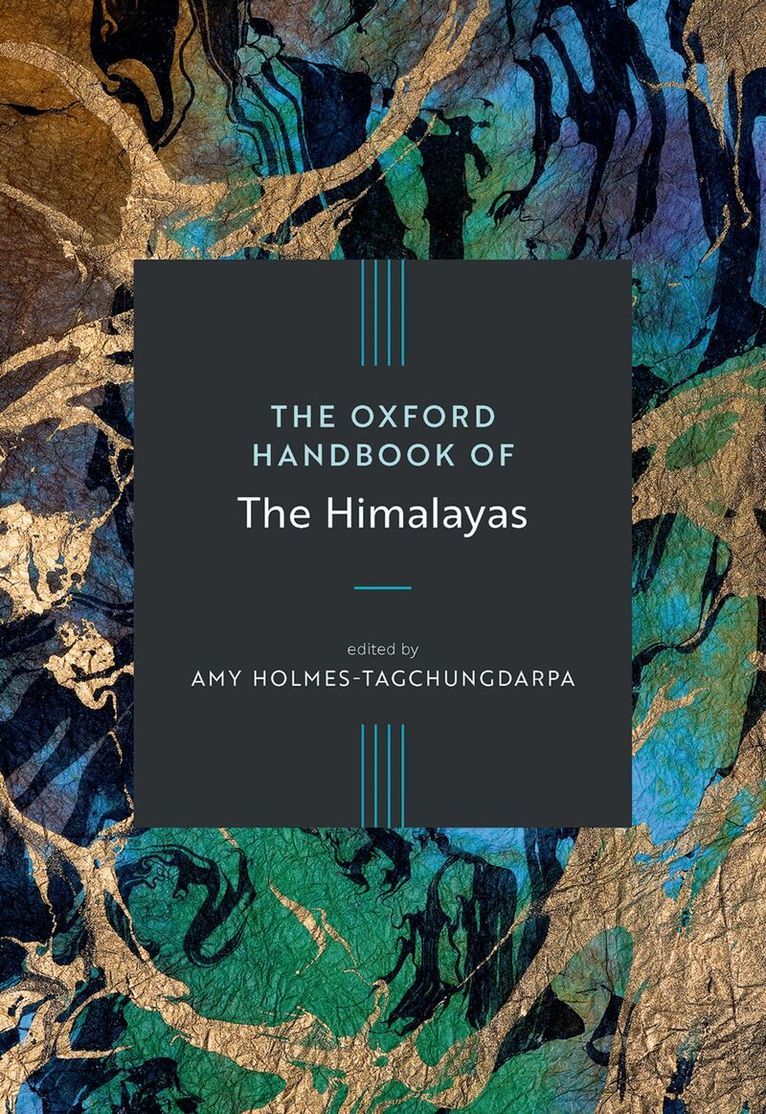
The Himalayas are not just mountains. They are also not just places for mountaineering, exploring, or extracting commodities. The Himalayan region is dynamic. Spanning eight contemporary nation states - from Afghanistan to Myanmar, including Bangladesh, Bhutan, China, India, Nepal, and Pakistan - the region is home to great diversity of people, languages, political formations, and ecosystems.It is also a region that is frequently imagined through siloed disciplinary perspectives, for its beautiful mountain vistas and geography, or its anthropological complexity. These perspectives developed during European colonial expansion in the region which has had long lasting repercussions for the making of borders and nation states as well as academic disciplines. The Oxford Handbook of the Himalayas provides an overview of the many ways that the Himalayas as a region are conceptualized and studied from the perspective of academics across multiple fields, including anthropology, history, geography, and religious studies, and from the people of the Himalayas. It engages with crucial themes for understanding this region in both local and global contexts, including through the lenses of relationships between Himalayan communities and their environments, political formations, international relations, race, ethnicity, language, gender, religion, economics, and infrastructures.This Handbook refuses the limitations of colonially-imposed boundaries, and instead emphasizes the themes of diversity, change, and connectedness to understand how the study of the Himalayas has developed, and how it continues to develop in conversation with the communities of the region. The Handbook is divided into five sections that provide an overview of the history of global engagements with the Himalayas. The first section provides an overview of the region. The second looks at colonial engagements and statemaking. The third examines how Himalayan worldviews have been represented in scholarship, and how these representations are interpreted with and engaged by local communities. The fourth critically examines local identities. The fifth examines contemporary issues that have developed from these earlier engagements and the growth of Himalayan diasporic communities around the world.
Social Life of Tibetan Biography
Textuality, Community, and Authority in the Lineage of Tokden Shakya Shri
Inbunden, Engelska, 2014
1 567 kr
Skickas inom 10-15 vardagar
The Social Life of Tibetan Biography explores the creation of Tibetan religious authority in Tibetan cultural areas throughout East, Inner, and South Asia through engaging with the relationship between textual biography and social community in the case of the Eastern Tibetan yogi Tokden Shakya Shri (1853–1919). It explores the different mechanisms used by Shakya Shri’s community in the creation of his biographical portrait to develop his lineage, including the use of biographical tropes, details of interpersonal connections, educational and patronage networks, and representations of sacred site creation and maintenance. In doing so, this study decenters Tibetan and Himalayan religious history through recognizing that peripheries could act as alternative centers of authority for diverse Tibetan Buddhist communities.
2 088 kr
Skickas inom 10-15 vardagar
This book explores the role of religion in discussions about climate change and, particularly, the development of responses to climate change on global, state, institutional, and local levels. It considers examples of the ways that different religious traditions, including Indigenous, Muslim, Buddhist, and Christian communities, have responded to the different effects of climate change by using different methodological approaches, including political science and international relations (e.g. public opinion polls and constructivism); religious studies scholarship on climate change, including an overview of religion and ecology as a subdiscipline in religious studies; and environmental humanities approaches.This volume interrogates the diverse ways religion both acts and is acted upon by different actors, including institutions and nation states, in response to climate change. Within single traditions, different actors advocate for planetary care and concern, while their co-religionists may remain passive or deny climate change as a phenomenon.This book unravels the complexities of how different religions approach climate change and recommends that religions are taken seriously in the development of climate change mitigation strategies at different scales.The Open Access version of this book, available at http://www.taylorfrancis.com, has been made available under a Creative Commons Attribution-Non Commercial-No Derivatives (CC BY-NC-ND) 4.0 license
292 kr
Skickas inom 10-15 vardagar
This book explores the role of religion in discussions about climate change and, particularly, the development of responses to climate change on global, state, institutional, and local levels. It considers examples of the ways that different religious traditions, including Indigenous, Muslim, Buddhist, and Christian communities, have responded to the different effects of climate change by using different methodological approaches, including political science and international relations (e.g. public opinion polls and constructivism); religious studies scholarship on climate change, including an overview of religion and ecology as a subdiscipline in religious studies; and environmental humanities approaches.This volume interrogates the diverse ways religion both acts and is acted upon by different actors, including institutions and nation states, in response to climate change. Within single traditions, different actors advocate for planetary care and concern, while their co-religionists may remain passive or deny climate change as a phenomenon.This book unravels the complexities of how different religions approach climate change and recommends that religions are taken seriously in the development of climate change mitigation strategies at different scales.The Open Access version of this book, available at http://www.taylorfrancis.com, has been made available under a Creative Commons Attribution-Non Commercial-No Derivatives (CC BY-NC-ND) 4.0 license