Anatolij Dvurecenskij – författare
Visar alla böcker från författaren Anatolij Dvurecenskij. Handla med fri frakt och snabb leverans.
8 produkter
8 produkter
Inbunden, Engelska, 1993
1 416 kr
Skickas inom 10-15 vardagar
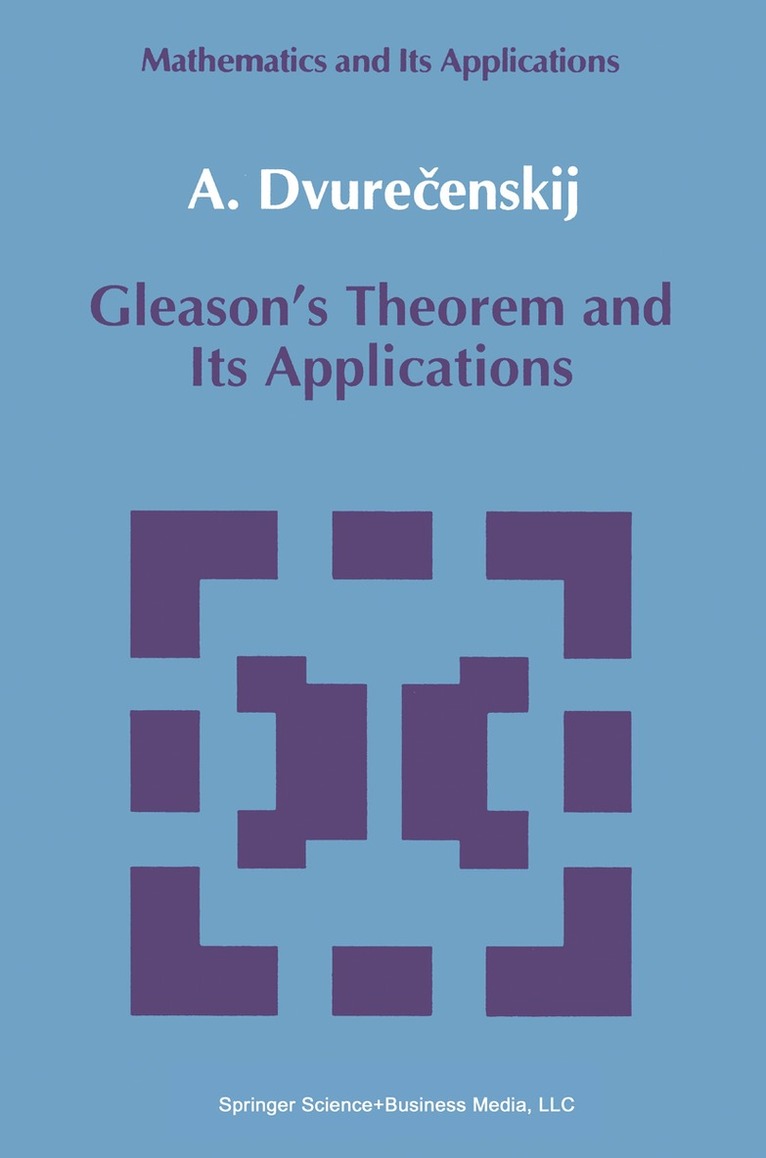
For many years physics and mathematics have had a fruitful influence on one another. Classical mechanics and celestial mechanics have produced very deep problems whose solutions have enhanced mathematics. On the other hand, mathematics itself has found interesting theories which then (sometimes after many years) have been reflected in physics, confirming the thesis that nothing is more practical than a good theory. The same is true for the younger physical discipline -of quantum mechanics. In the 1930s two events, not at all random, became: The mathematical back grounds of both quantum mechanics and probability theory. In 1936, G. Birkhoff and J. von Neumann published their historical paper "The logic of quantum mechanics", in which a quantum logic was suggested. The mathematical foundations of quantum mechanics remains an outstanding problem of mathematics, physics, logic and philosophy even today. The theory of quantum logics is a major stream in this axiomatical knowledge river, where L(H), the system of all closed subspaces of a Hilbert space H, due to J. von Neumann, plays an important role. When A.M. Gleason published his solution to G. Mackey's problem showing that any state (= probability measure) corresponds to a density operator, he probably did not anticipate that his solution would become a cornerstone of ax iomati cal theory of quantum mechanics nor that it would provide many interesting applications to mathematics.
Inbunden, Engelska, 2000
1 091 kr
Skickas inom 10-15 vardagar
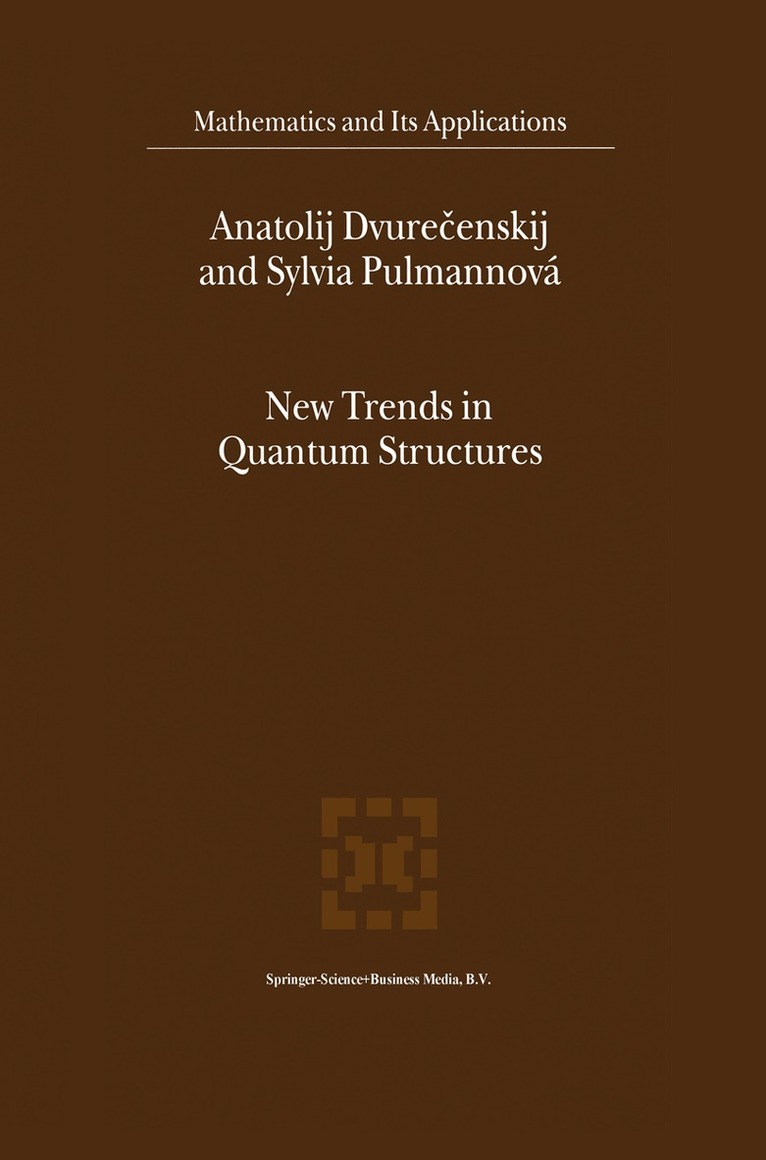
D. Hilbert, in his famous program, formulated many open mathematical problems which were stimulating for the development of mathematics and a fruitful source of very deep and fundamental ideas. During the whole 20th century, mathematicians and specialists in other fields have been solving problems which can be traced back to Hilbert's program, and today there are many basic results stimulated by this program. It is sure that even at the beginning of the third millennium, mathematicians will still have much to do. One of his most interesting ideas, lying between mathematics and physics, is his sixth problem: To find a few physical axioms which, similar to the axioms of geometry, can describe a theory for a class of physical events that is as large as possible. We try to present some ideas inspired by Hilbert's sixth problem and give some partial results which may contribute to its solution. In the Thirties the situation in both physics and mathematics was very interesting. A.N. Kolmogorov published his fundamental work Grundbegriffe der Wahrschein lichkeitsrechnung in which he, for the first time, axiomatized modern probability theory. From the mathematical point of view, in Kolmogorov's model, the set L of ex perimentally verifiable events forms a Boolean a-algebra and, by the Loomis-Sikorski theorem, roughly speaking can be represented by a a-algebra S of subsets of some non-void set n.
Häftad, Engelska, 2026
603 kr
Skickas inom 10-15 vardagar
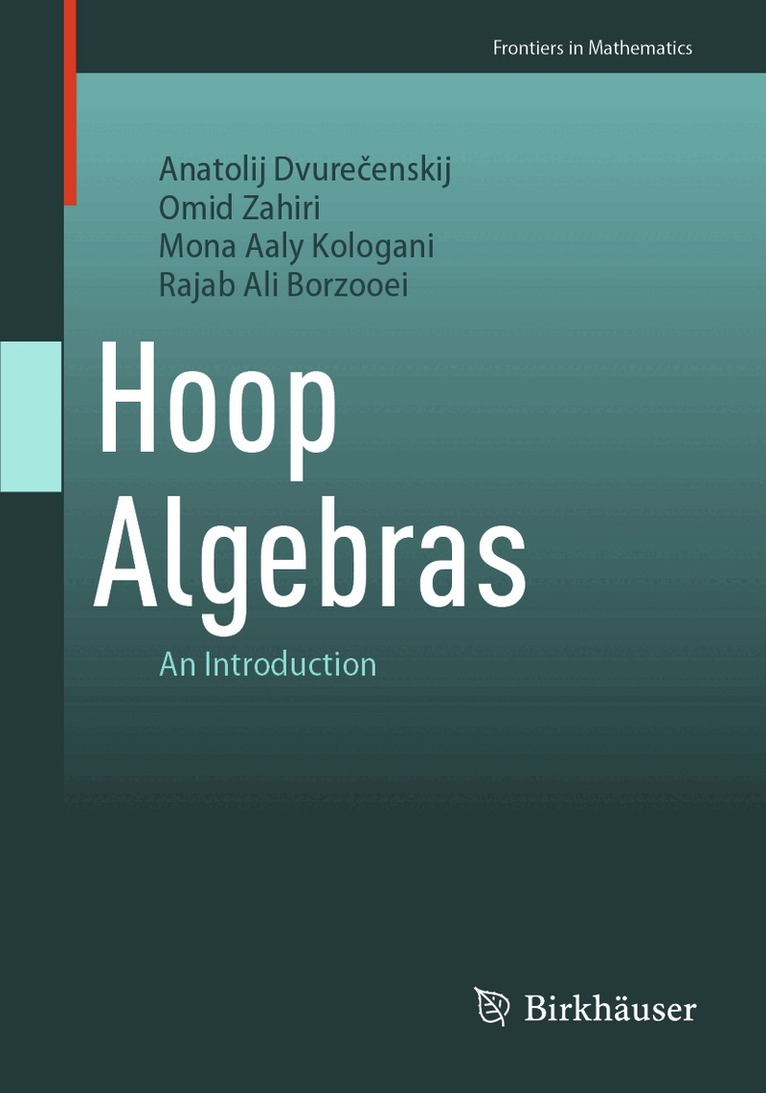
This book offers a comprehensive and in-depth exploration of hoop theory, a fascinating branch of algebra with deep connections to logic and other areas of mathematics. Among algebraic structures, hoops stand out as a rich subject of study, bridging the worlds of residuated lattices, BL-algebras, MV-algebras, and related systems. Starting with fundamental concepts of algebraic and lattice-theoretical structures, the book gradually delves into the core theory of hoops, investigating their algebraic structure, properties, and relationships with other algebraic systems. Significant attention is also devoted to the lattice-theoretical properties of hoops, and the interplay between algebraic and logical perspectives is emphasized. This book is intended for advanced undergraduates with a background in algebra and logic, Ph.D. students, and researchers. Featuring a number of examples and exercises, it serves as a valuable resource for those seeking a comprehensive and in-depth understanding of hoop theory and its applications.
E-bok
Engelska, 2026764 kr
Läs direkt efter köp
This book offers a comprehensive and in-depth exploration of hoop theory, a fascinating branch of algebra with deep connections to logic and other areas of mathematics. Among algebraic structures, hoops stand out as a rich subject of study, bridging the worlds of residuated lattices, BL-algebras, MV-algebras, and related systems. Starting with fundamental concepts of algebraic and lattice-theoretical structures, the book gradually delves into the core theory of hoops, investigating their algebraic structure, properties, and relationships with other algebraic systems. Significant attention is also devoted to the lattice-theoretical properties of hoops, and the interplay between algebraic and logical perspectives is emphasized. This book is intended for advanced undergraduates with a background in algebra and logic, Ph.D. students, and researchers. Featuring a number of examples and exercises, it serves as a valuable resource for those seeking a comprehensive and in-depth understanding of hoop theory and its applications.
Häftad, Engelska, 2010
1 416 kr
Skickas inom 10-15 vardagar
For many years physics and mathematics have had a fruitful influence on one another. Classical mechanics and celestial mechanics have produced very deep problems whose solutions have enhanced mathematics. On the other hand, mathematics itself has found interesting theories which then (sometimes after many years) have been reflected in physics, confirming the thesis that nothing is more practical than a good theory. The same is true for the younger physical discipline -of quantum mechanics. In the 1930s two events, not at all random, became: The mathematical back grounds of both quantum mechanics and probability theory. In 1936, G. Birkhoff and J. von Neumann published their historical paper "The logic of quantum mechanics", in which a quantum logic was suggested. The mathematical foundations of quantum mechanics remains an outstanding problem of mathematics, physics, logic and philosophy even today. The theory of quantum logics is a major stream in this axiomatical knowledge river, where L(H), the system of all closed subspaces of a Hilbert space H, due to J. von Neumann, plays an important role. When A.M. Gleason published his solution to G. Mackey's problem showing that any state (= probability measure) corresponds to a density operator, he probably did not anticipate that his solution would become a cornerstone of ax iomati cal theory of quantum mechanics nor that it would provide many interesting applications to mathematics.
Häftad, Engelska, 2010
1 091 kr
Skickas inom 10-15 vardagar
D. Hilbert, in his famous program, formulated many open mathematical problems which were stimulating for the development of mathematics and a fruitful source of very deep and fundamental ideas. During the whole 20th century, mathematicians and specialists in other fields have been solving problems which can be traced back to Hilbert's program, and today there are many basic results stimulated by this program. It is sure that even at the beginning of the third millennium, mathematicians will still have much to do. One of his most interesting ideas, lying between mathematics and physics, is his sixth problem: To find a few physical axioms which, similar to the axioms of geometry, can describe a theory for a class of physical events that is as large as possible. We try to present some ideas inspired by Hilbert's sixth problem and give some partial results which may contribute to its solution. In the Thirties the situation in both physics and mathematics was very interesting. A.N. Kolmogorov published his fundamental work Grundbegriffe der Wahrschein lichkeitsrechnung in which he, for the first time, axiomatized modern probability theory. From the mathematical point of view, in Kolmogorov's model, the set L of ex perimentally verifiable events forms a Boolean a-algebra and, by the Loomis-Sikorski theorem, roughly speaking can be represented by a a-algebra S of subsets of some non-void set n.
E-bok
PDF, Engelska, 20131 672 kr
Läs direkt efter köp
For many years physics and mathematics have had a fruitful influence on one another. Classical mechanics and celestial mechanics have produced very deep problems whose solutions have enhanced mathematics. On the other hand, mathematics itself has found interesting theories which then (sometimes after many years) have been reflected in physics, confirming the thesis that nothing is more practical than a good theory. The same is true for the younger physical discipline -of quantum mechanics. In the 1930s two events, not at all random, became: The mathematical back grounds of both quantum mechanics and probability theory. In 1936, G. Birkhoff and J. von Neumann published their historical paper "The logic of quantum mechanics", in which a quantum logic was suggested. The mathematical foundations of quantum mechanics remains an outstanding problem of mathematics, physics, logic and philosophy even today. The theory of quantum logics is a major stream in this axiomatical knowledge river, where L(H), the system of all closed subspaces of a Hilbert space H, due to J. von Neumann, plays an important role. When A.M. Gleason published his solution to G. Mackey''s problem showing that any state (= probability measure) corresponds to a density operator, he probably did not anticipate that his solution would become a cornerstone of ax iomati cal theory of quantum mechanics nor that it would provide many interesting applications to mathematics.
E-bok
PDF, Engelska, 20131 367 kr
Läs direkt efter köp
D. Hilbert, in his famous program, formulated many open mathematical problems which were stimulating for the development of mathematics and a fruitful source of very deep and fundamental ideas. During the whole 20th century, mathematicians and specialists in other fields have been solving problems which can be traced back to Hilbert''s program, and today there are many basic results stimulated by this program. It is sure that even at the beginning of the third millennium, mathematicians will still have much to do. One of his most interesting ideas, lying between mathematics and physics, is his sixth problem: To find a few physical axioms which, similar to the axioms of geometry, can describe a theory for a class of physical events that is as large as possible. We try to present some ideas inspired by Hilbert''s sixth problem and give some partial results which may contribute to its solution. In the Thirties the situation in both physics and mathematics was very interesting. A.N. Kolmogorov published his fundamental work Grundbegriffe der Wahrschein lichkeitsrechnung in which he, for the first time, axiomatized modern probability theory. From the mathematical point of view, in Kolmogorov''s model, the set L of ex perimentally verifiable events forms a Boolean a-algebra and, by the Loomis-Sikorski theorem, roughly speaking can be represented by a a-algebra S of subsets of some non-void set n.