Anders Borglin - Böcker
Visar alla böcker från författaren Anders Borglin. Handla med fri frakt och snabb leverans.
3 produkter
3 produkter
552 kr
Skickas inom 10-15 vardagar
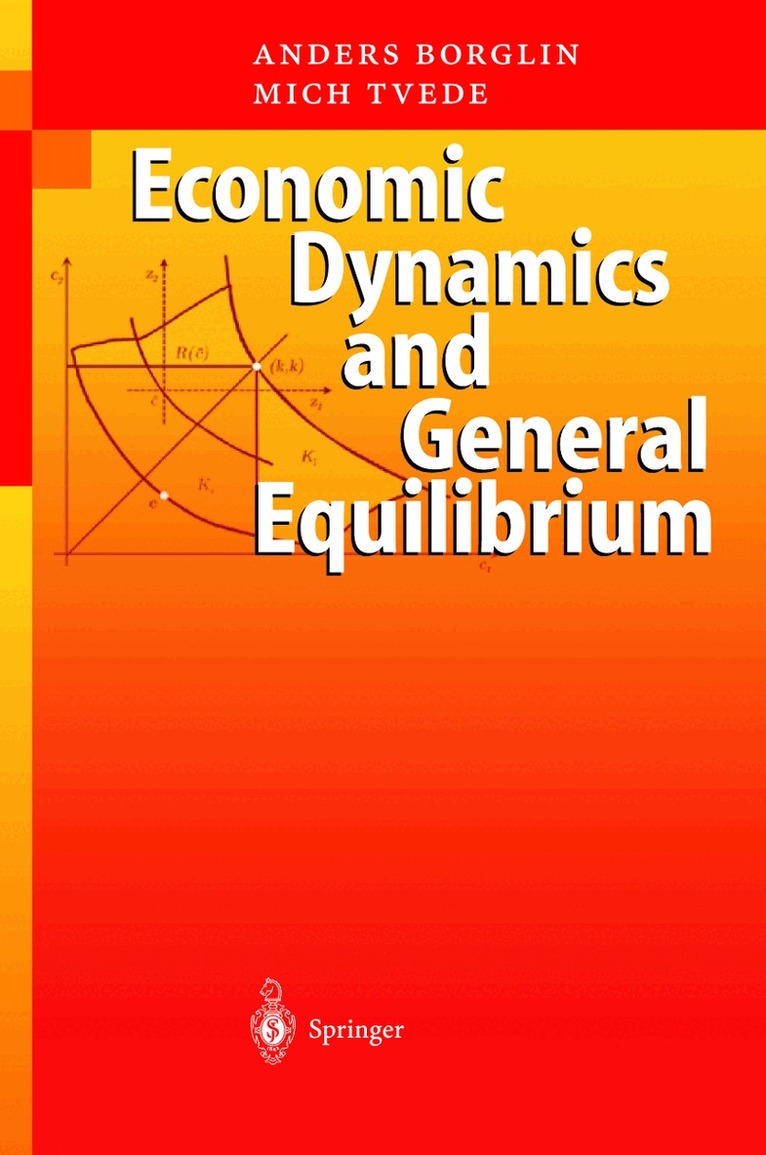
This book grew out of the teaching and lecture notes for a course in "Dynamic Economics" given at Copenhagen University where it has been part of a combined study program in economics and mathematics since 1986. The subjects in the course have varied over time but a common theme has been the study of economies over time and under uncertainty in the form of incomplete markets and the overlapping generations model. When I took up a position at Lund University in 1996 Mich Tvede took over responsibility for the course and together we developed a large part of the material, which formed the basis for the present book. He has generously allowed me to use all of our common material. There is a considerable overlap between general equilibrium theory with incomplete markets (GEI), finance and macroeconomic theory, which sterns from the considerations of time and uncertainty, as can be seen from the splendid textbooks by LeRoy and Werner [2001], Pliska [1997] and the seminal work on GEI by Magill and Quinzee [1996], in partic ular its "Historical Remarks" which off er a brilliant history of modern economic theory. The exposition here airns at making some of the results of GEI and on overlapping generations (OG) economies readily available to areader acquainted with economic theory at an upper undergraduate level.
Del 269 - Lecture Notes in Economics and Mathematical Systems
Optimality in Infinite Horizon Economies
Häftad, Engelska, 1986
552 kr
Skickas inom 10-15 vardagar
Modern welfare economics as it is known today to economists took its final shape with the emergence of the Arrow-Debreu model. The classical conjectures about the beneficient workings of markets together with the converse statement, that optimal (in the sense of Pareto) allocations may be sustained by prices and markets, has laid a firm foundation for further research in welfare economics. But more than that, it has inspired researchers to take up entirely new topics, notably by closer considerations of situations where the assumptions of the original model may seem overly restrictive. One of these new directions has been connected with generalizing the model so that it takes into account the possibility of infinitely many commodities. On the face of it, the idea of an infinity of commodities may seem a mathematical fancy having no "real" counterpart in economic life. This is not so, however. Quite to the contrary, infinity enters in a very natural way when it is taken into account that economic transactions take place over time. 2 In the Arrow-Debreu formalism, time may be incorporated into the model in a very simple way using dated commodities. Thus two commodities are considered as being different if they are to be delivered at different points of time.
536 kr
Skickas inom 10-15 vardagar
This book grew out of the teaching and lecture notes for a course in "Dynamic Economics" given at Copenhagen University where it has been part of a combined study program in economics and mathematics since 1986. The subjects in the course have varied over time but a common theme has been the study of economies over time and under uncertainty in the form of incomplete markets and the overlapping generations model. When I took up a position at Lund University in 1996 Mich Tvede took over responsibility for the course and together we developed a large part of the material, which formed the basis for the present book. He has generously allowed me to use all of our common material. There is a considerable overlap between general equilibrium theory with incomplete markets (GEI), finance and macroeconomic theory, which sterns from the considerations of time and uncertainty, as can be seen from the splendid textbooks by LeRoy and Werner [2001], Pliska [1997] and the seminal work on GEI by Magill and Quinzee [1996], in partic ular its "Historical Remarks" which off er a brilliant history of modern economic theory. The exposition here airns at making some of the results of GEI and on overlapping generations (OG) economies readily available to areader acquainted with economic theory at an upper undergraduate level.