• Fri frakt över 249 kr
  • •
  • Snabba leveranser
  • •
  • Billiga böcker
Kundservice

Du är på sajten för privatpersoner.

Företag, bibliotek eller offentlig verksamhet?

Du handlar på classic.bokus.com, där alla dina funktioner finns intakta.
Till classic.bokus.com
Bokus logotyp. Gå till startsidan.
  • Erbjudanden
  • Nyheter
  • Student
  • Topplistor
  • Barn & ungdom
  • Bokus Play
  • E-böcker
  • Pocketböcker
  • Spel & pussel

10% rabatt på allt med kod: NYSTART10 →

Sidfot

Mina sidor

    Hjälp

    • Kundservice
    • Vanliga frågor och svar
    • Frakt och leverans
    • Retur vid ångerrätt
    • Reklamera vara
    • Betalning
    • Köpvillkor
    • Allmänna villkor
    • Information om webbplatsens tillgänglighet

    Om Bokus

    • Om oss
    • Pressrum
    • För studenter
    • För företag
    • För bibliotek och offentlig verksamhet
    • För leverantörer
    • Hållbarhet

    Populärt

    • Aktuella erbjudanden
    • Presentkort
    • Studentlitteratur
    • Nya böcker
    • Topplistor
    • Signerade böcker
    • Engelska böcker

    Inspiration

    • Boktips
    • BookTok
    • Populära bokserier
    • Barnbokskaraktärer
    • Populära författare
    Logotyp för Bokus
    Följ oss på Facebook (extern länk)Följ oss på Instagram (extern länk)Följ oss på YouTube (extern länk)Följ oss på TikTok (extern länk)
    bokus @ CookiesAnpassa cookiesIntegritetspolicyKöpvillkor
    Till Citymail hemsida (extern länk)Till Budbee hemsida (extern länk)Till Postnord hemsida (extern länk)Till Schenker hemsida (extern länk)Till Early Bird hemsida (extern länk)Till Walleys hemsida (extern länk)
    1. Ekonomi och Ledarskap
    2. Nationalekonomi
    3. Internationell ekonomi

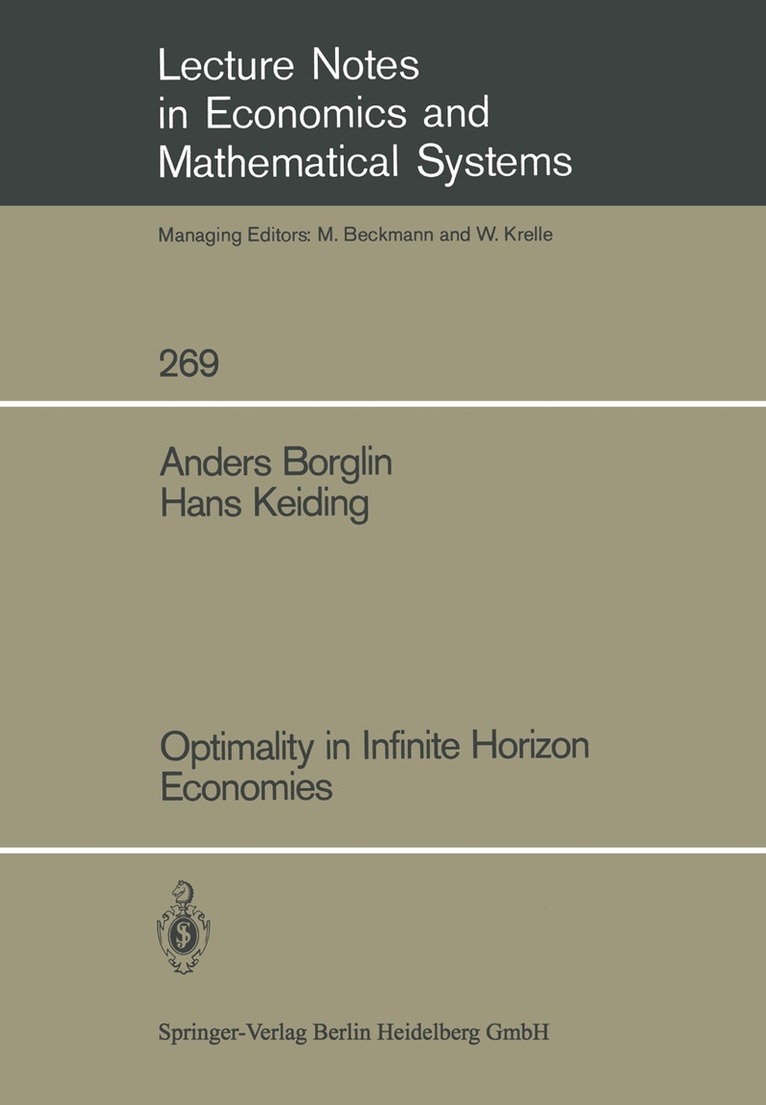
    Optimality in Infinite Horizon Economies

    AvAnders Borglin,Hans Keiding

    Häftad, Engelska, 1986

    Del 269 i serien Lecture Notes in Economics and Mathematical Systems

    563 kr

    Beställningsvara. Skickas inom 10-15 vardagar. Fri frakt över 249 kr.

    Beskrivning

    Modern welfare economics as it is known today to economists took its final shape with the emergence of the Arrow-Debreu model. The classical conjectures about the beneficient workings of markets together with the converse statement, that optimal (in the sense of Pareto) allocations may be sustained by prices and markets, has laid a firm foundation for further research in welfare economics. But more than that, it has inspired researchers to take up entirely new topics, notably by closer considerations of situations where the assumptions of the original model may seem overly restrictive. One of these new directions has been connected with generalizing the model so that it takes into account the possibility of infinitely many commodities. On the face of it, the idea of an infinity of commodities may seem a mathematical fancy having no "real" counterpart in economic life. This is not so, however. Quite to the contrary, infinity enters in a very natural way when it is taken into account that economic transactions take place over time. 2 In the Arrow-Debreu formalism, time may be incorporated into the model in a very simple way using dated commodities. Thus two commodities are considered as being different if they are to be delivered at different points of time.

    Produktinformation

    • Utgivningsdatum:1986-05-01
    • Mått:170 x 244 x 11 mm
    • Vikt:342 g
    • Format:Häftad
    • Språk:Engelska
    • Serie:Lecture Notes in Economics and Mathematical Systems
    • Antal sidor:182
    • Förlag:Springer-Verlag Berlin and Heidelberg GmbH & Co. KG
    • ISBN:9783540164753

    Utforska kategorier

    • Internationell ekonomi inom Ekonomi och Ledarskap
    • Ekonomisk politik inom Ekonomi och Ledarskap
    • Makroekonomi inom Ekonomi och Ledarskap

    Innehållsförteckning

    • 1: One-Good Production and Consumption Models.- 2: Reduced Models.- 3: Efficiency Criteria.- 4: Measures of Curvature and General Efficiency Criteria.- 5: Approximating Sets and Measures of Curvature.- 6: Market Structures and Overlapping Market Economies.- 7: Reduced Many-Goods Models.- 8: Efficiency Criteria for Many-Goods Models.- 9: Approximations of Many-Goods Models.- References.