Andreas Glindemann - Böcker
Visar alla böcker från författaren Andreas Glindemann. Handla med fri frakt och snabb leverans.
4 produkter
4 produkter
1 593 kr
Skickas inom 10-15 vardagar
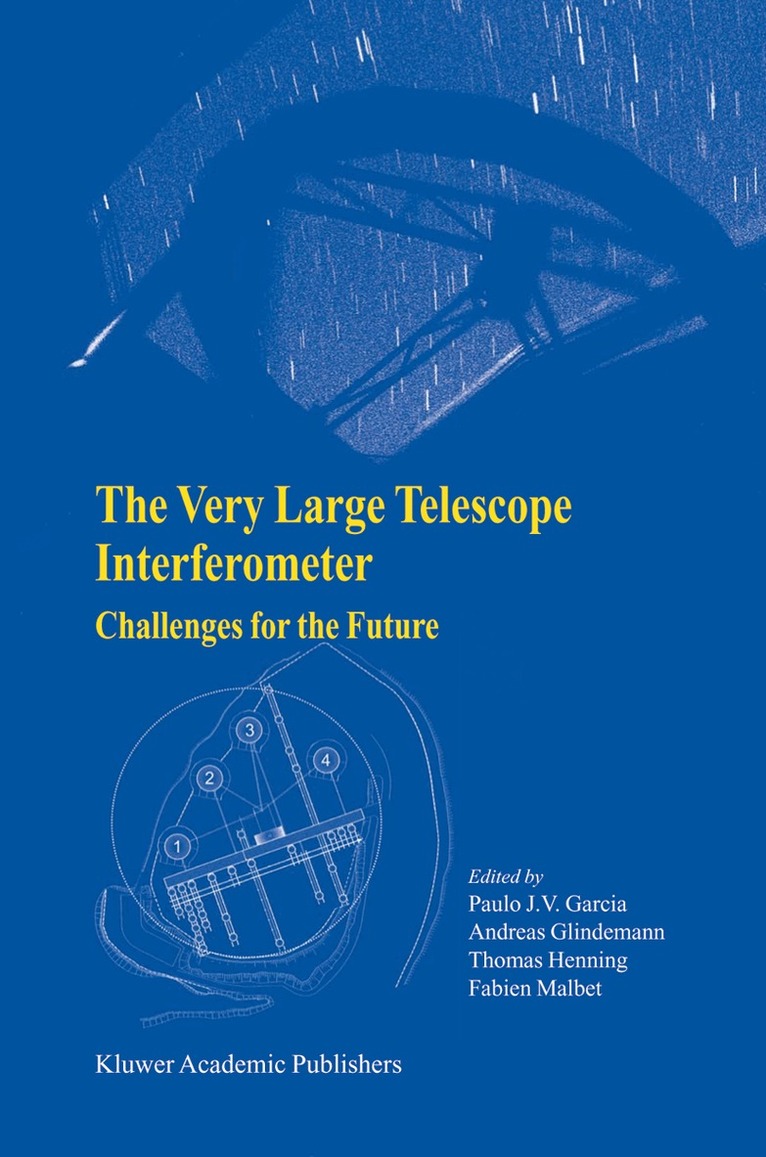
The workshop on The Very Large Telescope Interferometer: Challenges for the Future, which was part of JENAM 2002 organised by Sociedade Portuguesa de Astronomia, took place at the Departamentos de Matematica Aplicada e Matemclt- ica Pura da Universidade do Porto (FCUP) from the 5th to the 7th of September 2002. The Very Large Telescope Interferometer (VLTI) is the major interferometric facility in the world, operated by the European Southern Observatory. It is a unique facility as it is available to the community and has a sensitivity that will bring into reach vast classes of objects in the fields of planet searches, star formation and evolution and extragalatic astrophysics. The VLTI was open to the community on a shared risk basis in March 2002. This workshop was therefore an ideal place to obtain a broad view of optical interferometry and its scientific prospects. The workshop started with a presentation of the basics of interferometry the- ory/practice, then of the VLT, Keck and LBT interferometers. The VLTI instru- ments MIDI and AMBER were introduced to its users as well as specific cal- ibration and modelling tools.The bulk of the workshop addressed astrophysics being currently done with interferometers with very high quality reviews in the fields star formation, imaging, pulsating stars, Mira stars, active stellar shells and extragalactic astronomy. The workshop featured some talks presenting fresh VLTI data using the VINCI commissioning instrument.
1 593 kr
Skickas inom 10-15 vardagar
Over the last decade, stellar interferometry has developed from a specialist tool to a mainstream observing technique, attracting scientists whose research benefits from milliarcsecond angular resolution. Stellar interferometry has become part of the astronomer’s toolbox, complementing single-telescope observations by providing unique capabilities that will advance astronomical research. This carefully written book is intended to provide a solid understanding of the principles of stellar interferometry to students starting an astronomical research project in this field or to develop instruments and to astronomers using interferometry but who are not interferometrists per se. Illustrated by excellent drawings and calculated graphs the imaging process in stellar interferometers is explained starting from first principles on light propagation and diffraction,wave propagation through turbulence is described in detail using Kolmogorov statistics,the impact of turbulence on the imaging process is discussed both for single telescopes and for interferometers,instrumental techniques like beam combination and array layout are described, and the requirements for delay lines are derived,visibility measurements (modulus and phase) through turbulence are analyzed and limitations are quantified,correction methods (fringe tracking and adaptive optics) are presented, discussing closed loop operation with a dual feed system.The book closes with examples of contemporary stellar interferometers and useful appendices on the Fourier transform and atmospheric transmission bands.
1 170 kr
Skickas inom 10-15 vardagar
Over the last decade, stellar interferometry has developed from a specialist tool to a mainstream observing technique, attracting scientists whose research benefits from milliarcsecond angular resolution. Stellar interferometry has become part of the astronomer’s toolbox, complementing single-telescope observations by providing unique capabilities that will advance astronomical research. This carefully written book is intended to provide a solid understanding of the principles of stellar interferometry to students starting an astronomical research project in this field or to develop instruments and to astronomers using interferometry but who are not interferometrists per se. Illustrated by excellent drawings and calculated graphs the imaging process in stellar interferometers is explained starting from first principles on light propagation and diffraction,wave propagation through turbulence is described in detail using Kolmogorov statistics,the impact of turbulence on the imaging process is discussed both for single telescopes and for interferometers,instrumental techniques like beam combination and array layout are described, and the requirements for delay lines are derived,visibility measurements (modulus and phase) through turbulence are analyzed and limitations are quantified,correction methods (fringe tracking and adaptive optics) are presented, discussing closed loop operation with a dual feed system.The book closes with examples of contemporary stellar interferometers and useful appendices on the Fourier transform and atmospheric transmission bands.
1 593 kr
Skickas inom 10-15 vardagar
The workshop on The Very Large Telescope Interferometer: Challenges for the Future, which was part of JENAM 2002 organised by Sociedade Portuguesa de Astronomia, took place at the Departamentos de Matematica Aplicada e Matemclt- ica Pura da Universidade do Porto (FCUP) from the 5th to the 7th of September 2002. The Very Large Telescope Interferometer (VLTI) is the major interferometric facility in the world, operated by the European Southern Observatory. It is a unique facility as it is available to the community and has a sensitivity that will bring into reach vast classes of objects in the fields of planet searches, star formation and evolution and extragalatic astrophysics. The VLTI was open to the community on a shared risk basis in March 2002. This workshop was therefore an ideal place to obtain a broad view of optical interferometry and its scientific prospects. The workshop started with a presentation of the basics of interferometry the- ory/practice, then of the VLT, Keck and LBT interferometers. The VLTI instru- ments MIDI and AMBER were introduced to its users as well as specific cal- ibration and modelling tools.The bulk of the workshop addressed astrophysics being currently done with interferometers with very high quality reviews in the fields star formation, imaging, pulsating stars, Mira stars, active stellar shells and extragalactic astronomy. The workshop featured some talks presenting fresh VLTI data using the VINCI commissioning instrument.