Andrew Arana – författare
Visar alla böcker från författaren Andrew Arana. Handla med fri frakt och snabb leverans.
3 produkter
3 produkter
232 kr
Skickas inom 7-10 vardagar
A proof of a theorem can be said to be pure if it draws only on what is 'close' or 'intrinsic' to that theorem. In this Element we will investigate the apparent preference for pure proofs that has persisted in mathematics since antiquity, alongside a competing preference for impurity. In Section 1, we present two examples of purity, from geometry and number theory. In Section 2, we give a brief history of purity in mathematics. In Section 3, we discuss several different types of purity, based on different measures of distance between theorem and proof. In Section 4 we discuss reasons for preferring pure proofs, for the varieties of purity constraints presented in Section 3. In Section 5 we conclude by reflecting briefly on purity as a preference for the local and how issues of translation intersect with the considerations we have raised throughout this work.
748 kr
Skickas inom 7-10 vardagar
A proof of a theorem can be said to be pure if it draws only on what is 'close' or 'intrinsic' to that theorem. In this Element we will investigate the apparent preference for pure proofs that has persisted in mathematics since antiquity, alongside a competing preference for impurity. In Section 1, we present two examples of purity, from geometry and number theory. In Section 2, we give a brief history of purity in mathematics. In Section 3, we discuss several different types of purity, based on different measures of distance between theorem and proof. In Section 4 we discuss reasons for preferring pure proofs, for the varieties of purity constraints presented in Section 3. In Section 5 we conclude by reflecting briefly on purity as a preference for the local and how issues of translation intersect with the considerations we have raised throughout this work.
2 646 kr
Kommande
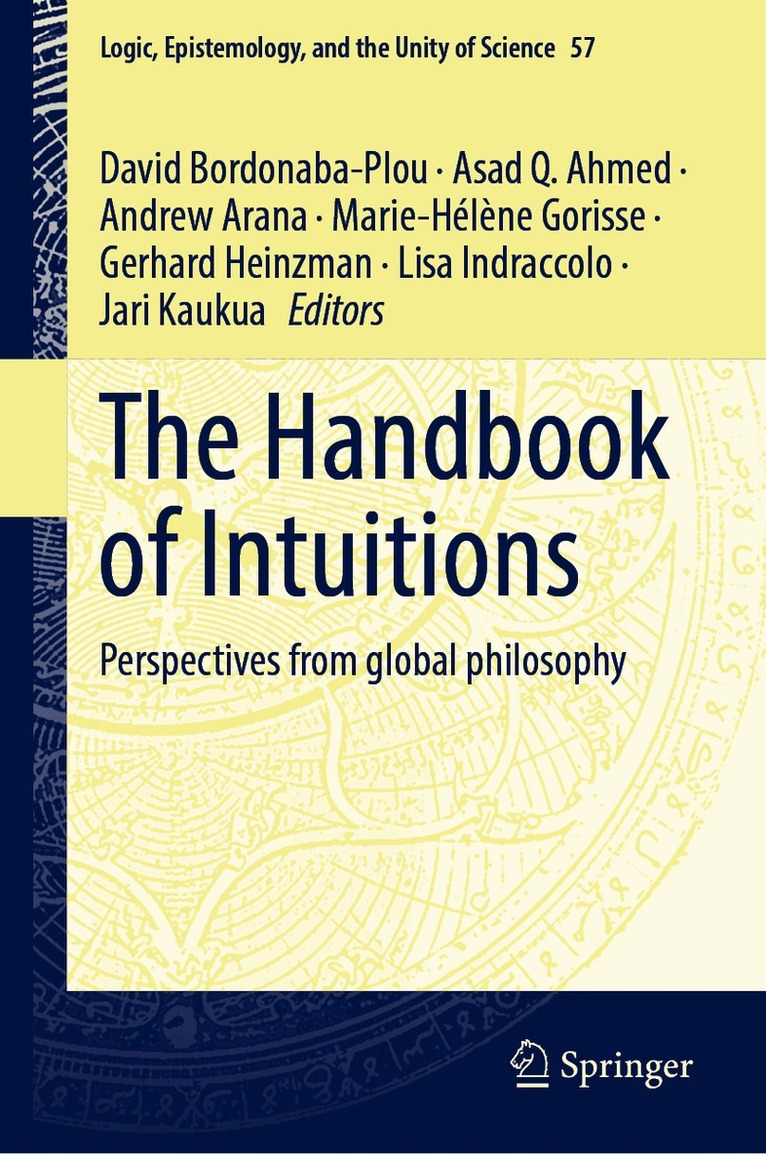
This Handbook presents a comprehensive overview of intuitions from a variety of traditions. It brings together works by the best specialists working on intuitions in five different traditions: the South Asian tradition, the Chinese tradition, the Japanese tradition, the Arabo-Islamic tradition, and the Western tradition with, in this last case, a focus on philosophy of language and on philosophy of mathematics. It highlights the similarities and differences between the traditions bringing the various perspectives into one volume.In the Western traditions, a first approximation to the meaning of the term may be to say that we intuit that p, as opposed to, for example, deducing that p, when we believe that p is true but without the mediation of any other belief, that serves as a basis for believing that p. In the naturalistic perspective, intuition is nothing other than the starting point of a rudimentary theory, expressed by classifications or by instances of singular propositions of the form “This is red”, the bona fide evidence of which are uncontroversial because they are commanded by a wide agreement – a perspective shared by South Asian traditions. Topics in this volume include the importance of intuitions in Madhva’s religious epistemology, intuition in early Confucian philosophy, Nishida and active intuition, intuition in Islamic mysticisms, and evidential and rhetorical moves in the study of language. This volume is of interest to researchers and students of intuition.