Andrew Carstairs-McCarthy - Böcker
Visar alla böcker från författaren Andrew Carstairs-McCarthy. Handla med fri frakt och snabb leverans.
10 produkter
10 produkter
The Origins of Complex Language
An Inquiry into the Evolutionary Beginnings of Sentences, Syllables, and Truth
Häftad, Engelska, 1999
769 kr
Skickas inom 5-8 vardagar
This book proposes a new theory of the origins of human language ability and presents an original account of the early evolution of language. It explains why humans are the only language-using animals, challenges the assumption that language is a consequence of intelligence, and offers a new perspective on human uniqueness. The author draws on evidence from archaeology, linguistics, cognitive science, and evolutionary biology. Making no assumptions about the reader's prior knowledge he first provides an introductory but critical survey of all sources of evidence for language evolution. He then considers what language itself reveals about its own and human origins and evolution. He shows that certain central aspects of language do not, unexpectedly, reflect what they are used for, are maladapted for their function. He considers why this should be, and argues that these odd aspects of language reveal important clues about its evolutionary origin. The Origins of Complex Language fulfils the promise of its title. In doing so it turns upside down conventional theories about the relation between cognition and expression, truth and reference, and the co-evolution of mind and body. Original in conception, brilliantly executed, stylishly written, this book will attract a wide range of readers interested in the evolution and origins of language.
The Origins of Complex Language
An Inquiry into the Evolutionary Beginnings of Sentences, Syllables, and Truth
Inbunden, Engelska, 1999
1 456 kr
Skickas inom 3-6 vardagar
This book proposes a new theory of the origins of human language ability and presents an original account of the early evolution of language. It explains why humans are the only language-using animals, challenges the assumption that language is a consequence of intelligence, and offers a new perspective on human uniqueness. The author draws on evidence from archaeology, linguistics, cognitive science, and evolutionary biology. Making no assumptions about the reader's prior knowledge he first provides an introductory but critical survey of all sources of evidence for language evolution. He then considers what language itself reveals about its own and human origins and evolution. He shows that certain central aspects of language do not, unexpectedly, reflect what they are used for, are maladapted for their function. He considers why this should be, and argues that these odd aspects of language reveal important clues about its evolutionary origin. The Origins of Complex Language fulfils the promise of its title. In doing so it turns upside down conventional theories about the relation between cognition and expression, truth and reference, and the co-evolution of mind and body. Original in conception, brilliantly executed, stylishly written, this book will attract a wide range of readers interested in the evolution and origins of language.
659 kr
Skickas inom 5-8 vardagar
This book considers the evolution of the grammatical structure of words in the more general contexts of human evolution and the origins of language. The consensus in many fields is that language is well designed for its purpose, and became so either through natural selection or by virtue of non-biological constraints on how language must be structured. Andrew Carstairs-McCarthy argues that in certain crucial respects language is not optimally designed. This can be seen, he suggests, in the existence of not one but two kinds of grammatical organization - syntax and morphology - and in the morphological and morpho-phonological complexity which leads to numerous departures from the one-form-one-meaning principle. Having discussed the issue of good and bad design in a wider biological context, the author shows that conventional explanations for the nature of morphology do not work. Its poor design features arose, he argues, from two characteristics present when the ancestors of modern humans had a vocabulary but no grammar. One of these was a synonymy-avoidance expectation, while the other was an articulatory and phonological apparatus that encouraged the development of new synonyms. Morphology developed in response to these conflicting pressures. In this stimulating and carefully argued account Professor McCarthy offers a powerful challenge to conventional views of the relationship between syntax and morphology, to the adaptationist view of language evolution, and to the notion that language in some way reflects 'laws of form'. This fundamental contribution to understanding the nature and evolution of language will be of wide interest to linguists of all theoretical persuasions as well as to scholars in cognitive science and anthropology.
1 701 kr
Skickas inom 7-10 vardagar
This book considers the evolution of the grammatical structure of words in the more general contexts of human evolution and the origins of language. The consensus in many fields is that language is well designed for its purpose, and became so either through natural selection or by virtue of non-biological constraints on how language must be structured. Andrew Carstairs-McCarthy argues that in certain crucial respects language is not optimally designed. This can be seen, he suggests, in the existence of not one but two kinds of grammatical organization - syntax and morphology - and in the morphological and morpho-phonological complexity which leads to numerous departures from the one-form-one-meaning principle. Having discussed the issue of good and bad design in a wider biological context, the author shows that conventional explanations for the nature of morphology do not work. Its poor design features arose, he argues, from two characteristics present when the ancestors of modern humans had a vocabulary but no grammar. One of these was a synonymy-avoidance expectation, while the other was an articulatory and phonological apparatus that encouraged the development of new synonyms. Morphology developed in response to these conflicting pressures. In this stimulating and carefully argued account Professor McCarthy offers a powerful challenge to conventional views of the relationship between syntax and morphology, to the adaptationist view of language evolution, and to the notion that language in some way reflects 'laws of form'. This fundamental contribution to understanding the nature and evolution of language will be of wide interest to linguists of all theoretical persuasions as well as to scholars in cognitive science and anthropology.
2 166 kr
Skickas inom 10-15 vardagar
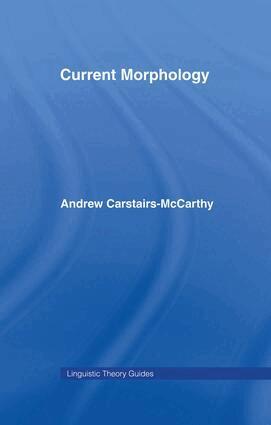
This book aims to provide a thorough and wide-ranging introduction to approaches to morphology in linguistic theory over the last twenty years. This comprehensive survey concentrates not only on the generative linguistic mainstream, but on approaches that are less fashionable or relatively unknown to English-speaking linguists, and highlights recent European, particularly German-speaking research.
1 400 kr
Skickas inom 10-15 vardagar
First published in 1987, this book broke new ground in research on inflectional morphology. Drawing on evidence from a wide variety of languages, it shows that this is not just a phenomenon left over from obsolete phonological processes but a subject deserving of respect in its own right. The book proposes constraints in three areas: (1) the organization of inflection class systems; (2) inflectional homonymy, or syncretism; (3) the direction of allomorphic conditioning. Carstairs-McCarthy’s notion of ‘paradigm economy’ revolutionized the study of inflection class systems but in its purest form, presented in this book, the hypothesis was too strong. In more recent works, the author has therefore argued that a version of it is an unexpected by-product of the brain’s aptitude for handling multiple vocabularies. The study of inflectional homonymy was pioneered by Roman Jakobson as evidence for the structuring of morphosyntactic categories or feature sets (case, number, tense, mood and so on) but his approach differed from that of this book, whose radical suggestions fertilized much subsequent work on ‘inflectional identity’. The direction of conditioning, first explored in this text, is debated actively within the Distributed Morphology framework popular within Chomskyan generative linguistics, despite disagreement with the Carstairs-McCarthy view that morphology is a domain of grammar entirely distinct from syntax. In The Evolution of Morphology (2010) the author takes these topics further, and also explains why stem alternation and affixation are importantly distinct as modes of inflectional expression.Inflectional allomorphy is an apparently pointless complication exhibited by many languages. However, this book suggests reasons why it is, nevertheless, easy for the brain to handle. The work thus has important implications beyond language, extending into human cognition.
383 kr
Skickas inom 10-15 vardagar
First published in 1987, this book broke new ground in research on inflectional morphology. Drawing on evidence from a wide variety of languages, it shows that this was not just a phenomenon left over from obsolete phonological processes but a subject deserving of more respect. The book proposes constraints in three areas: (1) the organization of inflection class systems; (2) inflectional homonymy, or syncretism; (3) the direction of allomorphic conditioning. Carstairs-McCarthy’s notion of ‘Paradigm Economy’ revolutionized the study of inflection class systems but in its purest form, presented in this book, the hypothesis was too strong. In more recent works, the author has therefore argued that a version of it is an unexpected by-product of the brain’s aptitude for handling multiple vocabularies. Inflectional homonymy was pioneered by Roman Jakobson as evidence for the structuring of morphosyntactic categories or feature sets (case, number, tense, mood and so on) but his interpretation differed from that of this book, whose radical suggestions fertilized much subsequent work on ‘inflectional identity’. Allomorphic conditioning, first explored in this book, is debated actively within the Distributed Morphology framework popular within Chomskyan generative linguistics, despite the contrast with the Carstairs-McCarthy view that morphology is a domain of grammar entirely distinct from syntax. In The Evolution of Morphology (2010) the author takes these topics further, including explaining why the distinction between stem alternation and affixation as inflectional expressions are importantly distinct.Inflectional allomorphy is an apparently pointless complication exhibited by many languages, however, this book suggests reasons why it is, nevertheless, easy for the brain to handle and thus, the work has important implications beyond language, extending into human cognition.
787 kr
Skickas inom 10-15 vardagar
This book aims to provide a thorough and wide-ranging introduction to approaches to morphology in linguistic theory over the last twenty years. This comprehensive survey concentrates not only on the generative linguistic mainstream, but on approaches that are less fashionable or relatively unknown to English-speaking linguists, and highlights recent European, particularly German-speaking research.
1 942 kr
Skickas inom 3-6 vardagar
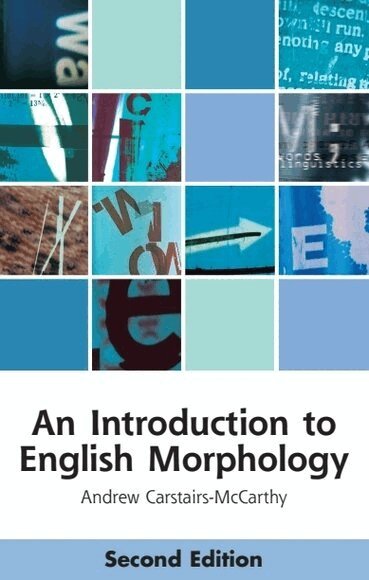
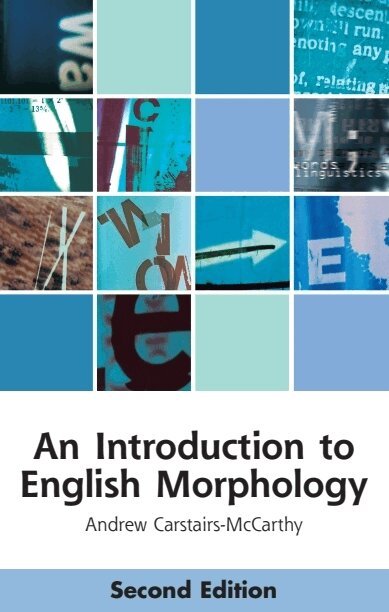
Bestselling introduction to English morphology, now revised and updatedWhat exactly are words? Are they the things that get listed in dictionaries, or are they the basic units of sentence structure? Andrew Carstairs-McCarthy explores the implications of these different approaches to words in English. He explains the various ways in which words are related to one another, and shows how the history of the English language has affected word structure.Topics include: words, sentences and dictionaries; a word and its parts (roots and affixes); a word and its forms (inflection); a word and its relatives (derivation); compound words; word structure; productivity; and the historical sources of English word formation.Requiring no prior linguistic training, this textbook is suitable for undergraduate students of English - literature or language - and provides a sound basis for further linguistic study.The second edition featuresupdated exercises throughout, with answers and discussionfully updated recommendations for further readingrefreshed examples and referencesa completely new introduction and glossary
275 kr
Skickas
Bestselling introduction to English morphology, now revised and updatedWhat exactly are words? Are they the things that get listed in dictionaries, or are they the basic units of sentence structure? Andrew Carstairs-McCarthy explores the implications of these different approaches to words in English. He explains the various ways in which words are related to one another, and shows how the history of the English language has affected word structure.Topics include: words, sentences and dictionaries; a word and its parts (roots and affixes); a word and its forms (inflection); a word and its relatives (derivation); compound words; word structure; productivity; and the historical sources of English word formation.Requiring no prior linguistic training, this textbook is suitable for undergraduate students of English - literature or language - and provides a sound basis for further linguistic study.The second edition featuresupdated exercises throughout, with answers and discussionfully updated recommendations for further readingrefreshed examples and referencesa completely new introduction and glossary