Andrew G. Barto - Böcker
Visar alla böcker från författaren Andrew G. Barto. Handla med fri frakt och snabb leverans.
2 produkter
2 produkter
1 215 kr
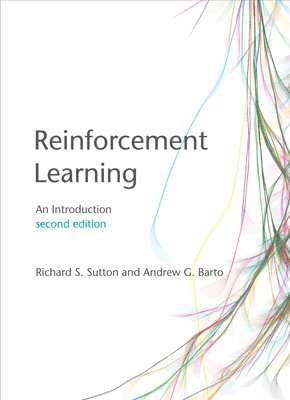
The significantly expanded and updated new edition of a widely used text on reinforcement learning, one of the most active research areas in artificial intelligence.Reinforcement learning, one of the most active research areas in artificial intelligence, is a computational approach to learning whereby an agent tries to maximize the total amount of reward it receives while interacting with a complex, uncertain environment. In Reinforcement Learning, Richard Sutton and Andrew Barto provide a clear and simple account of the field's key ideas and algorithms. This second edition has been significantly expanded and updated, presenting new topics and updating coverage of other topics.Like the first edition, this second edition focuses on core, online learning algorithms, with the more mathematical material set off in shaded boxes. Part I covers as much of reinforcement learning as possible without going beyond the tabular case for which exact solutions can be found. Many algorithms presented in this part are new for the second edition, including UCB, Expected Sarsa, and Double Learning. Part II extends these ideas to function approximation, with new sections on such topics as artificial neural networks and the Fourier basis, and offers expanded treatment of off-policy learning and policy-gradient methods. Part III has new chapters on reinforcement learning's relationships to psychology and neuroscience, as well as an updated case-studies chapter including AlphaGo and AlphaGo Zero, Atari game playing, and IBM Watson's wagering strategy. The final chapter discusses the future societal impacts of reinforcement learning.
Del 2 - IEEE Press Series on Computational Intelligence
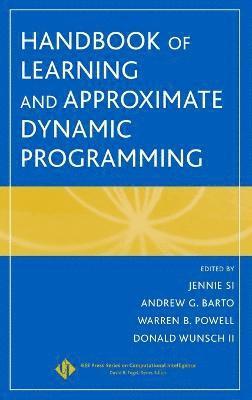
Handbook of Learning and Approximate Dynamic Programming
Inbunden, Engelska, 2004
2 007 kr
Skickas inom 7-10 vardagar
A complete resource to Approximate Dynamic Programming (ADP), including on-line simulation codeProvides a tutorial that readers can use to start implementing the learning algorithms provided in the bookIncludes ideas, directions, and recent results on current research issues and addresses applications where ADP has been successfully implementedThe contributors are leading researchers in the field