
Andrew Ilachinski – författare
Visar alla böcker från författaren Andrew Ilachinski. Handla med fri frakt och snabb leverans.
3 produkter
3 produkter
Häftad, Engelska, 2001
1 492 kr
Skickas inom 5-8 vardagar
Cellular automata are a class of spatially and temporally discrete mathematical systems characterized by local interaction and synchronous dynamical evolution. Introduced by the mathematician John von Neumann in the 1950s as simple models of biological self-reproduction, they are prototypical models for complex systems and processes consisting of a large number of simple, homogeneous, locally interacting components. Cellular automata have been the focus of great attention over the years because of their ability to generate a rich spectrum of very complex patterns of behavior out of sets of relatively simple underlying rules. Moreover, they appear to capture many essential features of complex self-organizing cooperative behavior observed in real systems.This book provides a summary of the basic properties of cellular automata, and explores in depth many important cellular-automata-related research areas, including artificial life, chaos, emergence, fractals, nonlinear dynamics, and self-organization. It also presents a broad review of the speculative proposition that cellular automata may eventually prove to be theoretical harbingers of a fundamentally new information-based, discrete physics. Designed to be accessible at the junior/senior undergraduate level and above, the book will be of interest to all students, researchers, and professionals wanting to learn about order, chaos, and the emergence of complexity. It contains an extensive bibliography and provides a listing of cellular automata resources available on the World Wide Web.
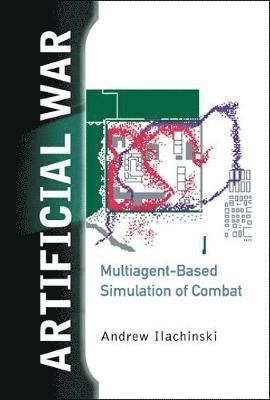
Inbunden, Engelska, 2004
2 663 kr
Skickas inom 5-8 vardagar
Military conflicts, particularly land combat, possess the characteristics of complex adaptive systems: combat forces are composed of a large number of nonlinearly interacting parts and are organized in a dynamic command-and-control network; local action, which often appears disordered, self-organizes into long-range order; military conflicts, by their nature, proceed far from equilibrium; military forces adapt to a changing combat environment; and there is no master “voice” that dictates the actions of every soldier (i.e., battlefield action is decentralized). Nonetheless, most modern “state of the art” military simulations ignore the self-organizing properties of combat.This book summarizes the results of a multiyear research effort aimed at exploring the applicability of complex adaptive systems theory to the study of warfare, and introduces a sophisticated multiagent-based simulation of combat called EINSTein. EINSTein, whose bottom-up, generative approach to modeling combat stands in stark contrast to the top-down or reductionist philosophy that still underlies most conventional military models, is designed to illustrate how many aspects of land combat may be understood as self-organized, emergent phenomena. Used worldwide by the military operations research community, EINSTein has pioneered the simulation of combat on a small to medium scale by using autonomous agents to model individual behaviors and personalities rather than hardware.
Inbunden, Engelska, 2001
2 223 kr
Tillfälligt slut
Cellular automata are a class of spatially and temporally discrete mathematical systems characterized by local interaction and synchronous dynamical evolution. Introduced by the mathematician John von Neumann in the 1950s as simple models of biological self-reproduction, they are prototypical models for complex systems and processes consisting of a large number of simple, homogeneous, locally interacting components. Cellular automata have been the focus of great attention over the years because of their ability to generate a rich spectrum of very complex patterns of behavior out of sets of relatively simple underlying rules. Moreover, they appear to capture many essential features of complex self-organizing cooperative behavior observed in real systems.This book provides a summary of the basic properties of cellular automata, and explores in depth many important cellular-automata-related research areas, including artificial life, chaos, emergence, fractals, nonlinear dynamics, and self-organization. It also presents a broad review of the speculative proposition that cellular automata may eventually prove to be theoretical harbingers of a fundamentally new information-based, discrete physics. Designed to be accessible at the junior/senior undergraduate level and above, the book will be of interest to all students, researchers, and professionals wanting to learn about order, chaos, and the emergence of complexity. It contains an extensive bibliography and provides a listing of cellular automata resources available on the World Wide Web.