Andrew J. Green - Böcker
Visar alla böcker från författaren Andrew J. Green. Handla med fri frakt och snabb leverans.
5 produkter
5 produkter
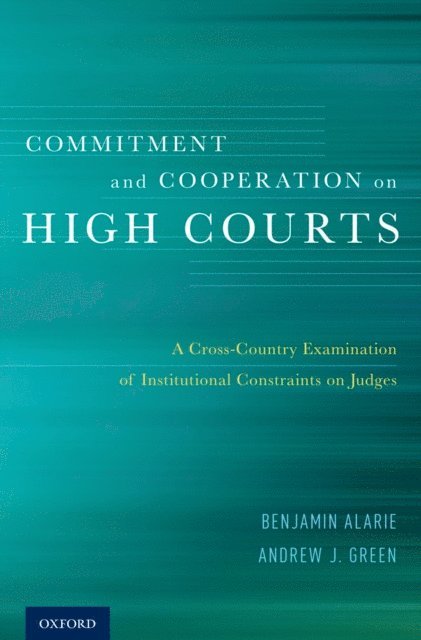
Commitment and Cooperation on High Courts
A Cross-Country Examination of Institutional Constraints on Judges
Inbunden, Engelska, 2017
1 863 kr
Skickas inom 3-6 vardagar
Judicial decision-making may ideally be impartial, but in reality it is influenced by many different factors, including institutional context, ideological commitment, fellow justices on a panel, and personal preference. Empirical literature in this area increasingly analyzes this complex collection of factors in isolation, when a larger sample size of comparative institutional contexts can help assess the impact of the procedures, norms, and rules on key institutional decisions, such as how appeals are decided. Four basic institutional questions from a comparative perspective help address these studies regardless of institutional context or government framework. Who decides, or how is a justice appointed? How does an appeal reach the court; what processes occur? Who is before the court, or how do the characteristics of the litigants and third parties affect judicial decision-making? How does the court decide the appeal, or what institutional norms and strategic behaviors do the judges perform to obtain their preferred outcome? This book explains how the answers to these institutional questions largely determine the influence of political preferences of individual judges and the degree of cooperation among judges at a given point in time. The authors apply these four fundamental institutional questions to empirical work on the Supreme Courts of the US, UK, Canada, India, and the High Court of Australia. The ultimate purpose of this book is to promote a deeper understanding of how institutional differences affect judicial decision-making, using empirical studies of supreme courts in countries with similar basic structures but with sufficient differences to enable meaningful comparison.
293 kr
Skickas inom 7-10 vardagar
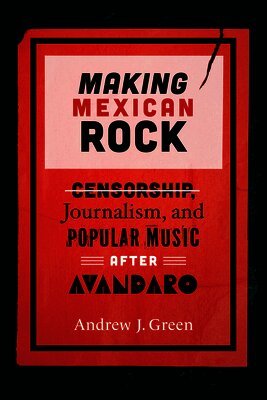
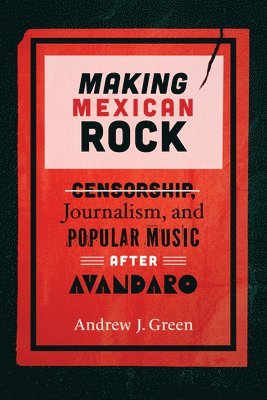
Mexican rock history has tended to end as Mexican democracy begins. The history of the genre has often been narrated teleologically: apparently censored under single‑party rule after the scandalous AvÁndaro Festival of 1971, rock constituted a potent expression of freedom in the late twentieth century, forging a strong association with Mexico’s transition away from authoritarian rule and toward neoliberal democracy. There is another story to tell, however, about the transformations in ideology underpinning rock’s emergent, cascading histories in Mexico, and about ways that these transformations have been contested. Placing history and ethnography into dialogue, Making Mexican Rock tells this story, reflecting on the imbrication of scholarship and journalism with the legitimizing myths of neoliberal globalization.Ethnomusicologist Andrew Green provides a counterpoint to studies of Latin American rock in which the state constitutes the “prime mover” of censorship against the genre. Eric Zolov’s Refried Elvis, still considered the definitive history of Mexican rock, concludes that the state censored rock by preventing its commercialization, and that rock led the resistance against single‑party rule during the democratic transition. Rock is understood, here, as a consistent antagonist of monolithic state power. Making Mexican Rock presumes a more distributed account of censorship that reflects extra‑ and para‑governmental sources of rock repression. There exist multiple “ends” of Mexican rock history, episodes of censorship which have recurred periodically ever since rock’s arrival to Mexico in the late 1950s, and there are shifts in ideology that change how these episodes are remembered—or indeed whether they are remembered at all.
1 451 kr
Skickas inom 5-8 vardagar
Mexican rock history has tended to end as Mexican democracy begins. The history of the genre has often been narrated teleologically: apparently censored under single‑party rule after the scandalous AvÁndaro Festival of 1971, rock constituted a potent expression of freedom in the late twentieth century, forging a strong association with Mexico’s transition away from authoritarian rule and toward neoliberal democracy. There is another story to tell, however, about the transformations in ideology underpinning rock’s emergent, cascading histories in Mexico, and about ways that these transformations have been contested. Placing history and ethnography into dialogue, Making Mexican Rock tells this story, reflecting on the imbrication of scholarship and journalism with the legitimizing myths of neoliberal globalization.Ethnomusicologist Andrew Green provides a counterpoint to studies of Latin American rock in which the state constitutes the “prime mover” of censorship against the genre. Eric Zolov’s Refried Elvis, still considered the definitive history of Mexican rock, concludes that the state censored rock by preventing its commercialization, and that rock led the resistance against single‑party rule during the democratic transition. Rock is understood, here, as a consistent antagonist of monolithic state power. Making Mexican Rock presumes a more distributed account of censorship that reflects extra‑ and para‑governmental sources of rock repression. There exist multiple “ends” of Mexican rock history, episodes of censorship which have recurred periodically ever since rock’s arrival to Mexico in the late 1950s, and there are shifts in ideology that change how these episodes are remembered—or indeed whether they are remembered at all.
121 kr
Skickas inom 5-8 vardagar
217 kr
Skickas inom 5-8 vardagar