• Fri frakt över 249 kr
  • •
  • Snabba leveranser
  • •
  • Billiga böcker
Kundservice

Du är på sajten för privatpersoner.

Företag, bibliotek eller offentlig verksamhet?

Du handlar på classic.bokus.com, där alla dina funktioner finns intakta.
Till classic.bokus.com
Bokus logotyp. Gå till startsidan.
  • Erbjudanden
  • Nyheter
  • Student
  • Topplistor
  • Barn & ungdom
  • Bokus Play
  • E-böcker
  • Pocketböcker
  • Spel & pussel

10% rabatt på allt med kod: NYSTART10 →

Sidfot

Mina sidor

    Hjälp

    • Kundservice
    • Vanliga frågor och svar
    • Frakt och leverans
    • Retur vid ångerrätt
    • Reklamera vara
    • Betalning
    • Köpvillkor
    • Allmänna villkor
    • Information om webbplatsens tillgänglighet

    Om Bokus

    • Om oss
    • Pressrum
    • För studenter
    • För företag
    • För bibliotek och offentlig verksamhet
    • För leverantörer
    • Hållbarhet

    Populärt

    • Aktuella erbjudanden
    • Presentkort
    • Studentlitteratur
    • Nya böcker
    • Topplistor
    • Signerade böcker
    • Engelska böcker

    Inspiration

    • Boktips
    • BookTok
    • Populära bokserier
    • Barnbokskaraktärer
    • Populära författare
    Logotyp för Bokus
    Följ oss på Facebook (extern länk)Följ oss på Instagram (extern länk)Följ oss på YouTube (extern länk)Följ oss på TikTok (extern länk)
    bokus @ CookiesAnpassa cookiesIntegritetspolicyKöpvillkor
    Till Citymail hemsida (extern länk)Till Budbee hemsida (extern länk)Till Postnord hemsida (extern länk)Till Schenker hemsida (extern länk)Till Early Bird hemsida (extern länk)Till Walleys hemsida (extern länk)
    1. Juridik
    2. Särskilda rättsområden
    3. Rättsordning

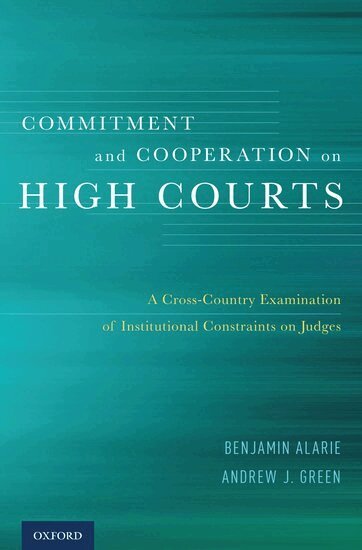
    Commitment and Cooperation on High Courts

    A Cross-Country Examination of Institutional Constraints on Judges

    AvBenjamin Alarie,Andrew J. Green

    Inbunden, Engelska, 2017

    1 936 kr

    Beställningsvara. Skickas inom 3-6 vardagar. Fri frakt över 249 kr.

    Beskrivning

    Judicial decision-making may ideally be impartial, but in reality it is influenced by many different factors, including institutional context, ideological commitment, fellow justices on a panel, and personal preference. Empirical literature in this area increasingly analyzes this complex collection of factors in isolation, when a larger sample size of comparative institutional contexts can help assess the impact of the procedures, norms, and rules on key institutional decisions, such as how appeals are decided. Four basic institutional questions from a comparative perspective help address these studies regardless of institutional context or government framework. Who decides, or how is a justice appointed? How does an appeal reach the court; what processes occur? Who is before the court, or how do the characteristics of the litigants and third parties affect judicial decision-making? How does the court decide the appeal, or what institutional norms and strategic behaviors do the judges perform to obtain their preferred outcome? This book explains how the answers to these institutional questions largely determine the influence of political preferences of individual judges and the degree of cooperation among judges at a given point in time. The authors apply these four fundamental institutional questions to empirical work on the Supreme Courts of the US, UK, Canada, India, and the High Court of Australia. The ultimate purpose of this book is to promote a deeper understanding of how institutional differences affect judicial decision-making, using empirical studies of supreme courts in countries with similar basic structures but with sufficient differences to enable meaningful comparison.

    Produktinformation

    • Utgivningsdatum:2017-09-14
    • Mått:155 x 236 x 27 mm
    • Vikt:658 g
    • Format:Inbunden
    • Språk:Engelska
    • Antal sidor:352
    • Förlag:OUP USA
    • ISBN:9780199397594

    Utforska kategorier

    • Rättsordning inom Juridik
    • Juridik: metod och teori inom Juridik
    • Författningsrätt och förvaltningsrätt inom Juridik

    Mer om författaren

    Benjamin Alarie is the Osler Chair in Business Law at the University of Toronto's Faculty of Law. He also serves as President of the Canadian Law and Economics Association. He works primarily in taxation law and judicial decision-making, and he has published in the American Business Law Journal, the British Tax Review, the Canadian Business Law Journal, the Canadian Tax Journal, and many other academic journals. He is co-author of several editions of Canadian Income Tax Law. Prior to joining the Faculty in 2004, Alarie clerked for Madam Justice Louise Arbour at the Supreme Court of Canada. He holds an MA and JD from Toronto and an LLM from Yale.Andrew J. Green is Associate Professor at the University of Toronto's Faculty of Law. His work focuses on environmental law, international trade and administrative law (how international trade rules constrain countries' ability to implement domestic environmental policy), and the role of law in fostering individuals' environmental values. He has published in the Harvard Environmental Law Review, the Virginia Environmental Law Review, the Supreme Court Law Review, and the Osgoode Hall Law Journal, among others. He holds a BA Hons from Queens, an MA and LLB from Toronto, and an LLM and JSD from Chicago.

    Recensioner i media

    The law is not an abstract ideal, but something that emerges from a specific institutional context. This book builds on this key idea to analyze how specific institutional features translate into specific legal experiences across several countries with well-established and highly varied legal systems. I highly recommend this book for anyone using comparative methods to understand how the law really works.

    Innehållsförteckning

    • ACKNOWLEDGMENTS INTRODUCTION 1 COMMITMENT AND COOPERATION ON HIGH COURTS 2 HOW DO JUDGES DECIDE? 3 PLANTING THE SEED: CHOOSING HIGH COURT JUDGES 4 WHO HEARS THE PARTICULAR APPEAL? 5 DO JUDGES CARE ABOUT OTHERS? 6 SLIPPING THROUGH THE SCREEN: HOW DO COURTS CHOOSE THE CASESTHEY HEAR? 7 THE INFLUENCE OF THE PARTIES ON JUDGES: ACCURACY OR AFFILIATION 8 NORMS, LEADERSHIP AND CONSENSUS 9 CONCLUSION APPENDICES 1 THE DATA 2 INFLUENCES ON JUDGE'S VOTES 3 DISSENT ANALYSIS INDEX