Andrew M. Smith II - Böcker
Visar alla böcker från författaren Andrew M. Smith II. Handla med fri frakt och snabb leverans.
3 produkter
3 produkter
1 752 kr
Skickas inom 7-10 vardagar
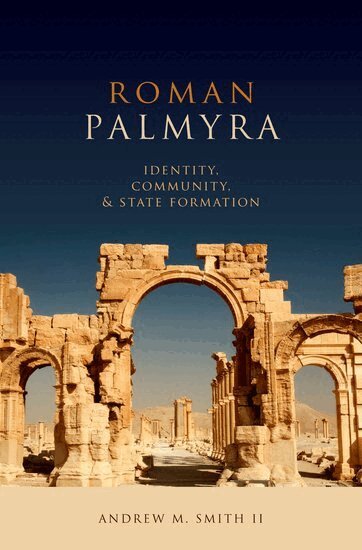
In social, economic, and cultural terms, the eastern frontier of the Roman Empire was vastly complex, which has fueled considerable debate among scholars concerning the nature of the interactions between Romans and natives in the Near East. Notions of imperialism, specifically "cultural" imperialism, frame much of the debate. Through a detailed analysis of Palmyrene identity and community formation, Andrew M. Smith II presents a social and political history of Roman Palmyra, the oasis city situated deep in the Syrian Desert midway between Damascus and the Euphrates river. This city-state is unique in the ancient world, since it began as a humble community, probably no more than an isolated village, and grew--due in part to its role in the caravan trade--into an economically powerful, cosmopolitan urban center of Graeco-Roman character that operated outside of Roman rule, yet under Roman patronage. The book therefore focuses on two aspects of Palmyrene civilization during the first three centuries of the Common Era: the emergence and subsequent development of Palmyra as a commercial and political center in the desert frontier between Rome and Parthia (and later Persia), and the "making" of Palmyrenes. This study is thus concerned with the creation, structure, and maintenance of Palmyrene identity and that of Palmyra as an urban community in a volatile frontier zone. The history of Palmyra's communal development would be wholly obscure were it not for the archaeological and epigraphic materials that testify to Palmyrene achievements and prosperity at home and abroad. These, complemented by the literary evidence, also provide insight into the relatively obscure historical process of sedentarization and of the relationships between pastoral and sedentary communities in the Roman Near East. In addition to examining Palmyra as a frontier community, the book will move beyond Syria to explore the development and maintenance of Palmyrene identity in diaspora settings in Italy, north Africa, and Europe. This study is thus concerned with the creation, structure, and maintenance of Palmyrene identity and that of Palmyra as an urban community in a volatile frontier zone.
Del 19 - Archaeological Reports
Roman Aqaba Project
Final Report, Volume 1: The Regional Environment and the Regional Survey
Inbunden, Engelska, 2014
326 kr
Skickas inom 5-8 vardagar
Includes 114 illustrations, some in colour. Recent scholarship on the Roman Empire has focused on the nature of its economy, including sites that served as nodules of commercial exchange. Aila was such a port city on the Red Sea on the southeastern frontier of the Empire, now within modern Aqaba in Jordan. The city of Aila emerged in the late 1st century BC within the Nabataean kingdom, a client state of the Roman Empire. The port continued to flourish into the early Islamic period, handling trade between the Empire and south Arabia, east Africa, and India. The Roman Aqaba Project aimed to reconstruct Aila’s economy diachronically. The project research design included a regional archaeological and environmental survey, excavation of the ancient city, and analysis of material remains relevant to Aila's economy. Six field seasons were conducted between 1994 and 2002, providing a detailed picture of the economic history of the city. Excavation revealed major elements of the city, such as domestic quarters, industrial facilities, fortifications, and a monumental building interpreted as an early Christian church. This first of three projected volumes of the project’s final report focuses on the regional environment and the regional survey. Analysis of the environment employs a wide range of evidence to analyse the physiography, geology, soils, seismic history, climate and natural resources. Various lines of evidence are employed to reconstruct the paleoclimate, which seems to have remained essentially hyperarid since early historical times. The report also includes results of an intensive archaeological survey of Wadi Araba, the shallow valley extending north from Aqaba to the Dead Sea. The project surveyed the southeastern the valley, recording 334 archaeological sites, most previously unrecorded. These of these were small and unobtrusive and ranged in date from Paleolithic to Late Islamic, but especially common were sites of the Chalcolithic/Early Bronze Age and the Early Roman/Nabataean periods, suggesting more intensive occupation in these periods. The volume also includes chapters on artifacts collected by the survey, including chipped stone tools, pottery, and Nabataean inscriptions. Aila apparently lacked any significant agricultural hinterland. The city was largely dependent on imports from more distant sources.
637 kr
Skickas inom 5-8 vardagar