Andrew Milne - Böcker
Visar alla böcker från författaren Andrew Milne. Handla med fri frakt och snabb leverans.
9 produkter
9 produkter
228 kr
Skickas
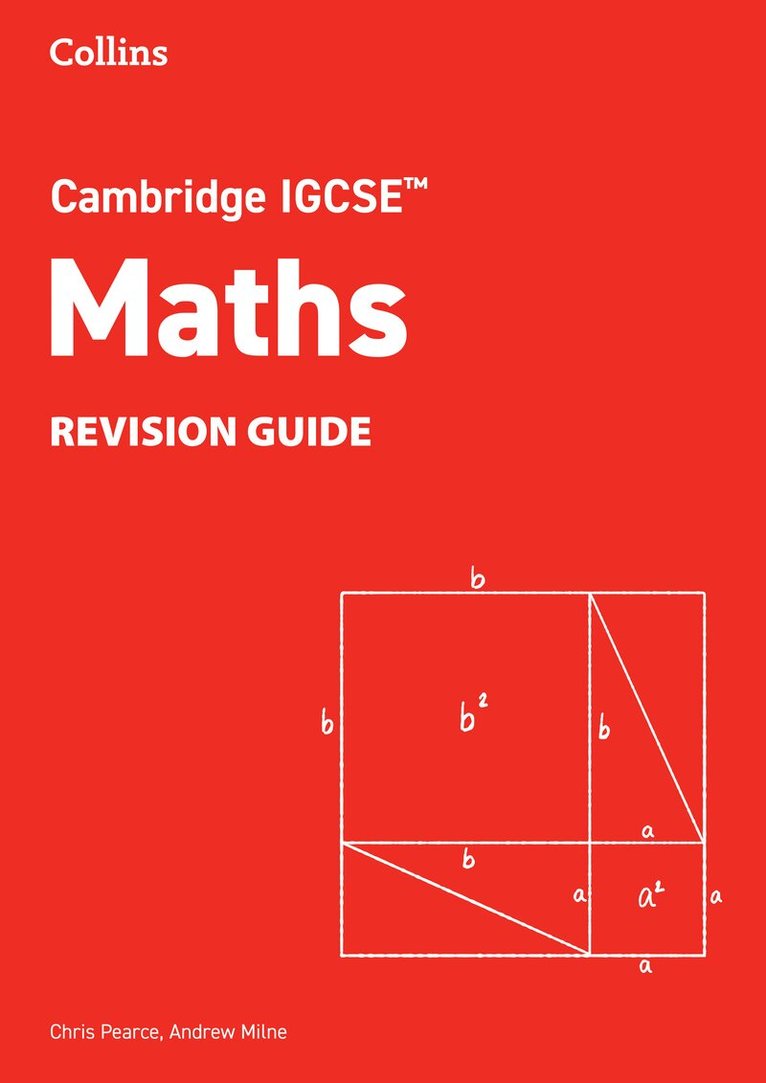
Exam Board: Cambridge Level: IGCSE Subject: Maths Suitable for the 2024 exams and onwards Revision and practice to help you fully prepare for the Cambridge IGCSE exams Collins Cambridge IGCSE Maths Revision Guide provides clear and accessible revision content to support all students. With focused revision for every topic, plus four separate practice opportunities, use this revision guide to build your confidence and help you prepare for your Cambridge IGCSE Maths assessments.Covering the Cambridge IGCSE and IGCSE (9–1) Maths syllabuses (0580/0980), for examination from 2024, this revision guide includes:• clear and concise syllabus coverage, with the Extended material clearly differentiated• topics in short, user-friendly sections to help you plan your revision in manageable chunks• worked examples and guidance on structuring your answers• support for key subject vocabulary (including a glossary) and exam command words• quick tests and exam-style practice questions for every topic, so you can check your progress and develop your exam skills• a complete set of exam-style practice papers to help you prepare for assessment• a free ebook version, so you can revise from anywhere.
271 kr
Skickas
Exam board: Pearson EdexcelLevel: GCSE Level 2Subject: MathsFirst teaching: 2024, Next exam: 2026Packed with worked examples, graded practice and exam-style questions for the highest grades this book helps high achievers prepare for the new exams for Pearson Edexcel Extended Mathematics Certificate Level 2 with confidence. Consolidate and model learning with clear worked examples and key pointsAim for the highest grades with plenty of practice at Distinction* levelDive deeper into maths with content signposted for Pass (grade 7), Merit (grade 8), Distinction (grade 9) and Distinction* (above grade 9)Prepare for assessment with up to date exam-style questions for the calculator and non-calculator paper with marks shownMotivate and challenge students with higher level independent practice for a smooth transition to Pearson Edexcel A Level MathsCheck answers at the back of the bookThe content is an extension of the GCSE Mathematics content. Over 50% of the specification will be algebra content, with the remaining content being a mixture of Number, Geometry, Probability and Ratio.
Sikhs of France and the United Kingdom
A Powerful Diaspora and the Quest for Recognition
Inbunden, Engelska, 2025
2 088 kr
Skickas inom 10-15 vardagar
The book provides a historical analysis of how India and the Sikh community have been situated within the international relations policies of the UK and France. It focuses on the turban campaigns, legal challenges, and lived experiences of Sikhs in both nations, offering new insights into diaspora identity, state policy, and integration.The book features first-hand interviews, case studies, and legal documentation, as well as historical newspaper archives that illuminate the Sikhs’ struggle for recognition. Readers will gain a deeper understanding of the differing legal and cultural landscapes that shape the lives of Sikhs in the UK—where exemptions have enabled them to freely express their religion—and France, where strict secularism curtails, or banishes it. These contrasts reveal how national set-ups exercise control over and impact identity, cohesion, and civil rights, equipping readers with nuanced knowledge of migration, religious freedom, and international law.A comparative study of the Sikh diaspora, the book will be essential reading for scholars and students of Sikh studies, British and French history, law, sociology, international relations, and migration or diaspora studies. It will also appeal to policy makers and activists interested in multiculturalism and human rights.
147 kr
Skickas inom 5-8 vardagar
765 kr
Skickas inom 7-10 vardagar
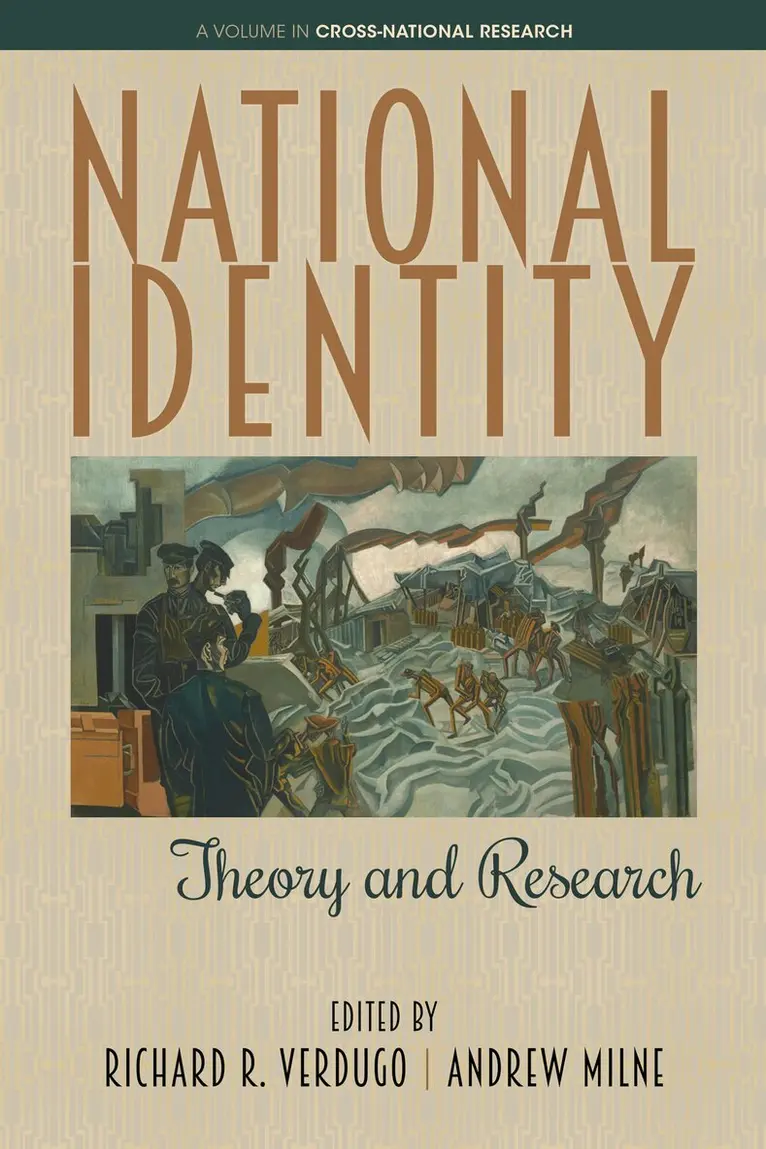
National identity has been the subject of much controversy and debate. Some have even suggested dropping the concept entirely. One group, Essentialists, argue that national identity is fixed, cultural, based on birth and ancestry. Another viewpoint is posited by Postmodernists who argue that national identity is malleable, invented or imagined. As alternatives, some have suggested that national identity is a hybrid of both Essentialist and Postmodernist views. And still others bypass this argument and suggest that national identity should be based on civic factors, such as shared values and norms about citizenship.While controversy and debate are healthy exercises in any science, at some point order must be established if science is to proceed. The present volume is based on the idea that national identity is an ideal-type concept; it does not completely capture reality, but is used for analytic purposes. In addition, rather than focusing on these theoretical debates, we pursue research with the idea that results from research will contribute to the field of national identity. Three areas of national identity are discussed: theoretical, national, and individual. Two chapters focus on the major theories about national identity, provide critiques, and make suggestions about the topic. In section two, six chapters provide case studies of national identity on Scotland, Ireland, Russia, Bosnia-Herzegovina, Germany, and France. In section three, two case studies focus on immigrants and the challenges they face in forming their identities, especially identifying with their host countries—Belgium, and the United Kingdom.Several important conclusions may be gleaned from the contributions of the present volume. To begin with, while national identity is a slippery concept, if the field wishes to move beyond debate about fundamentals, it would be well advised to view the concept as an ideal-type as suggested by the great German scholar, Max Weber. Secondly, the case studies included in the present volume indicate that national identity is not only based on ethnicity and culture, but on such external factors as governance regimes and their changes, economic crises, wars and other forms of aggressive activity, and social demographic changes in a population. These factors affect a population at the national level. For immigrants at the individual level, developing national identity is greatly affected by four interrelated factors: 1) the degree to which they are accepted by members of the host society; 2) immigrants’ language skills and physical appearances; 3) how well they are able to balance their host national identity, their ethnic identity, and acceptance of their native country; 4) and their generational status. Generally, at the national and individual levels, context and circumstances matter in developing national identity.
1 059 kr
Skickas inom 7-10 vardagar
National identity has been the subject of much controversy and debate. Some have even suggested dropping the concept entirely. One group, Essentialists, argue that national identity is fixed, cultural, based on birth and ancestry. Another viewpoint is posited by Postmodernists who argue that national identity is malleable, invented or imagined. As alternatives, some have suggested that national identity is a hybrid of both Essentialist and Postmodernist views. And still others bypass this argument and suggest that national identity should be based on civic factors, such as shared values and norms about citizenship.While controversy and debate are healthy exercises in any science, at some point order must be established if science is to proceed. The present volume is based on the idea that national identity is an ideal-type concept; it does not completely capture reality, but is used for analytic purposes. In addition, rather than focusing on these theoretical debates, we pursue research with the idea that results from research will contribute to the field of national identity. Three areas of national identity are discussed: theoretical, national, and individual. Two chapters focus on the major theories about national identity, provide critiques, and make suggestions about the topic. In section two, six chapters provide case studies of national identity on Scotland, Ireland, Russia, Bosnia-Herzegovina, Germany, and France. In section three, two case studies focus on immigrants and the challenges they face in forming their identities, especially identifying with their host countries—Belgium, and the United Kingdom.Several important conclusions may be gleaned from the contributions of the present volume. To begin with, while national identity is a slippery concept, if the field wishes to move beyond debate about fundamentals, it would be well advised to view the concept as an ideal-type as suggested by the great German scholar, Max Weber. Secondly, the case studies included in the present volume indicate that national identity is not only based on ethnicity and culture, but on such external factors as governance regimes and their changes, economic crises, wars and other forms of aggressive activity, and social demographic changes in a population. These factors affect a population at the national level. For immigrants at the individual level, developing national identity is greatly affected by four interrelated factors: 1) the degree to which they are accepted by members of the host society; 2) immigrants’ language skills and physical appearances; 3) how well they are able to balance their host national identity, their ethnic identity, and acceptance of their native country; 4) and their generational status. Generally, at the national and individual levels, context and circumstances matter in developing national identity.
528 kr
Kommande
The first volume of the two-volume book publication entitled "Multiculturalism, Conflict and Belonging", which stems out of the four-day international conference under the same title organized by Interdisciplinary.Net at Mansfield College, Oxford University, in September 2012, aims not only at exploring the concepts of "identity", "difference" and "belonging" from a theoretical perspective, but more importantly at relating them empirically to multicultural contexts that shed a better light on the concepts in question. Both volumes are composed of chapters under various themes that provide an analytical analysis on how individuals choose and shift from one identity to the other as well as how they voluntarily and involuntarily belong to one or the other group thus shaping the very fabrics of a multicultural environment. This first volume entitled "Identity, Difference and Belonging" is composed of nine chapters that are divided under two main themes, namely: (1) Making and Negotiating Identities: Education, Religion and Culture; and (2) Making Identities: Cultural Representations.
1 276 kr
Skickas inom 10-15 vardagar
This book is an attempt to make sense of the tension in Nietzsche’s work between the unashamedly egocentric and the apparently mystical.
1 276 kr
Skickas inom 10-15 vardagar
This book is an attempt to make sense of the tension in Nietzsche’s work between the unashamedly egocentric and the apparently mystical.