
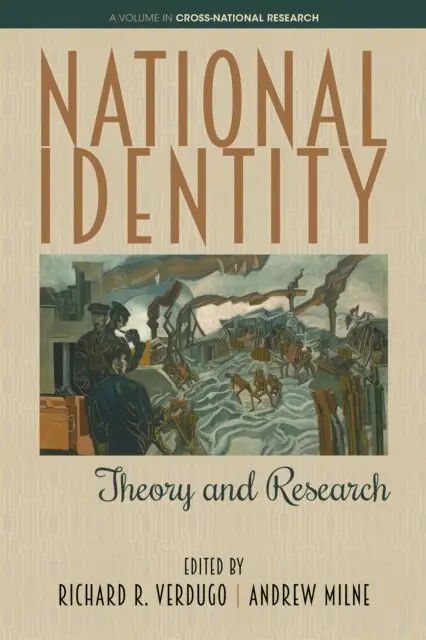
National Identity
Theory and Research
AvAndrew Milne,Richard R. Verdugo
E-bok
Engelska, 2016449 kr
Läs direkt i Bokus Reader – eller ladda ned till din enhet
Beskrivning
National identity has been the subject of much controversy and debate. Some have even suggested dropping the concept entirely. One group, Essentialists, argue that national identity is fixed, cultural, based on birth and ancestry. Another viewpoint is posited by Postmodernists who argue that national identity is malleable, invented or imagined. As alternatives, some have suggested that national identity is a hybrid of both Essentialist and Postmodernist views. And still others bypass this argument and suggest that national identity should be based on civic factors, such as shared values and norms about citizenship.
While controversy and debate are healthy exercises in any science, at some point order must be established if science is to proceed. The present volume is based on the idea that national identity is an ideal-type concept; it does not completely capture reality, but is used for analytic purposes. In addition, rather than focusing on these theoretical debates, we pursue research with the idea that results from research will contribute to the field of national identity. Three areas of national identity are discussed: theoretical, national, and individual. Two chapters focus on the major theories about national identity, provide critiques, and make suggestions about the topic. In section two, six chapters provide case studies of national identity on Scotland, Ireland, Russia, Bosnia-Herzegovina, Germany, and France. In section three, two case studies focus on immigrants and the challenges they face in forming their identities, especially identifying with their host countries—Belgium, and the United Kingdom.
Several important conclusions may be gleaned from the contributions of the present volume. To begin with, while national identity is a slippery concept, if the field wishes to move beyond debate about fundamentals, it would be well advised to view the concept as an ideal-type as suggested by the great German scholar, Max Weber. Secondly, the case studies included in the present volume indicate that national identity is not only based on ethnicity and culture, but on such external factors as governance regimes and their changes, economic crises, wars and other forms of aggressive activity, and social demographic changes in a population. These factors affect a population at the national level. For immigrants at the individual level, developing national identity is greatly affected by four interrelated factors: 1) the degree to which they are accepted by members of the host society; 2) immigrants’ language skills and physical appearances; 3) how well they are able to balance their host national identity, their ethnic identity, and acceptance of their native country; 4) and their generational status. Generally, at the national and individual levels, context and circumstances matter in developing national identity.
Produktinformation
Utforska kategorier
Hoppa över listan






Du kanske också är intresserad av
Senses and Memory
Hsuan L. Hsu, Chanelle Dupuis, Rachel S. Herz, Théophile Robert-Rimsky, Jieling Xiao, PerMagnus Lindborg, Shyama Ramsamy Goomany, Renata Pękowska, Helen Shaw, Andrew Milne, Annick Le Guérer, Roksana Zgierska, Fernanda Alves, Erzsébet Fanni Tóth, Benjamin Thorne, Andrew Kettler, Shari Bloom, Linda Kopitz, Chanelle Dupuis
Häftad, 2025
1 050 kr
Edexcel Level 2 Extended Maths Certificate Study and Practice
Anne Stothers, Trevor Senior, Andrew Milne
Häftad, 2025
297 kr