Andy Oram – författare
230 kr
Skickas inom 5-8 vardagar
341 kr
Skickas inom 5-8 vardagar
390 kr
Läs direkt efter köp
How do the experts solve difficult problems in software development? In this unique and insightful book, leading computer scientists offer case studies that reveal how they found unusual, carefully designed solutions to high-profile projects. You will be able to look over the shoulder of major coding and design experts to see problems through their eyes.This is not simply another design patterns book, or another software engineering treatise on the right and wrong way to do things. The authors think aloud as they work through their project''s architecture, the tradeoffs made in its construction, and when it was important to break rules.This book contains 33 chapters contributed by Brian Kernighan, KarlFogel, Jon Bentley, Tim Bray, Elliotte Rusty Harold, Michael Feathers,Alberto Savoia, Charles Petzold, Douglas Crockford, Henry S. Warren,Jr., Ashish Gulhati, Lincoln Stein, Jim Kent, Jack Dongarra and PiotrLuszczek, Adam Kolawa, Greg Kroah-Hartman, Diomidis Spinellis, AndrewKuchling, Travis E. Oliphant, Ronald Mak, Rogerio Atem de Carvalho andRafael Monnerat, Bryan Cantrill, Jeff Dean and Sanjay Ghemawat, SimonPeyton Jones, Kent Dybvig, William Otte and Douglas C. Schmidt, AndrewPatzer, Andreas Zeller, Yukihiro Matsumoto, Arun Mehta, TV Raman,Laura Wingerd and Christopher Seiwald, and Brian Hayes.Beautiful Code is an opportunity for master coders to tell their story. All author royalties will be donated to Amnesty International.
304 kr
Skickas inom 5-8 vardagar
352 kr
Läs direkt efter köp
Although most people don''t give security much attention until their personal or business systems are attacked, this thought-provoking anthology demonstrates that digital security is not only worth thinking about, it''s also a fascinating topic. Criminals succeed by exercising enormous creativity, and those defending against them must do the same. Beautiful Security explores this challenging subject with insightful essays and analysis on topics that include:
The underground economy for personal information: how it works, the relationships among criminals, and some of the new ways they pounce on their preyHow social networking, cloud computing, and other popular trends help or hurt our online securityHow metrics, requirements gathering, design, and law can take security to a higher levelThe real, little-publicized history of PGPThis book includes contributions from:
Peiter "Mudge" ZatkoJim StickleyElizabeth NicholsChenxi WangEd BellisBen EdelmanPhil Zimmermann and Jon CallasKathy WangMark CurpheyJohn McManusJames RouthRandy V. SabettAnton ChuvakinGrant Geyer and Brian DunphyPeter WaynerMichael Wood and Fernando FranciscoAll royalties will be donated to the Internet Engineering Task Force (IETF).
367 kr
Läs direkt efter köp
How do the experts solve difficult problems in software development? In this unique and insightful book, leading computer scientists offer case studies that reveal how they found unusual, carefully designed solutions to high-profile projects. You will be able to look over the shoulder of major coding and design experts to see problems through their eyes.This is not simply another design patterns book, or another software engineering treatise on the right and wrong way to do things. The authors think aloud as they work through their project''s architecture, the tradeoffs made in its construction, and when it was important to break rules.This book contains 33 chapters contributed by Brian Kernighan, KarlFogel, Jon Bentley, Tim Bray, Elliotte Rusty Harold, Michael Feathers,Alberto Savoia, Charles Petzold, Douglas Crockford, Henry S. Warren,Jr., Ashish Gulhati, Lincoln Stein, Jim Kent, Jack Dongarra and PiotrLuszczek, Adam Kolawa, Greg Kroah-Hartman, Diomidis Spinellis, AndrewKuchling, Travis E. Oliphant, Ronald Mak, Rogerio Atem de Carvalho andRafael Monnerat, Bryan Cantrill, Jeff Dean and Sanjay Ghemawat, SimonPeyton Jones, Kent Dybvig, William Otte and Douglas C. Schmidt, AndrewPatzer, Andreas Zeller, Yukihiro Matsumoto, Arun Mehta, TV Raman,Laura Wingerd and Christopher Seiwald, and Brian Hayes.Beautiful Code is an opportunity for master coders to tell their story. All author royalties will be donated to Amnesty International.
317 kr
Läs direkt efter köp
Although most people don''t give security much attention until their personal or business systems are attacked, this thought-provoking anthology demonstrates that digital security is not only worth thinking about, it''s also a fascinating topic. Criminals succeed by exercising enormous creativity, and those defending against them must do the same. Beautiful Security explores this challenging subject with insightful essays and analysis on topics that include:
The underground economy for personal information: how it works, the relationships among criminals, and some of the new ways they pounce on their preyHow social networking, cloud computing, and other popular trends help or hurt our online securityHow metrics, requirements gathering, design, and law can take security to a higher levelThe real, little-publicized history of PGPThis book includes contributions from:
Peiter "Mudge" ZatkoJim StickleyElizabeth NicholsChenxi WangEd BellisBen EdelmanPhil Zimmermann and Jon CallasKathy WangMark CurpheyJohn McManusJames RouthRandy V. SabettAnton ChuvakinGrant Geyer and Brian DunphyPeter WaynerMichael Wood and Fernando FranciscoAll royalties will be donated to the Internet Engineering Task Force (IETF).
341 kr
Skickas inom 5-8 vardagar
272 kr
Skickas inom 5-8 vardagar
432 kr
Läs direkt efter köp
Many claims are made about how certain tools, technologies, and practices improve software development. But which claims are verifiable, and which are merely wishful thinking? In this book, leading thinkers such as Steve McConnell, Barry Boehm, and Barbara Kitchenham offer essays that uncover the truth and unmask myths commonly held among the software development community. Their insights may surprise you.
Are some programmers really ten times more productive than others?Does writing tests first help you develop better code faster?Can code metrics predict the number of bugs in a piece of software?Do design patterns actually make better software?What effect does personality have on pair programming?What matters more: how far apart people are geographically, or how far apart they are in the org chart?Contributors include:
Jorge ArandaTom BallVictor R. BasiliAndrew BegelChristian BirdBarry BoehmMarcelo CataldoSteven ClarkeJason CohenRobert DeLineMadeline DiepHakan ErdogmusMichael GodfreyMark GuzdialJo E. HannayAhmed E. HassanIsrael HerraizKim Sebastian HerzigCory KapserBarbara KitchenhamAndrew KoLucas LaymanSteve McConnellTim MenziesGail MurphyNachi NagappanThomas J. OstrandDewayne PerryMarian PetreLutz PrecheltRahul PremrajForrest ShullBeth SimonDiomidis SpinellisNeil ThomasWalter TichyBurak TurhanElaine J. WeyukerMichele A. WhitecraftLaurie WilliamsWendy M. WilliamsAndreas ZellerThomas Zimmermann
276 kr
Läs direkt efter köp
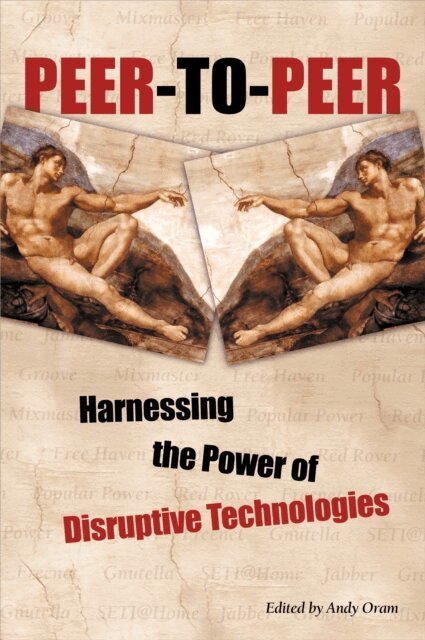
The term "peer-to-peer" has come to be applied to networks that expect end users to contribute their own files, computing time, or other resources to some shared project. Even more interesting than the systems'' technical underpinnings are their socially disruptive potential: in various ways they return content, choice, and control to ordinary users.While this book is mostly about the technical promise of peer-to-peer, we also talk about its exciting social promise. Communities have been forming on the Internet for a long time, but they have been limited by the flat interactive qualities of email and Network newsgroups. People can exchange recommendations and ideas over these media, but have great difficulty commenting on each other''s postings, structuring information, performing searches, or creating summaries. If tools provided ways to organize information intelligently, and if each person could serve up his or her own data and retrieve others'' data, the possibilities for collaboration would take off. Peer-to-peer technologies along with metadata could enhance almost any group of people who share an interest--technical, cultural, political, medical, you name it.This book presents the goals that drive the developers of the best-known peer-to-peer systems, the problems they''ve faced, and the technical solutions they''ve found. Learn here the essentials of peer-to-peer from leaders of the field:
Nelson Minar and Marc Hedlund of target="new">Popular Power, on a history of peer-to-peerClay Shirky of acceleratorgroup, on where peer-to-peer is likely to be headedTim O''Reilly of O''Reilly & Associates, on redefining the public''s perceptionsDan Bricklin, cocreator of Visicalc, on harvesting information from end-usersDavid Anderson of SETI@home, on how SETI@Home created the world''s largest computerJeremie Miller of Jabber, on the Internet as a collection of conversationsGene Kan of Gnutella and GoneSilent.com, on lessons from Gnutella for peer-to-peer technologiesAdam Langley of Freenet, on Freenet''s present and upcoming architectureAlan Brown of Red Rover, on a deliberately low-tech content distribution systemMarc Waldman, Lorrie Cranor, and Avi Rubin of AT&T Labs, on the Publius project and trust in distributed systemsRoger Dingledine, Michael J. Freedman, andDavid Molnar of Free Haven, on resource allocation and accountability in distributed systemsRael Dornfest of O''Reilly Network and Dan Brickley of ILRT/RDF Web, on metadataTheodore Hong of Freenet, on performanceRichard Lethin of Reputation Technologies, on how reputation can be built onlineJon Udell ofBYTE and Nimisha Asthagiri andWalter Tuvell of Groove Networks, on securityBrandon Wiley of Freenet, on gateways between peer-to-peer systemsYou''ll find information on the latest and greatest systems as well as upcoming efforts in this book.273 kr
Läs direkt efter köp
The term "peer-to-peer" has come to be applied to networks that expect end users to contribute their own files, computing time, or other resources to some shared project. Even more interesting than the systems'' technical underpinnings are their socially disruptive potential: in various ways they return content, choice, and control to ordinary users.While this book is mostly about the technical promise of peer-to-peer, we also talk about its exciting social promise. Communities have been forming on the Internet for a long time, but they have been limited by the flat interactive qualities of email and Network newsgroups. People can exchange recommendations and ideas over these media, but have great difficulty commenting on each other''s postings, structuring information, performing searches, or creating summaries. If tools provided ways to organize information intelligently, and if each person could serve up his or her own data and retrieve others'' data, the possibilities for collaboration would take off. Peer-to-peer technologies along with metadata could enhance almost any group of people who share an interest--technical, cultural, political, medical, you name it.This book presents the goals that drive the developers of the best-known peer-to-peer systems, the problems they''ve faced, and the technical solutions they''ve found. Learn here the essentials of peer-to-peer from leaders of the field:
Nelson Minar and Marc Hedlund of target="new">Popular Power, on a history of peer-to-peerClay Shirky of acceleratorgroup, on where peer-to-peer is likely to be headedTim O''Reilly of O''Reilly & Associates, on redefining the public''s perceptionsDan Bricklin, cocreator of Visicalc, on harvesting information from end-usersDavid Anderson of SETI@home, on how SETI@Home created the world''s largest computerJeremie Miller of Jabber, on the Internet as a collection of conversationsGene Kan of Gnutella and GoneSilent.com, on lessons from Gnutella for peer-to-peer technologiesAdam Langley of Freenet, on Freenet''s present and upcoming architectureAlan Brown of Red Rover, on a deliberately low-tech content distribution systemMarc Waldman, Lorrie Cranor, and Avi Rubin of AT&T Labs, on the Publius project and trust in distributed systemsRoger Dingledine, Michael J. Freedman, andDavid Molnar of Free Haven, on resource allocation and accountability in distributed systemsRael Dornfest of O''Reilly Network and Dan Brickley of ILRT/RDF Web, on metadataTheodore Hong of Freenet, on performanceRichard Lethin of Reputation Technologies, on how reputation can be built onlineJon Udell ofBYTE and Nimisha Asthagiri andWalter Tuvell of Groove Networks, on securityBrandon Wiley of Freenet, on gateways between peer-to-peer systemsYou''ll find information on the latest and greatest systems as well as upcoming efforts in this book.