Anna Karlström - Böcker
Visar alla böcker från författaren Anna Karlström. Handla med fri frakt och snabb leverans.
4 produkter
4 produkter
682 kr
Skickas inom 10-15 vardagar
Archaeologies of “Us” and “Them” explores the concept of indigeneity within the field of archaeology and heritage and in particular examines the shifts in power that occur when ‘we’ define ‘the other’ by categorizing ‘them’ as indigenous. Recognizing the complex and shifting distinctions between indigenous and non-indigenous pasts and presents, this volume gives a nuanced analysis of the underlying definitions, concepts and ethics associated with this field in order to explore Indigenous archaeology as a theoretical, ethical and political concept. Indigenous archaeology is an increasingly important topic discussed worldwide, and as such critical analyses must be applied to debates which are often surrounded by political correctness and consensus views. Drawing on an international range of global case studies, this timely and sensitive collection significantly contributes to the development of archaeological critical theory.
563 kr
Skickas inom 5-8 vardagar
2 374 kr
Skickas inom 10-15 vardagar
Archaeologies of “Us” and “Them” explores the concept of indigeneity within the field of archaeology and heritage and in particular examines the shifts in power that occur when ‘we’ define ‘the other’ by categorizing ‘them’ as indigenous. Recognizing the complex and shifting distinctions between indigenous and non-indigenous pasts and presents, this volume gives a nuanced analysis of the underlying definitions, concepts and ethics associated with this field in order to explore Indigenous archaeology as a theoretical, ethical and political concept. Indigenous archaeology is an increasingly important topic discussed worldwide, and as such critical analyses must be applied to debates which are often surrounded by political correctness and consensus views. Drawing on an international range of global case studies, this timely and sensitive collection significantly contributes to the development of archaeological critical theory.
275 kr
Skickas inom 5-8 vardagar
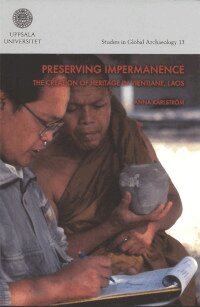
This thesis is about the heritage in Vientiane. In an attempt to go beyond a more traditional descriptive approach, the study aims at bringing forward a discussion about the definition, or rather the multiplicity of definitions, of the concept of heritage as such. The unavoidabe tension emanating from a modern western frame of thought being applied to the geographical and cultural setting of the study provides an opportunity to develop a criticism of some of the assumptions underlying our current definitions of heritage. For this particular study, heritage is defined as to include stories, places and things. It is a heritage that is complex and ambiguous, because the stories are parallel, the definitions and perceptions of place are manifold and contested, and the things and their meaning appear altered, depending on what approach to materiality is used. The objective is not to propose how to identify and manage such a complex heritage. Rather, it is about what causes this complexity and ambiguity and what is in between the stories, places and things. In addition, the study aims to critically deconstruct the contemporary heritage discourse, which privileges material authenticity, form and fabric and the idea that heritage values are universal and should be preserved for the future and preferably forever. In Laos, Buddhism dominates as religious practice. In this context, the notion of material impermanence also governs the perception of reality. Approaches to materiality in Buddhism are related to the general ideas that things are important from a contemporary perspective and primarily as containers for spiritual values, that the spiritual values carry the connection to the past, and that heritage is primarily spiritual in nature and has little to do with physical structure and form. By exploring the concepts of restoration, destruction and consumption in such a perspective, we understand that preservation and restoration are active processes of materialisation. We also understand that destruction and consumption are necessary for the appreciation of certain heritage expressions, and that heritage is being constantly created. With this understanding, this book is an argument for challenging contemporary western heritage discourse and question its fundamental ideology of preservationism.