Anne Sa'adah - Böcker
Visar alla böcker från författaren Anne Sa'adah. Handla med fri frakt och snabb leverans.
3 produkter
3 produkter
789 kr
Skickas inom 3-6 vardagar
Marshalling historical materials to make a descriptive argument in social theory, this wide-ranging book compares the liberal revolution in France to the liberal revolutions in England and America and argues that the causes and outcomes of these upheavals were decisive in shaping later patterns of politics. "Conflict is the stuff of politics," writes Anne Sa'adah, and liberal politics, because of its emphasis on the individual and its legitimation of self-interest, complicates the task of creating political community in a particularly interesting way. In England and America, the tension between conflict and community was resolved in a manner consistent with political stability. In France, the tension produced an instability that has surfaced periodically throughout subsequent French history. Why this is so is the subject of a work that treats the making of the modern political world in an unusually systematic way. In France, England, and America, the relationship of the state to society under the prerevolutionary regime limited revolutionary options.Sa'adah focuses on how this relationship created a politics of exclusion in France, while allowing a politics of transaction in England and America. Originally published in 1990. The Princeton Legacy Library uses the latest print-on-demand technology to again make available previously out-of-print books from the distinguished backlist of Princeton University Press. These editions preserve the original texts of these important books while presenting them in durable paperback and hardcover editions. The goal of the Princeton Legacy Library is to vastly increase access to the rich scholarly heritage found in the thousands of books published by Princeton University Press since its founding in 1905.
Shaping of Liberal Politics in Revolutionary France
A Comparative Perspective
Inbunden, Engelska, 2016
1 817 kr
Skickas inom 3-6 vardagar
Marshalling historical materials to make a descriptive argument in social theory, this wide-ranging book compares the liberal revolution in France to the liberal revolutions in England and America and argues that the causes and outcomes of these upheavals were decisive in shaping later patterns of politics. "Conflict is the stuff of politics," writes Anne Sa'adah, and liberal politics, because of its emphasis on the individual and its legitimation of self-interest, complicates the task of creating political community in a particularly interesting way. In England and America, the tension between conflict and community was resolved in a manner consistent with political stability. In France, the tension produced an instability that has surfaced periodically throughout subsequent French history. Why this is so is the subject of a work that treats the making of the modern political world in an unusually systematic way. In France, England, and America, the relationship of the state to society under the prerevolutionary regime limited revolutionary options.Sa'adah focuses on how this relationship created a politics of exclusion in France, while allowing a politics of transaction in England and America. Originally published in 1990. The Princeton Legacy Library uses the latest print-on-demand technology to again make available previously out-of-print books from the distinguished backlist of Princeton University Press. These editions preserve the original texts of these important books while presenting them in durable paperback and hardcover editions. The goal of the Princeton Legacy Library is to vastly increase access to the rich scholarly heritage found in the thousands of books published by Princeton University Press since its founding in 1905.
808 kr
Skickas inom 10-15 vardagar
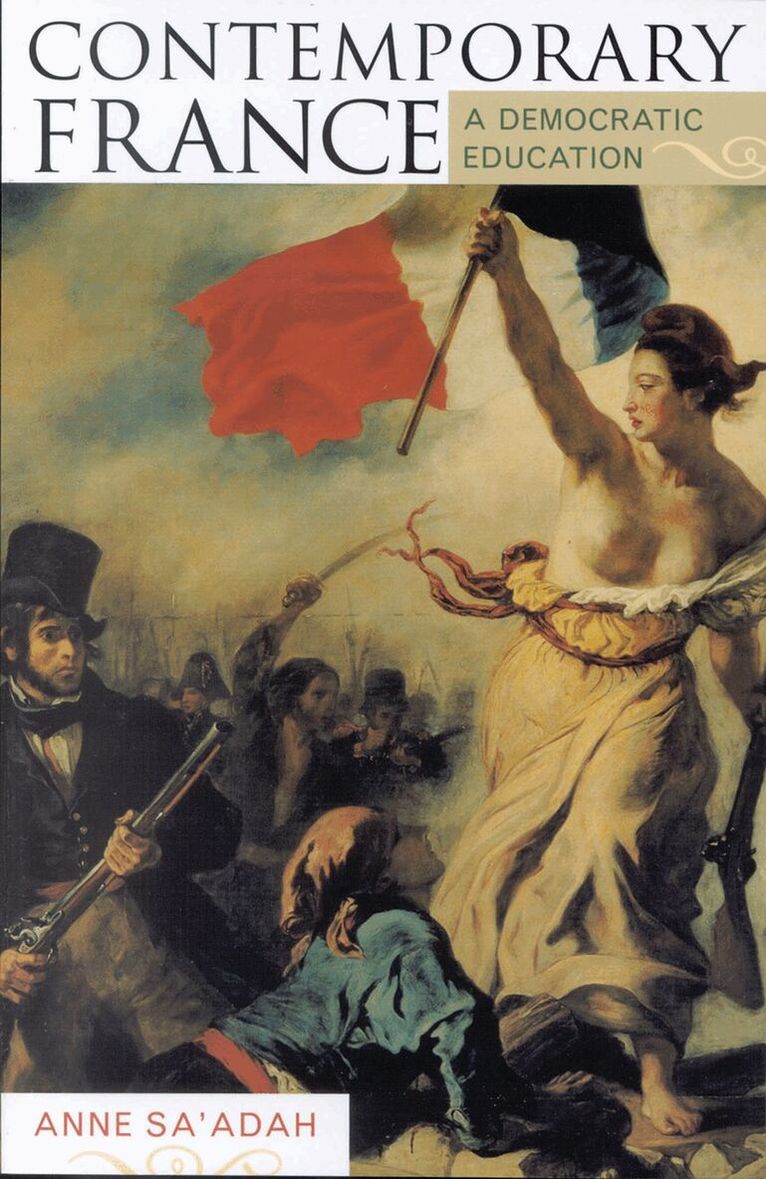
This dynamic introduction to contemporary France analyzes the problems and possibilities of democracy in a globalizing world. France was present at the creation of modern democratic politics in the eighteenth century, yet democratic stability has often eluded the country. Now, as established and new democracies everywhere confront the challenges of globalization—cultural diversity, economic change, the erosion of state sovereignty—France's rich and varied experience contains valuable lessons about what works (democratically speaking) and what does not. Anne Sa'adah describes actors, beliefs, institutions, and policies; she also interprets democratic politics in France in general and explores why and with what political consequences so many people in France experience globalization as a harbinger of national decline. The author is especially attentive to the importance of historical legacies, especially of the centralizing logic of the Old Regime, the Revolution and the expansionary dynamic and internal instability it spawned, World War II, and decolonization. Pivotal chapters focus on France's often dysfunctional system of representation, state-society relations, group politics, social policy, and France's role in Europe and the world.