Annika Sundén - Böcker
Visar alla böcker från författaren Annika Sundén. Handla med fri frakt och snabb leverans.
4 produkter
4 produkter
Del 2014 - Konjunkturrådets rapport
Hur får vi råd med välfärden? Konjunkturrådets rapport 2014
Häftad, Svenska, 2014
255 kr
Skickas
Välfärdstjänster som skola, vård och omsorg utgör, tillsammans med socialförsäkringar och bidrag, kärnan i den svenska välfärdsstaten. I takt med att samhället blir rikare och den tekniska utvecklingen fortskrider ökar efterfrågan på välfärdstjänster. Därmed utmanas den framtida finansieringen av välfärdstjänsterna. Hur stora är utmaningarna? Kan välfärdsstaten i sin nuvarande utformning behållas? Hur kan medborgarnas stigande krav på välfärd mötas utan skattehöjningar? SNS Konjunkturråd 2014 presenterar och analyserar olika förslag på lösningar. Fördelningsaspekter är i detta resonemang centrala eftersom tidigare förslag riskerar leda till att inte alla får tillgång till välfärdstjänster av hög kvalitet. Den övergripande frågan blir därmed hur problemet kan bemästras samtidigt som det sociala kontraktet mellan individ och stat upprätthålls. SNS Konjunkturråd 2014 består av Annika Sundén (ordförande), docent i nationalekonomi och verksam vid Pensionsmyndigheten, Torben M. Andersen, professor i nationalekonomi, Århus universitet, och Jesper Roine, docent i nationalekonomi, Handelshögskolan i Stockholm och Stockholm Institute of Transition Economics (SITE).
365 kr
Skickas inom 10-15 vardagar
Despite the recent downturn in the stock market, the 1990s boom and the shift to defined contribution plans mean that more individuals will have significant wealth upon retirement. How they use that wealth will determine not only their own well-being, but also the living standards of their children, the resources available to philanthropies, and the level of investment capital in the economy. This volume explores the reasons why people save, how they decide to allocate their wealth once they retire, and how givers select their beneficiaries. It also assesses the extent to which the estate tax and annuitization of retirement wealth affects the amount and nature of wealth transfers. Finally, it looks at the impact of wealth transfersfirst on the amount of aggregate saving and capital accumulation, and then on the distribution of wealth among households. Several conclusions emerge. First, gifts and bequests are important; they may account for about half of total wealth in America. Second, rich people make most of the wealth transfers. They are thoughtful about how much they pay in taxes and how they dispose of their wealth. They care about philanthropic causes and view their charitable contributions as more than a way to avoid paying estate taxes. Third, most nonrich people probably have some lexicographic preferences about the disposition of their wealth; they want to ensure they have adequate resources to take care of their own needs, and if money is left over, they would like it to go to their children. Fourth, little support has emerged for the pure altruistic model of bequests. Fifth, institutions matter. In the case of the rich, the estate tax probably reduces saving and increases bequests to charity. In the case of the nonrich, the shift to defined contribution plans will at a minimum mean that they have more wealth in their hands when they die, and therefore they will leave larger accidental bequests. It might also increase their interest in lea
296 kr
Skickas inom 10-15 vardagar
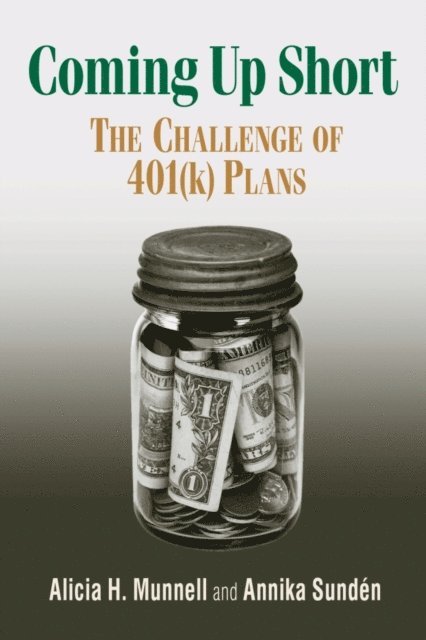
As the baby boom begins to withdraw from the labor force, ensuring a secure retirement income becomes an increasingly important issue, the number of people over age 65 is expected to double by 2030. That trend will continue, accompanied by worries about stock market volatility, corporate malfeasance, a rapidly changing economy, and the viability of Social Security. In Coming Up Short, two experts on retirement policy analyze 401(k) plans, the fastest-growing type of employer-sponsored pensions and a vital source of retirement income for the American middle class. Alicia Munnell and Annika Sunden chronicle the development of 401(k) plans, now the dominant form of private pensions. In accessible language, they explain how such plans work and discuss their popularity. For employees, these plans are appealing becuase they have more control over their own retirement funds, and the plans are portable. For employers, the plans are generally less costly than defined benefit plans. Despite those advantages, there are some significant downsides to 401(k) plans. These plans shift all the risk and responsibility to employees, who must decide whether to join, how much to contribute, how to invest, whether to ""cash out"" when changing jobs, and how to manage their nest egg in retirement. These are difficult decisions, and while in theory 401(k)s could be an effective savings vehicle for retirement, in practice many people make mistakes at every step along the way. Com ing Up Short discusses why these mistakes are made and proposes various reforms to ensure that the aging population will have adequate retirement income. Comprehensive and up-to-date, Coming Up Short is an essential resource on 401(k) plans for financial service professionals, policymakers, academics, and individuals planning for their own retirement.
303 kr
Skickas
Det har skrivits mycket om behovet av att reformera det svenska trygghetssystemet de senaste åren. Bakgrunden är bl.a. önskan att minska det som kommit att kallas utanförskap, dvs. att få arbetslösa och långtidssjukskrivna tillbaka på arbetsmarknaden. Syftet har också varit att långsiktigt öka antalet arbetade timmar i ekonomin för att därigenom ha bättre möjlighet att finansiera välfärden i framtiden. En aspekt som än så länge inte fått så mycket uppmärksamhet är deltidsförmånerna. Till skillnad från många andra länder kan man i Sverige få deltidsersättning från de flesta socialförsäkringar, a-kassa inräknad. Deltidsersättningar motiveras med att de stöttar arbetslinjen det är bättre att arbeta lite än att inte arbeta alls. Men de kan också leda till inlåsning om deltidsrelationen blir permanent. Resultatet kan med andra ord bli antingen fler eller färre timmar, beroende på vilken av effekterna som dominerar. Välfärd på deltid går igenom omfattningen av deltidsersättningar i de olika trygghetssystemen och presenterar vad forskningen vet om deltidsförmånernas påverkan på arbetsutbudet. Författarna diskuterar också kopplingar mellan frivilligt och ofrivilligt deltidsarbete. Kan det vara så att en stor efterfrågan på deltidstjänster, framför allt hos kvinnor med småbarn, bidrar till att delar av arbetsmarknaden anpassar sig till deltidsarbete, vilket i sin tur ger ofrivilligt deltidsarbete som följd? Boken avslutas med en uppmaning till politikerna att hitta en bättre balans mellan att uppmuntra till deltidsarbete i vissa livssituationer men inte i andra. Laura Hartman, fil.dr i nationalekonomi, är verksam vid Institutet för arbetsmarknadspolitisk utvärdering, IFAU, och extern forskningsledare på SNS. 7