Anthony F. D’Elia - Böcker
Visar alla böcker från författaren Anthony F. D’Elia. Handla med fri frakt och snabb leverans.
4 produkter
4 produkter
Del 146 - Harvard Historical Studies
Renaissance of Marriage in Fifteenth-Century Italy
Inbunden, Engelska, 2005
720 kr
Skickas inom 7-10 vardagar
Weddings in fifteenth-century Italian courts were grand, sumptuous affairs that often required guests to listen attentively to lengthy orations given in Latin. In this book, Anthony D'Elia shows how Italian humanists used these orations to support claims of legitimacy and assertions of superiority among families jockeying for power, as well as to advocate for marriage and sexual pleasure. Humanists stressed the value of marriage in practical terms as a means for consolidating wealth, forming political alliances, and maintaining power by providing heirs. They also presented women in a positive light, as helpmates and even examples of wisdom and learning. While D'Elia focuses on Italian courts, he also examines ideas about marriage and celibacy from Antiquity to Republican Florence and Reformation Germany, revealing the continuities and distinctions between Italian humanist and Protestant thought on marriage.In bringing to life this fascinating elite culture, D'Elia makes a valuable contribution to the history of the Renaissance, women, and the family, and to studies of rhetoric and the classical tradition.
282 kr
Skickas inom 7-10 vardagar
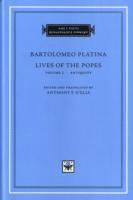
Bartolomeo Platina (1421–1481), historian, political theorist, and author of a best-selling cookbook, began life as a mercenary soldier and ended it as the head of the Vatican Library. A papal official under the humanist Pope Pius II, he was a member of the humanist academies of Cardinal Bessarion and Pomponio Leto, and was twice imprisoned for conspiring against Pope Paul II. Returning to favor under Pope Sixtus IV, he composed his most famous work, a biographical compendium of the Roman popes from St. Peter down to his own time. The work critically synthesized a wide range of sources and became the standard reference work on papal history for early modern Europe, reprinted dozens of times and translated into a number of languages. A characteristic work of Renaissance humanism, it used Christian antiquity as a standard against which to criticize modern churchmen. This edition contains the first complete translation into English and an improved Latin text. Volume 1, the first of a projected four, covers the period from the founding of the church through ad 461.
297 kr
Skickas inom 10-15 vardagar
In 1468, on the final night of Carnival in Rome, Pope Paul II sat enthroned above the boisterous crowd, when a scuffle caught his eye. His guards had intercepted a mysterious stranger trying urgently to convey a warning—conspirators were lying in wait to slay the pontiff. Twenty humanist intellectuals were quickly arrested, tortured on the rack, and imprisoned in separate cells in the damp dungeon of Castel Sant’Angelo.Anthony D’Elia offers a compelling, surprising story that reveals a Renaissance world that witnessed the rebirth of interest in the classics, a thriving homoerotic culture, the clash of Christian and pagan values, the contest between republicanism and a papal monarchy, and tensions separating Christian Europeans and Muslim Turks. Using newly discovered sources, he shows why the pope targeted the humanists, who were seen as dangerously pagan in their Epicurean morals and their Platonic beliefs about the soul and insurrectionist in their support of a more democratic Church. Their fascination with Sultan Mehmed II connected them to the Ottoman Turks, enemies of Christendom, and the love of the classical world tied them to recent rebellious attempts to replace papal rule with a republic harking back to the glorious days of Roman antiquity.From the cosmetic-wearing, parrot-loving pontiff to the Turkish sultan, savage in war but obsessed with Italian culture, D’Elia brings to life a Renaissance world full of pageantry, mayhem, and conspiracy and offers a fresh interpretation of humanism as a dynamic communal movement.
Pagan Virtue in a Christian World
Sigismondo Malatesta and the Italian Renaissance
Inbunden, Engelska, 2016
464 kr
Skickas inom 10-15 vardagar
In 1462 Pope Pius II performed the only reverse canonization in history, publicly damning a living man. The target was Sigismondo Malatesta, Lord of Rimini and a patron of the arts with ties to the Florentine Renaissance. Condemned to an afterlife of torment, he was burned in effigy in several places in Rome. What had this cultivated nobleman done to merit such a fate?Pagan Virtue in a Christian World examines anew the contributions and contradictions of the Italian Renaissance, and in particular how the recovery of Greek and Roman literature and art led to a revival of pagan culture and morality in fifteenth-century Italy. The court of Sigismondo Malatesta (1417–1468), Anthony D’Elia shows, provides a case study in the Renaissance clash of pagan and Christian values, for Sigismondo was nothing if not flagrant in his embrace of the classical past. Poets likened him to Odysseus, hailed him as a new Jupiter, and proclaimed his immortal destiny. Sigismondo incorporated into a Christian church an unprecedented number of zodiac symbols and images of the Olympian gods and goddesses and had the body of the Greek pagan theologian Plethon buried there.In the literature and art that Sigismondo commissioned, pagan virtues conflicted directly with Christian doctrine. Ambition was celebrated over humility, sexual pleasure over chastity, muscular athleticism over saintly asceticism, and astrological fortune over providence. In the pagan themes so prominent in Sigismondo’s court, D’Elia reveals new fault lines in the domains of culture, life, and religion in Renaissance Italy.