Anthony Phelan – författare
Visar alla böcker från författaren Anthony Phelan. Handla med fri frakt och snabb leverans.
6 produkter
Reading Heinrich Heine
Häftad, 2010
804 kr
Lägg i varukorg
This book is a comprehensive study of the nineteenth-century German poet Heinrich Heine. Anthony Phelan examines the complete range of Heine's work, from the early poetry and 'Pictures of Travel' to the last poems, including personal polemic and journalism. Phelan provides original and detailed …
Reading Heinrich Heine
Inbunden, 2007
1797 kr
Lägg i varukorg
This book is a comprehensive study of the nineteenth-century German poet Heinrich Heine. Anthony Phelan examines the complete range of Heine's work, from the early poetry and 'Pictures of Travel' to the last poems, including personal polemic and journalism. Phelan provides original and detailed …
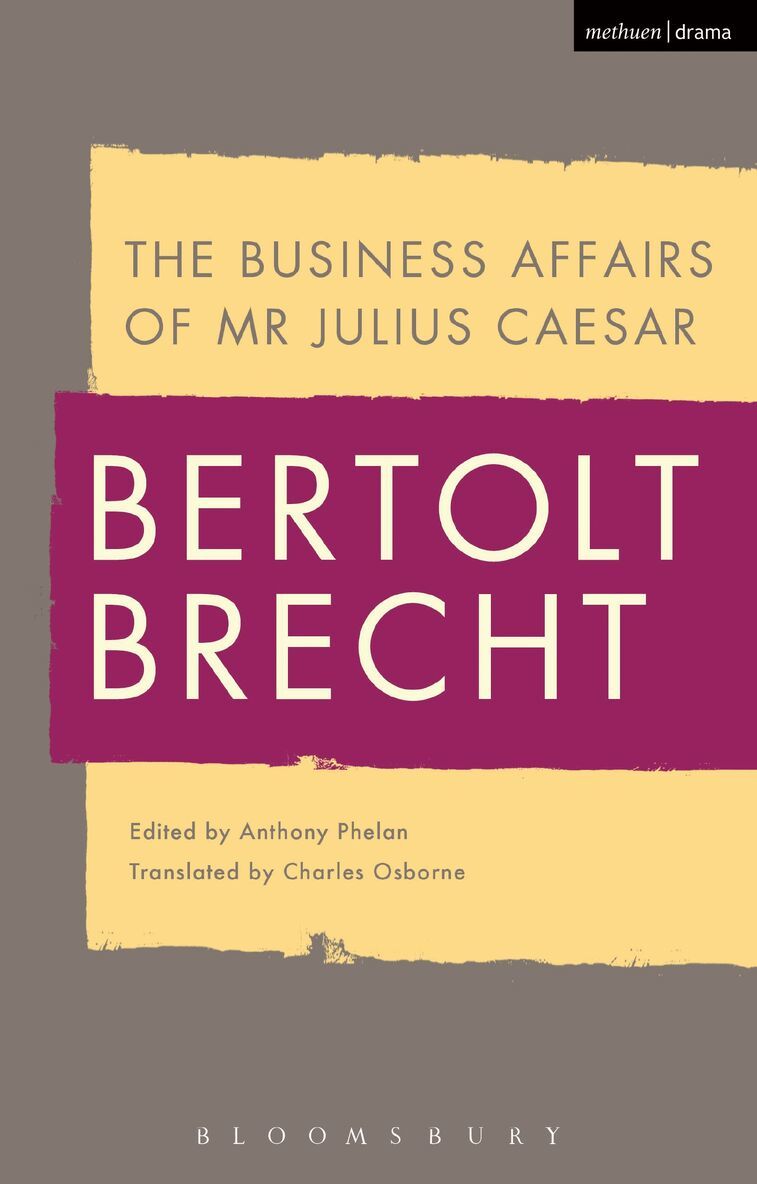
Business Affairs of Mr Julius Caesar
Av Bertolt Brecht, Anthony Phelan m. fl.
Häftad, 2016
413 kr
Lägg i varukorg
Bertolt Brecht’s extraordinary historical novel presents an aspiring scholar's efforts to write an idealized life of Julius Caesar twenty years after his death. But the historian abandons his planned biography, confronted by a baffling range of contradictory views. Was Caesar an opportunist, a …
Business Affairs of Mr Julius Caesar
Av Bertolt Brecht, Anthony Phelan m. fl.
Inbunden, 2016
1386 kr
Lägg i varukorg
Bertolt Brecht’s extraordinary historical novel presents an aspiring scholar's efforts to write an idealized life of Julius Caesar twenty years after his death. But the historian abandons his planned biography, confronted by a baffling range of contradictory views. Was Caesar an opportunist, a …
Business Affairs of Mr Julius Caesar
Av Bertolt Brecht, Anthony Phelan m. fl.
E-bok, 2016
448 kr
Lägg i varukorg
Bertolt Brecht''s extraordinary historical novel presents an aspiring scholar''s efforts to write an idealized life of Julius Caesar twenty years after his death. But the historian abandons his planned biography, confronted by a baffling range of contradictory views. Was Caesar an opportunist, a …
Business Affairs of Mr Julius Caesar
Av Bertolt Brecht, Anthony Phelan m. fl.
E-bok, 2016
448 kr
Lägg i varukorg
Bertolt Brecht''s extraordinary historical novel presents an aspiring scholar''s efforts to write an idealized life of Julius Caesar twenty years after his death. But the historian abandons his planned biography, confronted by a baffling range of contradictory views. Was Caesar an opportunist, a …