Antón Alvar Nuño - Böcker
Visar alla böcker från författaren Antón Alvar Nuño. Handla med fri frakt och snabb leverans.
3 produkter
3 produkter
2 113 kr
Skickas inom 10-15 vardagar
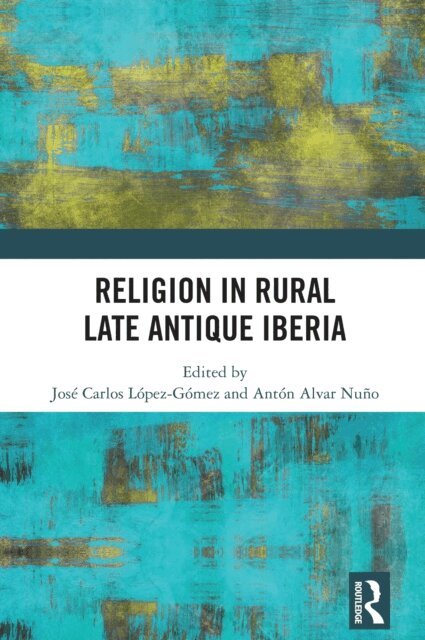
This volume examines the dynamism and complexity of religious expressions in rural settings across Late Antique Iberia.Chapters demonstrate that the rural world was a dynamic space which formed an integral part of the multi-directional process of religious exchange on the Iberian Peninsula in Late Antiquity, thus refuting the idea that rural spaces, and in turn rural religious practices, were static and unchanging, anchored in tradition and resistant to any process of religious change. The chapters present a series of case studies that examine phenomena such as the multi-locality of certain religious groups that moved periodically between the city and the countryside, the strategies that local agents used to shape religious expressions in rural areas (significantly marked by the permeability between the urban and rural worlds), the creation of religious landscapes as spaces imbued with cultural meanings by religious authorities that conceive the rural world as a place of refuge and spiritual experience, or the analysis of trans-local religious networks that connected rural and urban settings, facilitating the transmission of rituals and practices between these two spheres. Finally, both the introduction and the final chapter discuss the concept of “rural religion” and its applicability to the sphere of Late Antiquity.This volume provides a much-needed resource for students and scholars of religion in Late Antique Iberia, and in the post-Roman world more broadly, as well as anyone working on rural religion in the ancient, Late Antique and Medieval worlds.
Calling Upon Gods, Offering Bodies
Strategies of Human-Divine Communication in the Roman Empire from Individual Experience to Social Reproduction
Häftad, Engelska, 2024
896 kr
Skickas inom 5-8 vardagar
This volume aims at analysing how self-experience of religious communication becomes a reflexive phenomenon reproduced in time and space to constitute a collectively shared narrative. The issues addressed in this volume investigate how individual, creative micro-strategies of communication with the gods became established patterns of behaviour, to what extent individual behaviour was mediated by cultural constraints, or why individual biographies of divine experience became exempla and identity markers. The different chapters of this volume explore human-divine communication through three different study-cases: linguistic communication and, specially, the role and processes of construction of divine epithets; the use of the body as a tool for communication with the supernatural; and the role of objects in the human-divine communicative act.
Del 195 - Religions in the Graeco-Roman World
SENSORIVM: The Senses in Roman Polytheism
Inbunden, Engelska, 2021
2 171 kr
Skickas inom 5-8 vardagar
SENSORIVM: The Senses in Roman Polytheism explores how a range of cults and rituals were perceived and experienced by participants through one or more senses.The present collection brings together papers from an international group of researchers all inspired by ‘the sensory turn’. Focusing on a wide range of ritual traditions from around the ancient Roman world, they explore the many ways in which smell and taste, sight and sound, separately and together, involved participants in religious performance. Music, incense, images and colors, contrasts of light and dark played as great a role as belief or observance in generating religious experience.Together they contribute to an original understanding of the Roman sensory universe, and add an embodied perspective to the notion of Lived Ancient Religion.Contributors are Martin Devecka; Visa Helenius; Yulia Ustinova; Attilio Mastrocinque; Maik Patzelt; Mark Bradley; Adeline Grand-Clément; Rocío Gordillo Hervás; Rebeca Rubio; Elena Muñiz Grijalvo; David Espinosa-Espinosa; A. César González-García, Marco V. García-Quintela; Jörg Rüpke; Rosa Sierra del Molino; Israel Campos Méndez; Valentino Gasparini; Nicole Belayche; Antón Alvar Nuño; Jaime Alvar Ezquerra; Clelia Martínez Maza.