Antonio M. López - Böcker
Visar alla böcker från författaren Antonio M. López. Handla med fri frakt och snabb leverans.
2 produkter
2 produkter
969 kr
Skickas inom 7-10 vardagar
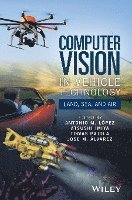
A unified view of the use of computer vision technology for different types of vehiclesComputer Vision in Vehicle Technology focuses on computer vision as on-board technology, bringing together fields of research where computer vision is progressively penetrating: the automotive sector, unmanned aerial and underwater vehicles. It also serves as a reference for researchers of current developments and challenges in areas of the application of computer vision, involving vehicles such as advanced driver assistance (pedestrian detection, lane departure warning, traffic sign recognition), autonomous driving and robot navigation (with visual simultaneous localization and mapping) or unmanned aerial vehicles (obstacle avoidance, landscape classification and mapping, fire risk assessment).The overall role of computer vision for the navigation of different vehicles, as well as technology to address on-board applications, is analysed.Key features: Presents the latest advances in the field of computer vision and vehicle technologies in a highly informative and understandable way, including the basic mathematics for each problem.Provides a comprehensive summary of the state of the art computer vision techniques in vehicles from the navigation and the addressable applications points of view.Offers a detailed description of the open challenges and business opportunities for the immediate future in the field of vision based vehicle technologies.This is essential reading for computer vision researchers, as well as engineers working in vehicle technologies, and students of computer vision.
430 kr
Skickas inom 10-15 vardagar
Pedestrian Protection Systems (PPSs) are on-board systems aimed at detecting and tracking people in the surroundings of a vehicle in order to avoid potentially dangerous situations. These systems, together with other Advanced Driver Assistance Systems (ADAS) such as lane departure warning or adaptive cruise control, are one of the most promising ways to improve traffic safety. By the use of computer vision, cameras working either in the visible or infra-red spectra have been demonstrated as a reliable sensor to perform this task. Nevertheless, the variability of human’s appearance, not only in terms of clothing and sizes but also as a result of their dynamic shape, makes pedestrians one of the most complex classes even for computer vision. Moreover, the unstructured changing and unpredictable environment in which such on-board systems must work makes detection a difficult task to be carried out with the demanded robustness.In this brief, the state of the art in PPSs is introduced through the review of the most relevant papers of the last decade. A common computational architecture is presented as a framework to organize each method according to its main contribution. More than 300 papers are referenced, most of them addressing pedestrian detection and others corresponding to the descriptors (features), pedestrian models, and learning machines used. In addition, an overview of topics such as real-time aspects, systems benchmarking and future challenges of this research area are presented.