A.R. Negandhi - Böcker
Visar alla böcker från författaren A.R. Negandhi. Handla med fri frakt och snabb leverans.
2 produkter
2 produkter
1 096 kr
Skickas inom 10-15 vardagar
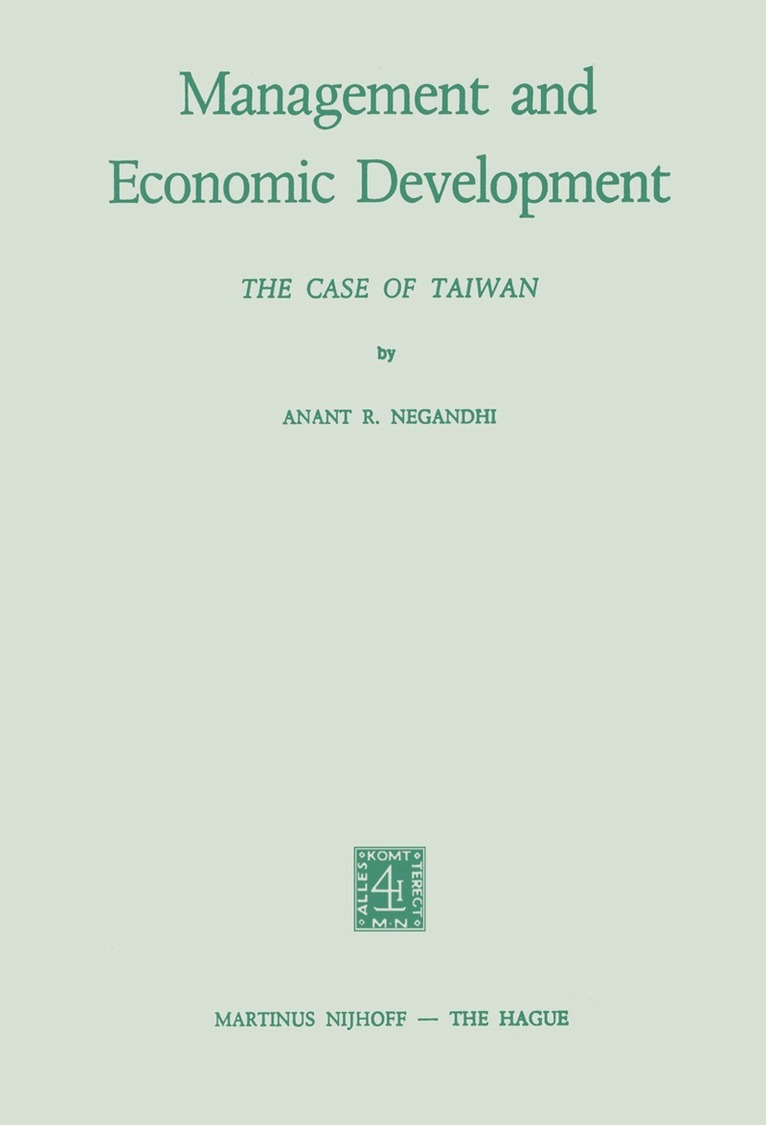
The ping-pong diplomacy and its aftermath discussion, coupled with the entry of communist China into the United Nations and the subsequent expulsion of Taiwan, will generate considerable political dialogue about the changing balance of power and the fate of the other China. These political discussions will obviously overshadow the true role and function of the existence of Taiwan. Given the time, Taiwan could become a model for the development process for other emerging countries. Taiwan's experience with eco nomic development has real relevance for many countries. For exam ple, in less than two decades Taiwan has achieved the industrial and economic growth that should well make it the envy of nearly all other developing nations. Its per capita income is exceeded only by Japan among the countries of the Far East. Yet, despite vigorous economic and industrial growth, obvious breakdowns in this economic progress come into view. The lack of managerial input threatens to become a real bottleneck. The study reported in this volume examines the feasibility and utility of transferring advanced management know-how and practices into the industrial enterprises in Taiwan in order to generate further economic and industrial growth. The study itself concerns management practices and effectiveness of American subsidiaries, Japanese sub sidiaries, and comparable local firms in Taiwan.
Del 11 - Studies of Social Life
Managerialism for Economic Development
Essays on India
Häftad, Engelska, 2012
552 kr
Skickas inom 10-15 vardagar
That a developing economy needs management even more than resources is now becoming abundantly clear to all students of growth. There was perhaps a facile assumption in the earlier years that the rate of growth in a developing country depended in almost direct proportion to two factors: the resources available within the country, the land, water, minerals, savings and other relevant inputs; and the initial importation of aid from without, in terms of capital and skills not available within - but the factor of good management was somehow ignored, as also the attitudes of the people and their leadership to growth. These two factors are now coming into their own as being crucial to development and there is a new appreciation of the need for a good supply of well trained managers and providing them with an environment that is permissive and encouraging. These essays are a timely analysis of this new-felt need, and a valuable source of new leads and hypotheses, for they examine the multi-facets of the problem of India's growth, but with keeping the professional manager squarely in the middle of the study. And after all it is he upon whom the major responsibility for develop ment and growth will depend, given the chance. The contributors to this symposium are seven young Indians, all management educators of distinction at universities in the United States, and one hopes that they will themselves pick up some of the leads and pursue them. P. L.