Arie Arnon – författare
1 060 kr
Skickas inom 7-10 vardagar
603 kr
Skickas inom 7-10 vardagar
1 116 kr
Skickas inom 10-15 vardagar
1 116 kr
Skickas inom 10-15 vardagar
1 459 kr
Läs direkt efter köp
1 850 kr
Skickas inom 5-8 vardagar
1 671 kr
Skickas inom 10-15 vardagar
2 110 kr
Läs direkt efter köp
This book provides a unique historical perspective on expectations in economic theory, and applications of expectations models in economic history. Based on papers presented at the 2017 Thomas Guggenheim Conference, it brings together the work of economists, historians of economics, and economic historians on issues and events concerning expectations in economics and economic history. The contributions address: (i) the history of expectations models; (ii) growth, expectations and political economy; (iii) controversies regarding expectations methods and models; (iv) expectations in theory and reality; and (v) expectations in economic history.
The book opens with a lecture by Thomas Guggenheim Prize winner Duncan Foley on the evolution of expectations in modern economic thought. The remaining content is divided into two parts, the first of which focuses on the utilization of expectations in the “ancient” and “meso” periods of high theory, i.e., from Smithian to Keynesian approaches. The papers cover topics such as “modern” applications of expectations in both “Tobinesque-Phillips” and “Harrodian-Solowian” contexts, and the debate between Friedmanite and Keynesian approaches to expectation formation. In turn, the last part presents essays on the role of economic expectations in connection with historical events and contexts, ranging from the early 20th century to World War II, and on the application of expectations theory to hyperinflation and stabilization, taking Israel as a case study.1 671 kr
Skickas inom 10-15 vardagar
1 893 kr
Skickas inom 10-15 vardagar
2 436 kr
Läs direkt efter köp
This book examines financial markets from a historical perspective. Bringing together contributions from leading historians of economic thought, economists and economic historians, it offers an integrated approach and reflects on the workings of financial markets, their impact on and relation with the rest of the economy and how their role was and is understood by economics. The contributions cover topics such as classical and modern economic thinking on financial markets and institutions, as well as financial models and innovations, and also present case studies on financial history and on policy issues. The historical perspective leads to a representation of markets not as abstract and timeless mechanisms but as institutions populated by a diversity of agents, subject to rules and customs, and influenced by scientific developments and economic theories.
1 893 kr
Skickas inom 10-15 vardagar
732 kr
Skickas inom 5-8 vardagar
1 459 kr
Läs direkt efter köp
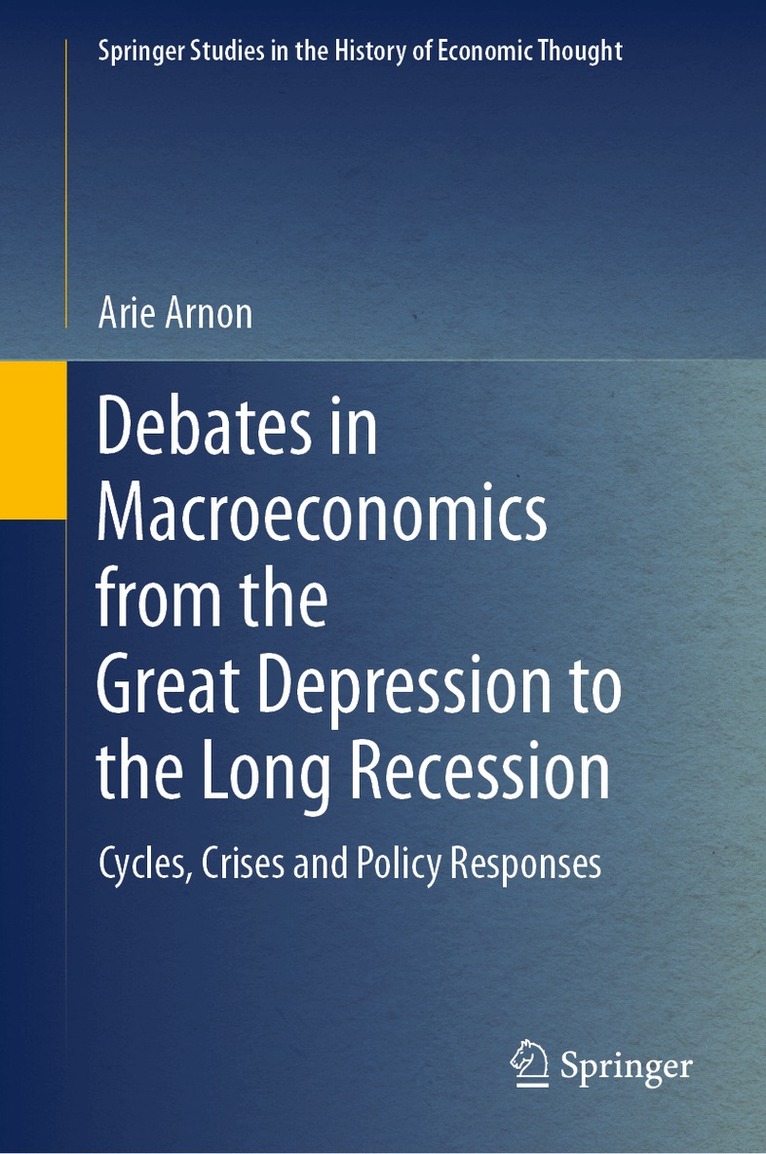
This book assesses major schools of thought in macroeconomic theory between the Great Depression and the Long Recession, focusing on their analysis of cycles, crises and macro-policy. It explores the road from the dominance of Keynesian ideas to those of New Classical Macroeconomics (NCM) toward the end of the millennium.
The book covers the early influential work of Knut Wicksell; the economic debates of the 1930s, with core contributions from John Maynard Keynes and Friedrich von Hayek; the rise of Keynesianism in the 1950s and its decline since the 1970s; the rise of Monetarism in the 1960s; and NCM’s subsequent rise to prominence.
Finally, the book outlines how macroeconomics has evolved from its birth in the 1930s as a theory separate from microeconomics, resulting in a split between macro- and micro-theories, and ended up with a new hegemonic paradigm based on microfoundations. The ensuing policy thinking witnessed a transformation from "active" macro-policy after the Great Depression to a far more "passive" macro-policy during the last quarter of the twentieth century, which may have contributed to missing the signs of the impending Long Recession of 2008.
“When the 2008 crisis struck, macroeconomists were caught with models that were theoretically elegant yet inappropriate to the needs of the moment. A broader historical perspective may have prevented the jettisoning of Keynesian models that had proved useful in the past and might have done so again. This highly readable book by Arie Arnon is a wonderful antidote to economists’ short time horizon and contributes mightily to restore the profession’s “collective memory” of the diversity of ideas within macroeconomics.”
Professor Dani Rodrik, Harvard Kennedy School732 kr
Skickas inom 5-8 vardagar
1 116 kr
Skickas inom 10-15 vardagar
1 459 kr
Läs direkt efter köp
1 116 kr
Skickas inom 10-15 vardagar