Armen H. Zemanian - Böcker
Visar alla böcker från författaren Armen H. Zemanian. Handla med fri frakt och snabb leverans.
7 produkter
7 produkter
613 kr
Skickas inom 7-10 vardagar
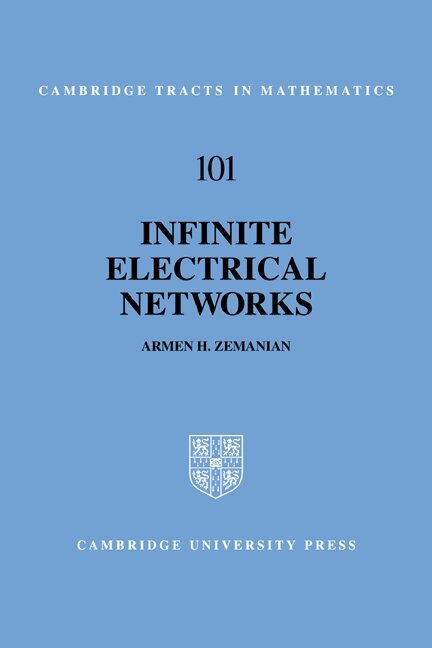
This book presents the salient features of the general theory of infinite electrical networks in a coherent exposition. Using the basic tools of functional analysis and graph theory, the author examines the fundamental developments in the field and discusses applications to other areas of mathematics. The first half of the book presents existence and uniqueness theorems for both infinite-power and finite-power voltage-current regimes, and the second half discusses methods for solving problems in infinite cascades and grids. A notable feature is the invention of transfinite networks, roughly analogous to Cantor's extension of the natural numbers to the transfinite ordinals. The last chapter is a survey of application to exterior problems of partial differential equations, random walks on infinite graphs, and networks of operators on Hilbert spaces.
1 469 kr
Skickas inom 7-10 vardagar
This book presents the salient features of the general theory of infinite electrical networks in a coherent exposition. Using the basic tools of functional analysis and graph theory, the author examines the fundamental developments in the field and discusses applications to other areas of mathematics. The first half of the book presents existence and uniqueness theorems for both infinite-power and finite-power voltage-current regimes, and the second half discusses methods for solving problems in infinite cascades and grids. A notable feature is the invention of transfinite networks, roughly analogous to Cantor's extension of the natural numbers to the transfinite ordinals. The last chapter is a survey of application to exterior problems of partial differential equations, random walks on infinite graphs, and networks of operators on Hilbert spaces.
536 kr
Skickas inom 10-15 vardagar
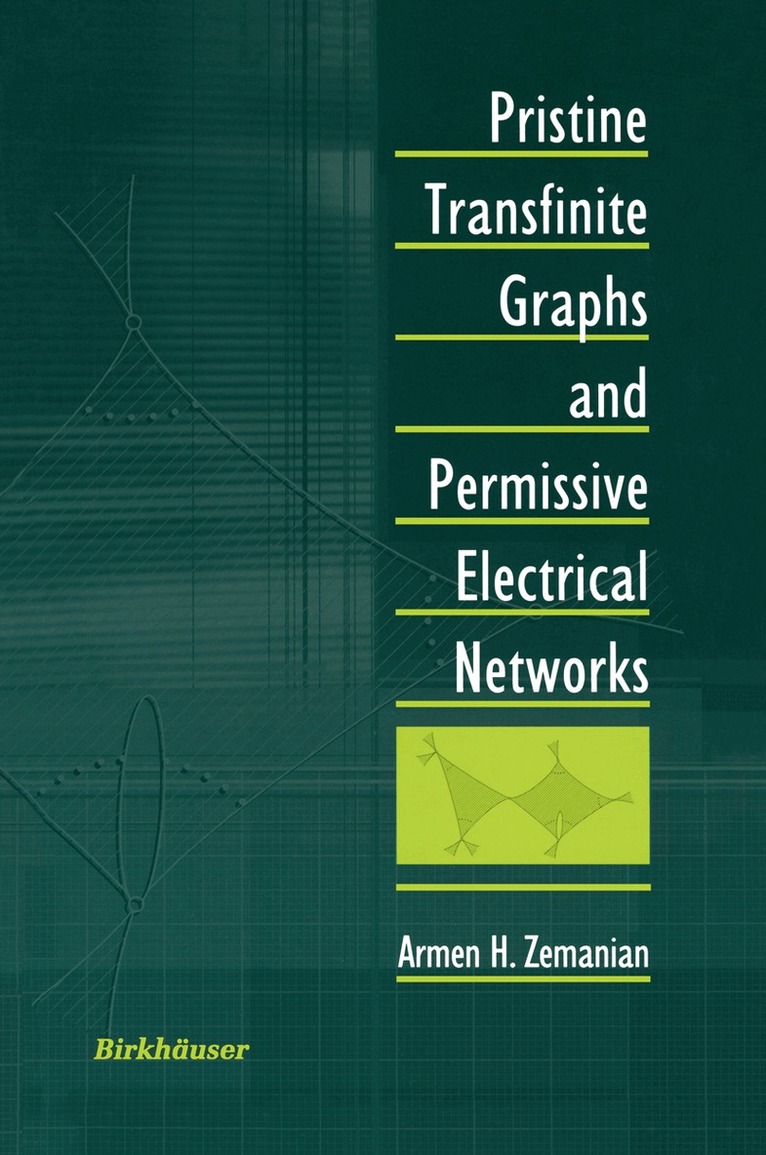
"What good is a newborn baby?" Michael Faraday's reputed response when asked, "What good is magnetic induction?" But, it must be admitted that a newborn baby may die in infancy. What about this one- the idea of transfiniteness for graphs, electrical networks, and random walks? At least its bloodline is robust. Those subjects, along with Cantor's transfinite numbers, comprise its ancestry. There seems to be general agreement that the theory of graphs was born when Leonhard Euler published his solution to the "Konigsberg bridge prob lem" in 1736 [8]. Similarly, the year of birth for electrical network theory might well be taken to be 184 7, when Gustav Kirchhoff published his volt age and current laws [ 14]. Ever since those dates until just a few years ago, all infinite undirected graphs and networks had an inviolate property: Two branches either were connected through a finite path or were not connected at all. The idea of two branches being connected only through transfinite paths,that is, only through paths having infinitely many branches was never invoked, or so it appears from a perusal of various surveys of infinite graphs [17], [20], [29], [32]. Our objective herein is to explore this idea and some of its ramifications. It should be noted however that directed graphs having transfinite paths have appeared in set theory [6, Section 4.
536 kr
Skickas inom 10-15 vardagar
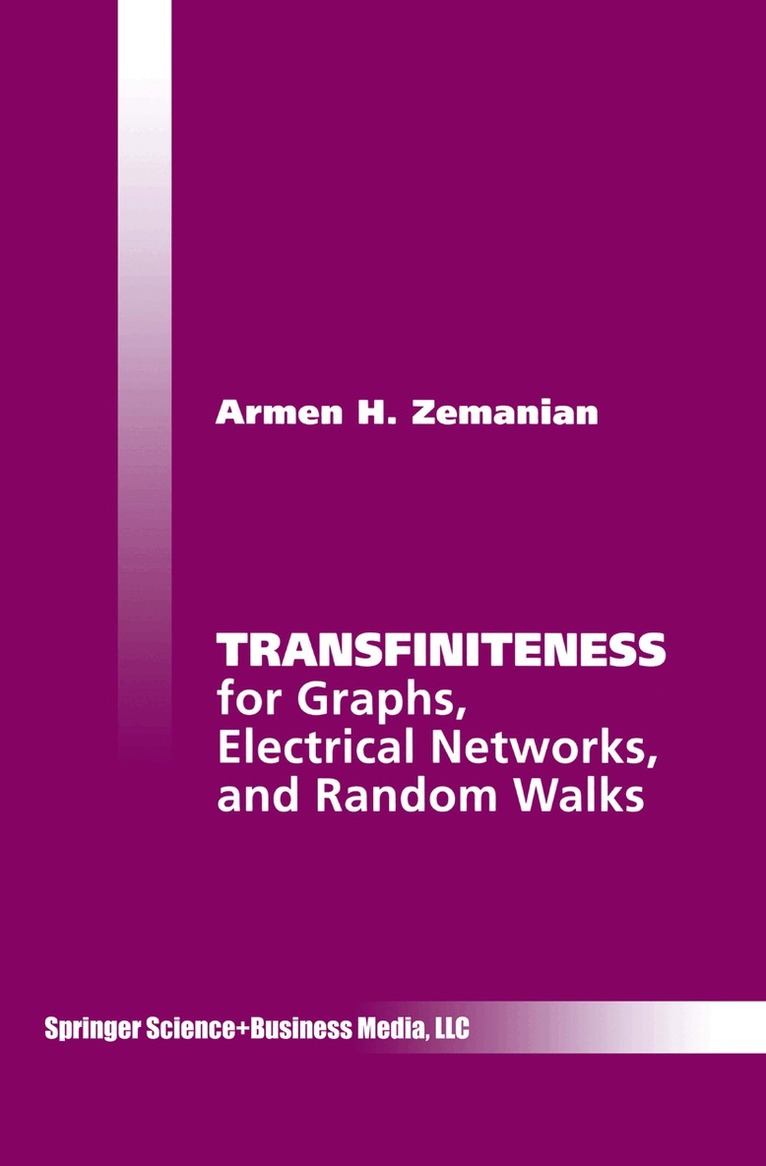
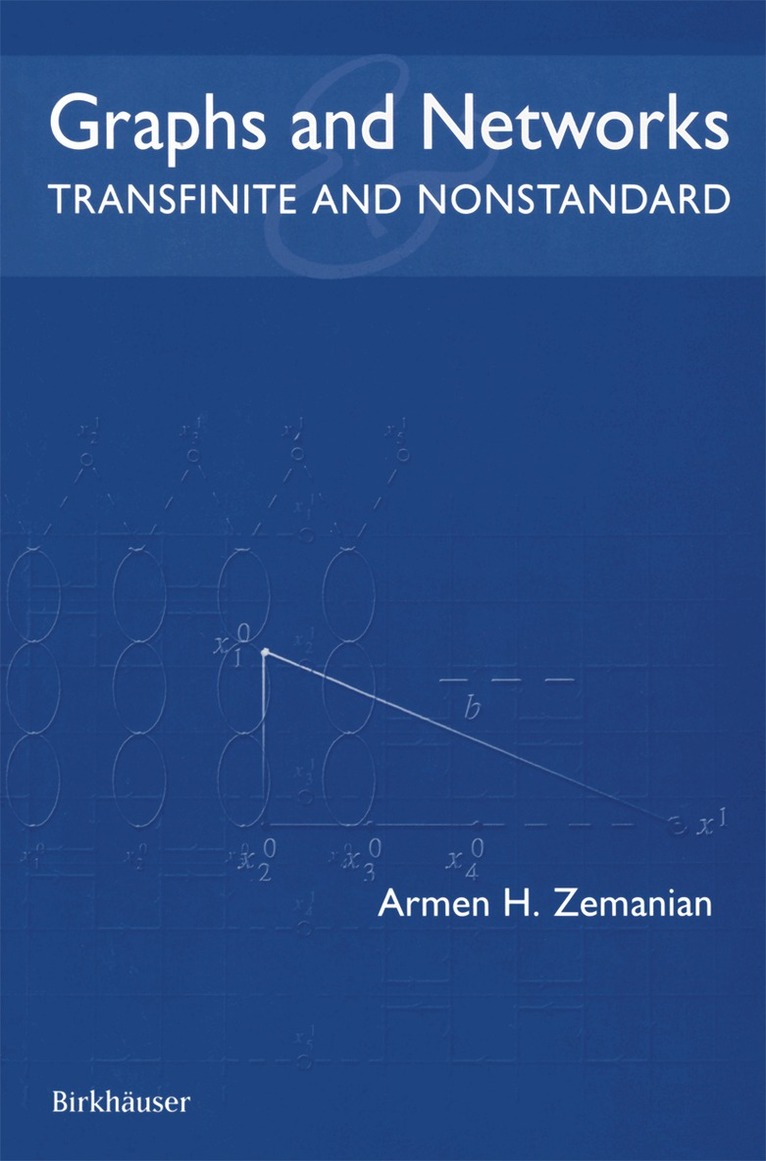
A transfinite graph or electrical network of the first rank is obtained conceptually by connecting conventionally infinite graphs and networks together at their infinite extremities. This process can be repeated to obtain a hierarchy of transfiniteness whose ranks increase through the countable ordinals. This idea, which is of recent origin, has enriched the theories of graphs and networks with radically new constructs and research problems. The book provides a more accessible introduction to the subject that, though sacrificing some generality, captures the essential ideas of transfiniteness for graphs and networks. Thus, for example, some results concerning discrete potentials and random walks on transfinite networks can now be presented more concisely. Conversely, the simplifications enable the development of many new results that were previously unavailable. Topics and features: *A simplified exposition provides an introduction to transfiniteness for graphs and networks.*Various results for conventional graphs are extended transfinitely. *Minty's powerful analysis of monotone electrical networks is also extended transfinitely.*Maximum principles for node voltages in linear transfinite networks are established. *A concise treatment of random walks on transfinite networks is developed. *Conventional theory is expanded with radically new constructs. Mathematicians, operations researchers and electrical engineers, in particular, graph theorists, electrical circuit theorists, and probabalists will find an accessible exposition of an advanced subject.
536 kr
Skickas inom 10-15 vardagar
This book examines results on transfinite graphs and networks achieved through research over the past several years. These new results, covering the mathematical theory of electrical circuits, are different from those presented in two previously published books by the author, "Transfiniteness for Graphs, Electrical Networks, and Random Walks" and "Pristine Transfinite Graphs and Permissive Electrical Networks".Two initial chapters present preliminary theory summarizing all essential ideas needed, relieving the reader of any need to consult those prior books. Subsequent chapters are devoted entirely to novel results and cover: - Connectedness ideas and their relationship to hypergraphs - Distance ideas and their extension to transfinite graphs with more complications, such as the replacement of natural-number distances by ordinal-number distances - Nontransitivity of path-based connectedness alleviated by replacing paths with walks, leading to a more powerful theory for transfinite graphs and networks
536 kr
Skickas inom 10-15 vardagar
A transfinite graph or electrical network of the first rank is obtained conceptually by connecting conventionally infinite graphs and networks together at their infinite extremities. This process can be repeated to obtain a hierarchy of transfiniteness whose ranks increase through the countable ordinals. This idea, which is of recent origin, has enriched the theories of graphs and networks with radically new constructs and research problems. The book provides a more accessible introduction to the subject that, though sacrificing some generality, captures the essential ideas of transfiniteness for graphs and networks. Thus, for example, some results concerning discrete potentials and random walks on transfinite networks can now be presented more concisely. Conversely, the simplifications enable the development of many new results that were previously unavailable. Topics and features: *A simplified exposition provides an introduction to transfiniteness for graphs and networks.*Various results for conventional graphs are extended transfinitely. *Minty's powerful analysis of monotone electrical networks is also extended transfinitely.*Maximum principles for node voltages in linear transfinite networks are established. *A concise treatment of random walks on transfinite networks is developed. *Conventional theory is expanded with radically new constructs. Mathematicians, operations researchers and electrical engineers, in particular, graph theorists, electrical circuit theorists, and probabalists will find an accessible exposition of an advanced subject.
536 kr
Skickas inom 10-15 vardagar
"What good is a newborn baby?" Michael Faraday's reputed response when asked, "What good is magnetic induction?" But, it must be admitted that a newborn baby may die in infancy. What about this one- the idea of transfiniteness for graphs, electrical networks, and random walks? At least its bloodline is robust. Those subjects, along with Cantor's transfinite numbers, comprise its ancestry. There seems to be general agreement that the theory of graphs was born when Leonhard Euler published his solution to the "Konigsberg bridge prob lem" in 1736 [8]. Similarly, the year of birth for electrical network theory might well be taken to be 184 7, when Gustav Kirchhoff published his volt age and current laws [ 14]. Ever since those dates until just a few years ago, all infinite undirected graphs and networks had an inviolate property: Two branches either were connected through a finite path or were not connected at all. The idea of two branches being connected only through transfinite paths,that is, only through paths having infinitely many branches was never invoked, or so it appears from a perusal of various surveys of infinite graphs [17], [20], [29], [32]. Our objective herein is to explore this idea and some of its ramifications. It should be noted however that directed graphs having transfinite paths have appeared in set theory [6, Section 4.