Arne Kalland - Böcker
Visar alla böcker från författaren Arne Kalland. Handla med fri frakt och snabb leverans.
11 produkter
11 produkter
2 222 kr
Skickas inom 10-15 vardagar
From being an important centre which attracted a large number of merchants during the feudal period, Shingū, on the northern shores of Kyushu is today a suburb of Fukuoka City. Fishing is a slowly-dying occupation and this volume analyses how the fishermen adjust to changing circumstances. Although Japan is the largest fishing nation in the world, when originally published this book was the first to be published in English which focussed on the composition and role performance of the crews and larger net-groups. This analysis has been set in an historical perspective, showing how the vertical structures during the Tokugawa period have changed to more egalitarian structures where much energy is spent to hinder the development of any new hierarchy.
2 155 kr
Skickas inom 10-15 vardagar
This book gives a social anthropological account of whaling culture in Japan. When originally published this was the first comprehensive account in English of the history of Japanese whaling, showing how it has given rise to a particular culture. The volume discusses what happens when that culture is threatened. At the same time as explaining the work organization of those involved in whaling, the role of whaling companies in local and national economies, and the role of the whale in the establishment and maintenance of local community identity (ritual, food, gift-giving), the authors address the wider political and so-called "environmental" issues surrounding whaling in general, and Japanese whaling in particular.
725 kr
Skickas inom 10-15 vardagar
This book gives a social anthropological account of whaling culture in Japan. When originally published this was the first comprehensive account in English of the history of Japanese whaling, showing how it has given rise to a particular culture. The volume discusses what happens when that culture is threatened. At the same time as explaining the work organization of those involved in whaling, the role of whaling companies in local and national economies, and the role of the whale in the establishment and maintenance of local community identity (ritual, food, gift-giving), the authors address the wider political and so-called "environmental" issues surrounding whaling in general, and Japanese whaling in particular.
671 kr
Skickas inom 10-15 vardagar
From being an important centre which attracted a large number of merchants during the feudal period, Shingū, on the northern shores of Kyushu is today a suburb of Fukuoka City. Fishing is a slowly-dying occupation and this volume analyses how the fishermen adjust to changing circumstances. Although Japan is the largest fishing nation in the world, when originally published this book was the first to be published in English which focussed on the composition and role performance of the crews and larger net-groups. This analysis has been set in an historical perspective, showing how the vertical structures during the Tokugawa period have changed to more egalitarian structures where much energy is spent to hinder the development of any new hierarchy.
752 kr
Skickas inom 10-15 vardagar
This highly acclaimed, 'bold and refreshing' collection of essays takes a critical look at Asians' perception of their natural environments as well as at Western views of Asia in this respect.
2 088 kr
Skickas inom 7-10 vardagar
This highly acclaimed, 'bold and refreshing' collection of essays takes a critical look at Asians' perception of their natural environments as well as at Western views of Asia in this respect.
1 078 kr
Skickas inom 10-15 vardagar
It is often claimed that the Japanese have a particular love for nature, a love often reflected in their art and material culture. But today equal notice is being given to the environmental degradation caused by the Japanese at home as well as abroad. How can these phenomena be reconciled? This issue is but one of several raised that this volume seeks to address in its examination of the human-nature relationship in Japan. Through topics ranging from medieval literature and fine arts through to modern vending machines and tourism, the authors document the great diversity in how people perceive their natural environment and how they come to terms with nature, be it through brute force, rituals or idealization. The main message of the book is that 'nature' and the 'natural' are concepts very much conditioned by their context, an approach quite different from the uncompromising stance so often found in the West.
820 kr
Skickas inom 10-15 vardagar
This volume paints a general picture of the environmental situation in Asia, backing it up with several case studies.Two major points are made in this general picture. The first is that environmental campaigns in Asia tend to have a local focus; they react to very concrete problems in the immediate neighbourhood and as such usually people are engaged in a cause for practical rather than idealistic reasons. Such can be seen in case studies from the volume dealing with campaigns against logging and tree plantations, tourist facilities and factories and in support or defence of nature reserves. This pattern is in marked contrast to the profile of the most successful Western movements (in terms of fund-raising at least) for whom the focus is on perceived problems in distant parts of the world.The second point is evidence in several of the case studies in the volume, namely that environmental campaigns cannot be understood in terms of environmental issues alone. Rather, they should be regarded as a form of cultural critique and frequently are a form of political resistance in situations where open political action is too risky.
Del 12 - Environmental Anthropology and Ethnobiology
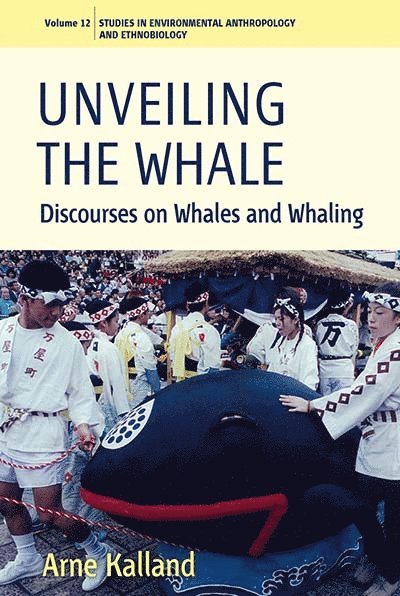
Unveiling the Whale
Discourses on Whales and Whaling
Häftad, Engelska, 2011
566 kr
Skickas inom 3-6 vardagar
Kalland's direct approach is to be commended as well as the accessibility of the book (blessedly free of jargonized language), and for creating new avenues for further research into the attribution of values and anti-values to highly contentious environmental discourses. Durham Anthropology Journal Kalland's deconstruction of the 'Superwhale' as an environmentalist symbol and magnet for New Age belief systems is a very accessible and engaging example of discourse analysis. Many readers will find it a bit unsettling to recognize their own unexamined pro-whale, anti-whaling sentiments as elements of a hegemonic discourse centered on a figment of shared imagination--a body of values, sentiments, and emotive symbols--rather than a flesh and blood animal. Choice ...a unique work. Surprisingly, perhaps, given the prominence of its subject, there is nothing comparable in the literature. It draws on the author's decades-long devotion to the topic. As a result, it is rich in its command of the academic, policy, and popular literatures on the subject. It is, simply put, authoritative. It is also convincing.Michael Dove, Yale University a thorough and very interesting analysis of the whaling controversy. Kay Milton, Queen's University Belfast Whaling has become one of the most controversial environmental issues. It is not that all whale species are at the brink of extinction, but that whales have become important symbols to both pro- and anti-whaling factions and can easily be appropriated as the common heritage of humankind. This book, the first of its kind, is therefore not about whales and whaling per se but about how people communicate about whales and whaling. It contributes to a better understanding and discussion of controversial environmental issues: Why and how are issues selected? How is knowledge on these issues produced and distributed by organizations and activists? And why do affluent countries like Japan and Norway still support whaling, which is of insignificant economic importance? Basing his analysis on fieldwork in Japan and Norway and at the International Whaling Commission, the author argues how an image of a "superwhale" has been constructed and how this image has replaced meat and oil as the important whale commodity.He concludes that the whaling issue provides an arena where NGOs and authorities on each side can unite, swapping political legitimacy and building personal relations that can be useful on issues where relations are less harmonious. Arne Kalland is Professor of Social Anthropology at the University of Oslo. He has written extensively on marine resource management and people's perceptions of nature. Recently he has addressed the relationship between religion and ecology. He has edited several books on human-nature relations and done fieldwork in Japan, Norway and Thailand.
2 772 kr
Skickas inom 10-15 vardagar
This volume paints a general picture of the environmental situation in Asia, backing it up with several case studies.Two major points are made in this general picture. The first is that environmental campaigns in Asia tend to have a local focus; they react to very concrete problems in the immediate neighbourhood and as such usually people are engaged in a cause for practical rather than idealistic reasons. Such can be seen in case studies from the volume dealing with campaigns against logging and tree plantations, tourist facilities and factories and in support or defence of nature reserves. This pattern is in marked contrast to the profile of the most successful Western movements (in terms of fund-raising at least) for whom the focus is on perceived problems in distant parts of the world.The second point is evidence in several of the case studies in the volume, namely that environmental campaigns cannot be understood in terms of environmental issues alone. Rather, they should be regarded as a form of cultural critique and frequently are a form of political resistance in situations where open political action is too risky.
1 956 kr
Skickas inom 3-6 vardagar
Whaling has become one of the most controversial environmental issues. It is not that all whale species are at the brink of extinction, but that whales have become important symbols to both pro- and anti-whaling factions and can easily be appropriated as the common heritage of humankind. This book, the first of its kind, is therefore not about whales and whaling per se but about how people communicate about whales and whaling. It contributes to a better understanding and discussion of controversial environmental issues: Why and how are issues selected? How is knowledge on these issues produced and distributed by organizations and activists? And why do affluent countries like Japan and Norway still support whaling, which is of insignificant economic importance? Basing his analysis on fieldwork in Japan and Norway and at the International Whaling Commission, the author argues how an image of a “superwhale” has been constructed and how this image has replaced meat and oil as the important whale commodity. He concludes that the whaling issue provides an arena where NGOs and authorities on each side can unite, swapping political legitimacy and building personal relations that can be useful on issues where relations are less harmonious.