Arne T. Skjeltorp - Böcker
Visar alla böcker från författaren Arne T. Skjeltorp. Handla med fri frakt och snabb leverans.
5 produkter
5 produkter
1 578 kr
Skickas inom 10-15 vardagar
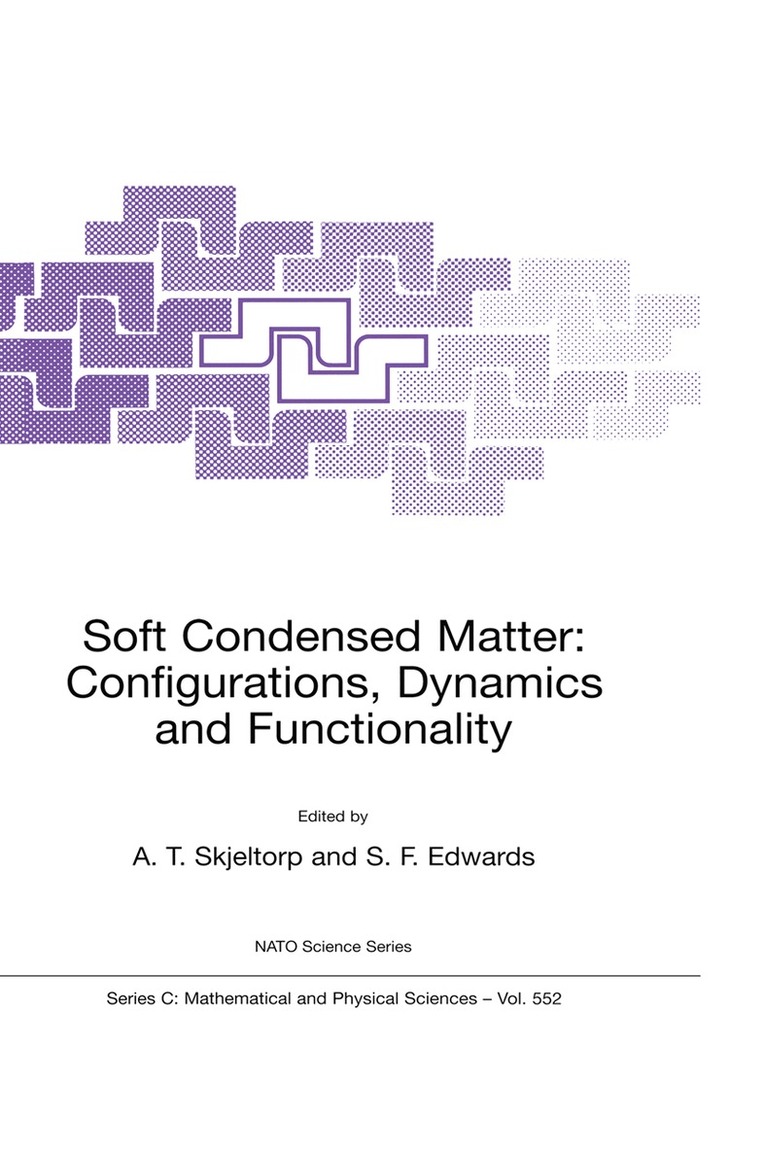
The term "soft condensed matter" encompasses a wide range of substances which are neither ordinary solids nor ordinary liquids. They do have vestigial liquid and solid properties, but their character is much more complex and subtle. Systems range from foams and complex fluids to granular materials and biomaterials (proteins, DNA, membranes). The structural states they adopt are driven by subtle competition between intermolecular interaction energies and entropic forces, both of which are often close to thermal energies at room temperature. Configurations and their dynamic evolution are significant determinants of a wide variety of mesoscopic and microscopic properties. The book reviews both the language needed to discuss such systems, as well as basic questions about such phenomena as competing ground states, nonlinear feedback, and slow dynamics. The approach is pedagogical and tutorial. The level is appropriate to graduate researchers, either moving into the field or already active in it.
1 064 kr
Skickas inom 10-15 vardagar
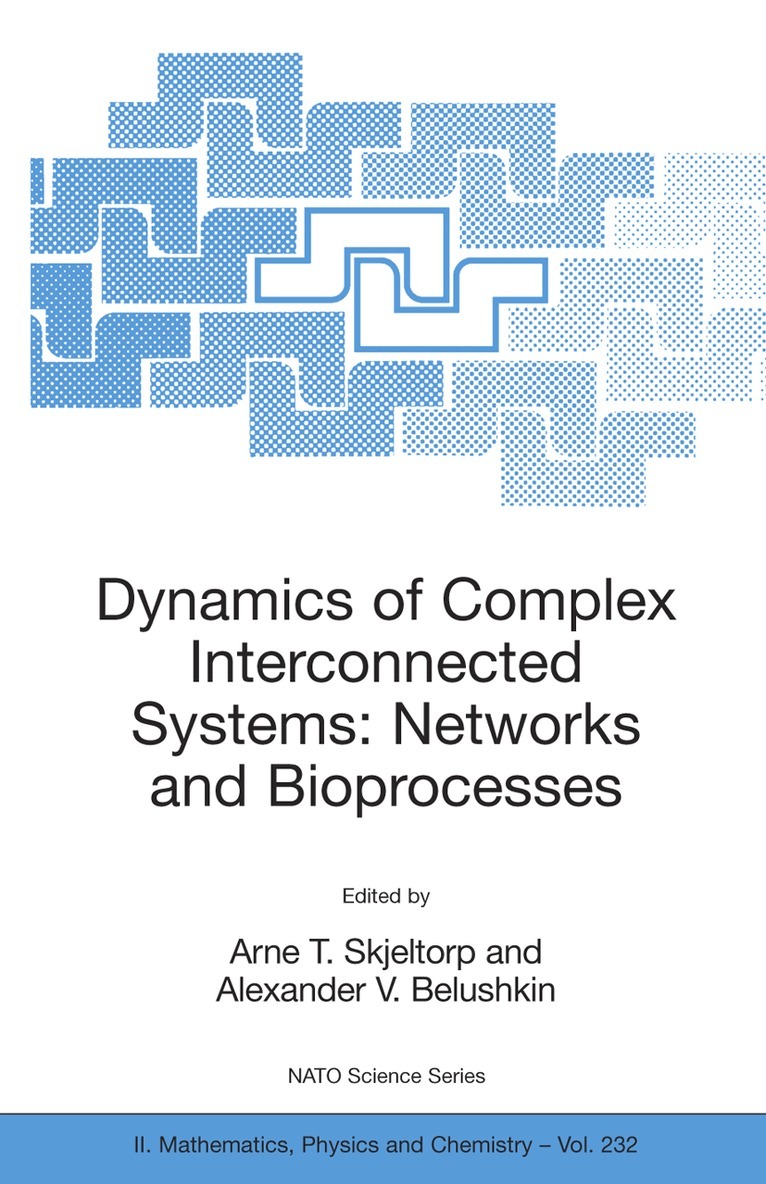
This volume comprises the proceedings of a NATO Advanced Study Institute (ASI) held at Geilo, Norway, 11-21 April 2005, the eighteenth ASI in a series held every two years since 1971. The objective of this ASI was to identify and discuss areas where synergism between modern physics and biology may be most fruitfully applied to the study of bioprocesses for molecular recognition, and of networks for converting molecular reactions into usable signals and appropriate responses. Many fields of research are confronted with networks. Genetic and metabolic networks describe how proteins, substrates and genes interact in a cell; social networks quantify the interactions between people in the society; the Internet is a complex web of computers; ecological systems are best described as a web of species. In many cases, the interacting networks manifest so-called emergent properties that are not possessed by any of the individual components. This means that the detailed knowledge of the components is insufficient to describe the whole system. Recent work has indicated that networks in nature have so-called scale-free characteristics, and the associated dynamic network modelling shows unexpected results such as an amazing robustness against accidental failures, a property that is rooted in their inhomogeneous topology. Understanding these phenomena and turning them to use in chemical and biological threat detection and response will require exploring a wide range of network structures as well.
1 049 kr
Skickas inom 10-15 vardagar
This volume comprises the proceedings of a NATO Advanced Study Institute (ASI) held at Geilo, Norway, 11-21 April 2005, the eighteenth ASI in a series held every two years since 1971. The objective of this ASI was to identify and discuss areas where synergism between modern physics and biology may be most fruitfully applied to the study of bioprocesses for molecular recognition, and of networks for converting molecular reactions into usable signals and appropriate responses. Many fields of research are confronted with networks. Genetic and metabolic networks describe how proteins, substrates and genes interact in a cell; social networks quantify the interactions between people in the society; the Internet is a complex web of computers; ecological systems are best described as a web of species. In many cases, the interacting networks manifest so-called emergent properties that are not possessed by any of the individual components. This means that the detailed knowledge of the components is insufficient to describe the whole system. Recent work has indicated that networks in nature have so-called scale-free characteristics, and the associated dynamic network modelling shows unexpected results such as an amazing robustness against accidental failures, a property that is rooted in their inhomogeneous topology. Understanding these phenomena and turning them to use in chemical and biological threat detection and response will require exploring a wide range of network structures as well.
1 578 kr
Skickas inom 10-15 vardagar
Evolution is a critical challenge for many areas of science, technology and development of society. The book reviews general evolutionary facts such as origin of life and evolution of the genome and clues to evolution through simple systems. Emerging areas of science such as "systems biology" and "bio-complexity" are founded on the idea that phenomena need to be understood in the context of highly interactive processes operating at different levels and on different scales. This is where physics meets complexity in nature, and where we must begin to learn about complexity if we are to understand it. Similarly, there is an increasingly urgent need to understand and predict the evolutionary behavior of highly interacting man-made systems, in areas such as communications and transport, which permeate the modern world. The same applies to the evolution of human networks such as social, political and financial systems, where technology has tended to vastly increase both the complexity and speed of interaction, which is sometimes effectively instantaneous. The book contains reviews on such diverse areas as evolution experiments with microorganisms, the origin and evolution of viruses, evolutionary dynamics of genes and environment in cancer development, aging as an evolution-facilitating program, evolution of vision and evolution of financial markets.
1 578 kr
Skickas inom 10-15 vardagar
Evolution is a critical challenge for many areas of science, technology and development of society. The book reviews general evolutionary facts such as origin of life and evolution of the genome and clues to evolution through simple systems. Emerging areas of science such as "systems biology" and "bio-complexity" are founded on the idea that phenomena need to be understood in the context of highly interactive processes operating at different levels and on different scales. This is where physics meets complexity in nature, and where we must begin to learn about complexity if we are to understand it. Similarly, there is an increasingly urgent need to understand and predict the evolutionary behavior of highly interacting man-made systems, in areas such as communications and transport, which permeate the modern world. The same applies to the evolution of human networks such as social, political and financial systems, where technology has tended to vastly increase both the complexity and speed of interaction, which is sometimes effectively instantaneous. The book contains reviews on such diverse areas as evolution experiments with microorganisms, the origin and evolution of viruses, evolutionary dynamics of genes and environment in cancer development, aging as an evolution-facilitating program, evolution of vision and evolution of financial markets.