Arthur S. Miller - Böcker
Visar alla böcker från författaren Arthur S. Miller. Handla med fri frakt och snabb leverans.
5 produkter
5 produkter
928 kr
Skickas inom 10-15 vardagar
Miller examines the evolution of the system in response to climactic social and economic changes and questions how the American political system will adapt to the crisis-filled world of the late twentieth century.
928 kr
Skickas inom 10-15 vardagar
This collection of nine essays selected from the nonjudical writings of Judge J. Skelly Wright deals with many of the important legal-policy questions of his career. Emphasizing his long-held belief that the disadvantaged should receive special protection, he details some of the ways in which the courts have failed to meet the needs of the underprivileged. He expands his views on judical activism, the uses and abuses of money in America's political process, and other of his abiding concerns. Each essay is preceded by an introductory statement discussing the content of the article.
928 kr
Skickas inom 10-15 vardagar
This book presents a rounded critique of the conventional wisdom about the legality of nuclear weapons by experts in international and constitutional law. Part I addresses the status of nuclear weapons under international law. Scholars on one side of the question draw upon treaties and international custom to argue that most uses of nuclear weapons are illegal and that even mere possession of such weaponry is legally unjustifiable. Others argue that law cannot be imposed on the nuclear weapons states without their consent and that nuclear weapons provide deterrence that binds the superpowers in a peaceful balance of power. Part I concludes with a comprehensive bibliography on nuclear weapons and international law. Part II, the section that focuses on nuclear weapons and American constitutional law, offers widely divergent approaches and conclusions. Although there is no explicit prohibition of such weapons in the United States Constitution, several contributors suggest that the advent of nuclear weapons has so changed the milieu in which constitutional institutions operate that many accepted conclusions must be reexamined. Part III explores the effects of nuclear weapons on the environment and the medical consequences of nuclear war.
809 kr
Skickas inom 10-15 vardagar
The principle revealed in Death by Installments is that the Eighth Amendment's prohibition against cruel and unusual punishment does not guarantee protection to black men who kill whites. Reading the carefully researched and well-told story of Willie Francis offers a four-decade-old view of both the society's commitment to this principle, and the Supreme Court's unwillingness then and now to challenge it. Derrick Bell, Harvard Law School ...not just a `good' but a splendidly written, expertly researched, grippingly told, and passionately presented tome that can proudly take its place alongside Anthony Lewis' Gideon's Trumpet. Henry J. Abraham, University of VirginiaThe case of Willie Francis has been scrutinized and reexamined over the past several decades, and it is still not clear whether he was guilty of the crime for which he was executed in Louisiana forty years ago. Miller and Bowman's book recounts the ordeal of this teenaged black youth who was sent a second time to the electric chair a year after repeated attempts to supply enough current to kill him failed. His tragic story raises disturbing questions not only about capital punishment itself but about the humanity of our methods of carrying out executions and our capacity as a nation to uphold fundamental rights guaranteed by our Constitution.Miller and Bowman describe Francis' experiences from the time of his arrest, and they review the legal struggles within the Supreme Court that followed the botched execution attempt. In considering Eighth Amendment provisions against cruel and unusual punishment, the Court held that Willie Francis' previous subjection to electrical current did not make his subsequent electrocution any more cruel in the constitutional sense than any other electrocution. The authors examine the far-reaching implications of this stand in light of the many similar--but unpublicized--incidents of prolonged, agonizing executions by electrocution, gas, and even lethal injection. They contend that the Court has never faced the issue squarely and that its failure to set limits on the inflicting of pain in the Willie Francis case renders the Eighth Amendment guarantee meaningless.
387 kr
Skickas inom 10-15 vardagar
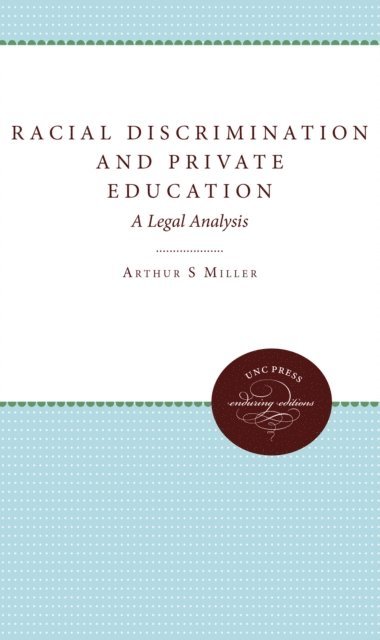
Miller discusses the possible governmental sanctions against integration and the possible ways in which the guarantees of the First and Fourteenth Amendments might be sought and obtained for private schools. He also analyzes the possible effects of discriminatory administrative enforcement of laws as a weapon against integration and the use of and protection against extra-legal sanctions.A UNC Press Enduring Edition -- UNC Press Enduring Editions use the latest in digital technology to make available again books from our distinguished backlist that were previously out of print. These editions are published unaltered from the original, and are presented in affordable paperback formats, bringing readers both historical and cultural value.