Ashild Kolas - Böcker
Visar alla böcker från författaren Ashild Kolas. Handla med fri frakt och snabb leverans.
6 produkter
6 produkter
567 kr
Skickas inom 3-6 vardagar
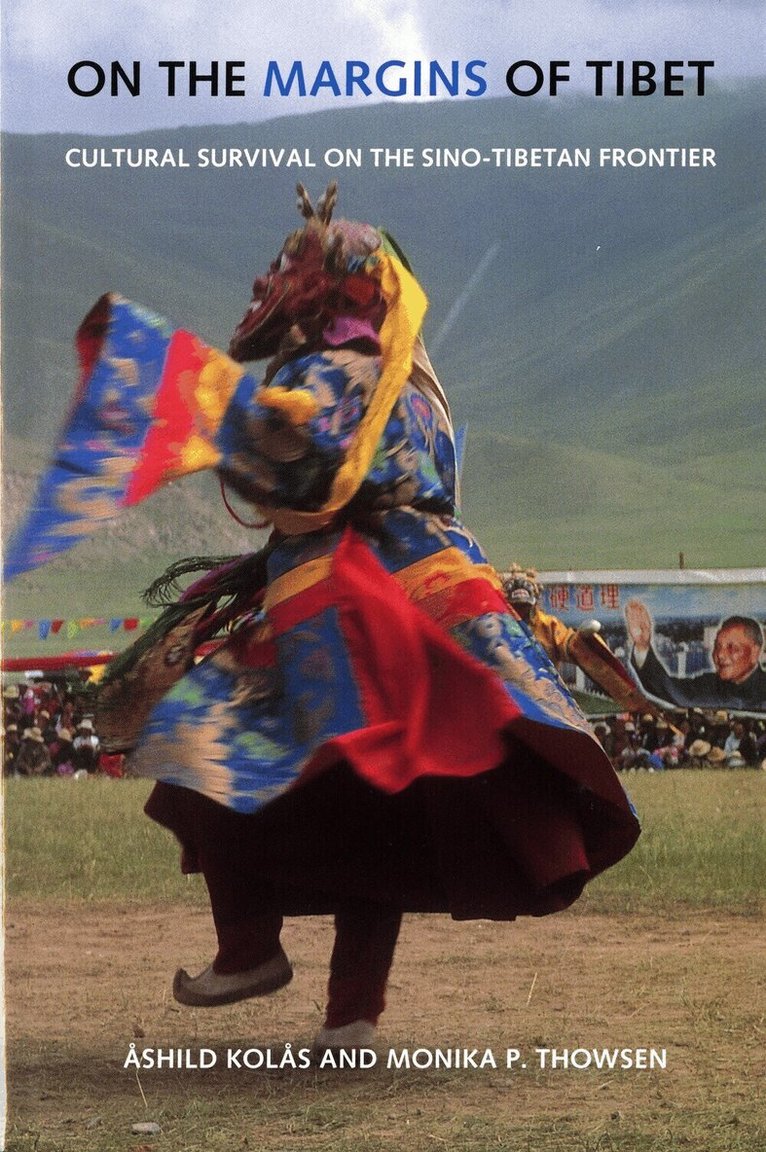
Open-access edition: DOI 10.6069/9780295804101The state of Tibetan culture within contemporary China is a highly politicized topic on which reliable information is rare. But what is Tibetan culture and how should it be developed or preserved? The Chinese authorities and the Tibetans in exile present conflicting views on almost every aspect of Tibetan cultural life.Ashild Kolas and Monika Thowsen have gathered an astounding array of data to quantify Tibetan cultural activities--involving Tibetan language, literature, visual arts, museums, performing arts, festivals, and religion. Their study is based on fieldwork and interviews conducted in the ethnic Tibetan areas surrounding the Tibetan Autonomous Region--parts of the Chinese provinces of Sichuan, Gansu, Yunnan, and Qinghai. Aware of the ambiguous nature of information collected in restricted circumstances, they make every effort to present a complete and unbiased picture of Tibetan communities living on China's western frontiers.Kolas and Thowsen investigate the present conditions of Tibetan cultural life and cultural expression, providing a wealth of detailed information on topics such as the number of restored monasteries and nunneries and the number of monks, nuns, and tulkus (reincarnated lamas) affiliated with them; sources of funding for monastic reconstruction and financial support of clerics; types of religious ceremonies being practiced; the content of monastic and secular education; school attendance; educational curriculum and funding; the role of language in Tibetan schools; and Tibetan news and cultural media.On the Margins of Tibet will be of interest to historians and social scientists studying modern China and Tibetan culture, and to the many others concerned about Tibet's place in the world.
2 171 kr
Skickas inom 10-15 vardagar
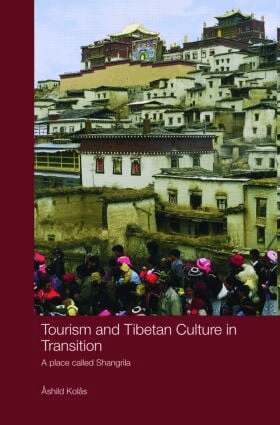
This book explores the relationship between tourism, culture and ethnic identity in Tibet in , focusing in particular on Shangrila, a Tibetan region in Southwest China, to show how local ‘Tibetan culture’ is reconstructed as a marketable commodity for tourists. It analyses the socio-economic effects of Shangrila tourism in Tibet, investigating who benefits economically, whilest also considering its political implications and the ways in which tourism might be linked to the negotiation and reassertion of ethnic identity. It goes on to examine the spatial re-imagining provoked by the development of tourism, and asks whether a tourist destination inevitably becomes a ‘pseudo-community’ for the visited. Can a fictitious name, invented for the sake of tourists, still provide the ‘natives’ of a place with a sense of identity? This book argues that conceptions of place are closely linked to notions of social identity, and in the case of Shangrila particularly to ethnic identity. Viewing the spatial as socially constructed, and place-making as vital to social organisation, this is a study of how place is constructed and contested. It describes how local villagers and monastic elites have negotiated the area’s religious geography, how agents of the Communist state have redefined it as a minority area, and how tourism developers are now marketing the region as Shangrila for tourist consumption. It outlines the different ‘place-making’ strategies utilised by the various social actors, including local villagers to create the communities in which they live, monastic elites to invent a Buddhist Tibetan realm of ‘religious geography’, agents of the People’s Republic of China to define the area as part of the communist state, and tourism developers to market the region as ‘Shangrila’ for tourist consumption. Overall, this book is an insightful account of the complex links between tourism, culture and Tibetanethnic identity in Tibet, and will be of interest to a wide range of disciplines including social anthropology, sociology, human geography, tourism and development studies.
656 kr
Skickas inom 10-15 vardagar
This book explores the relationship between tourism, culture and ethnic identity in Tibet in , focusing in particular on Shangrila, a Tibetan region in Southwest China, to show how local ‘Tibetan culture’ is reconstructed as a marketable commodity for tourists. It analyses the socio-economic effects of Shangrila tourism in Tibet, investigating who benefits economically, whilest also considering its political implications and the ways in which tourism might be linked to the negotiation and reassertion of ethnic identity. It goes on to examine the spatial re-imagining provoked by the development of tourism, and asks whether a tourist destination inevitably becomes a ‘pseudo-community’ for the visited. Can a fictitious name, invented for the sake of tourists, still provide the ‘natives’ of a place with a sense of identity? This book argues that conceptions of place are closely linked to notions of social identity, and in the case of Shangrila particularly to ethnic identity. Viewing the spatial as socially constructed, and place-making as vital to social organisation, this is a study of how place is constructed and contested. It describes how local villagers and monastic elites have negotiated the area’s religious geography, how agents of the Communist state have redefined it as a minority area, and how tourism developers are now marketing the region as Shangrila for tourist consumption. It outlines the different ‘place-making’ strategies utilised by the various social actors, including local villagers to create the communities in which they live, monastic elites to invent a Buddhist Tibetan realm of ‘religious geography’, agents of the People’s Republic of China to define the area as part of the communist state, and tourism developers to market the region as ‘Shangrila’ for tourist consumption. Overall, this book is an insightful account of the complex links between tourism, culture and Tibetanethnic identity in Tibet, and will be of interest to a wide range of disciplines including social anthropology, sociology, human geography, tourism and development studies.
India's Human Security
Lost Debates, Forgotten People, Intractable Challenges
Inbunden, Engelska, 2013
2 171 kr
Skickas inom 10-15 vardagar
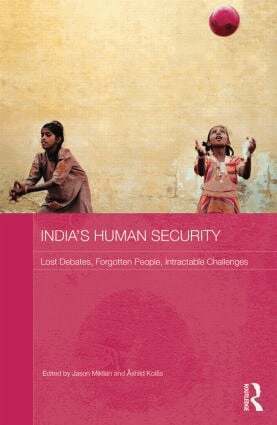
India's explosive economic growth and emerging power status make it a key country of interest for policymakers, researchers and scholars within South Asia and around the world. But while many of India's threats and conflicts are strategized and discussed extensively within the confines of security studies, strategic studies and conventional international relations perspectives, many less visible challenges are set to impact significantly on India's potential for economic growth as well as the human security and livelihoods of hundreds of millions of Indian citizens.Drawing on extensive research within India, this book looks at some of the ‘hidden risks’ that India faces, exploring how a broadened scope of what constitutes ‘risk’ itself holds value for Indian security studies practitioners and policymakers. It highlights several human security risks facing India, including the inability of the world’s largest democracy to deal effectively with widespread poverty and health issues, resource depletion and environmental mismanagement, pervasive corruption and institutionalized crime, communal violence, a protracted Maoist insurgency, and deadlocked peace processes in the Northeast among others. The book extracts common themes from these seemingly disparate problems, discussing what underlying failures allow them to persist and why policymakers heavily securitize some political issues while ignoring others.Providing an understanding of how several lesser-studied risks can pose potential or actual threats to Indian society and its ‘emerging power’ growth narrative, this book is a useful contribution to South Asian Studies, International Security Studies and Global Politics.
668 kr
Skickas inom 10-15 vardagar
India's explosive economic growth and emerging power status make it a key country of interest for policymakers, researchers and scholars within South Asia and around the world. But while many of India's threats and conflicts are strategized and discussed extensively within the confines of security studies, strategic studies and conventional international relations perspectives, many less visible challenges are set to impact significantly on India's potential for economic growth as well as the human security and livelihoods of hundreds of millions of Indian citizens.Drawing on extensive research within India, this book looks at some of the ‘hidden risks’ that India faces, exploring how a broadened scope of what constitutes ‘risk’ itself holds value for Indian security studies practitioners and policymakers. It highlights several human security risks facing India, including the inability of the world’s largest democracy to deal effectively with widespread poverty and health issues, resource depletion and environmental mismanagement, pervasive corruption and institutionalized crime, communal violence, a protracted Maoist insurgency, and deadlocked peace processes in the Northeast among others. The book extracts common themes from these seemingly disparate problems, discussing what underlying failures allow them to persist and why policymakers heavily securitize some political issues while ignoring others.Providing an understanding of how several lesser-studied risks can pose potential or actual threats to Indian society and its ‘emerging power’ growth narrative, this book is a useful contribution to South Asian Studies, International Security Studies and Global Politics.
1 956 kr
Skickas inom 3-6 vardagar
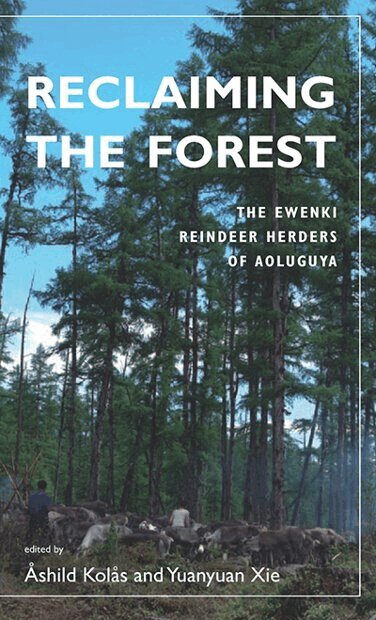
The reindeer herders of Aoluguya, China, are a group of former hunters who today see themselves as "keepers of reindeer" as they engage in ethnic tourism and exchange experiences with their Evenki neighbors in Russian Siberia. Though to some their future seems problematic, this book focuses on the present, challenging the pessimistic outlook, reviewing current issues and describing the efforts of the Ewenki to reclaim their forest lifestyle and develop new forest livelihoods. Both academic and literary contributions balance the volume written by authors who are either indigenous to the region or have carried out fieldwork among the Aoluguya Ewenki since the late 1990s.