Avraham Grossman - Böcker
Visar alla böcker från författaren Avraham Grossman. Handla med fri frakt och snabb leverans.
3 produkter
3 produkter
292 kr
Skickas inom 7-10 vardagar
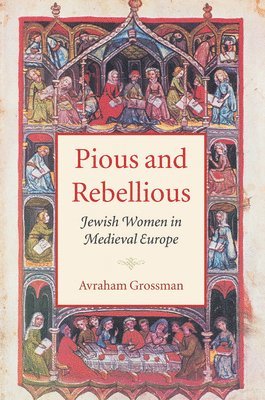
This volume, an amazing act of historical recovery and reconstruction, offers a comprehensive examination of Jewish women in Europe during the High Middle Ages (1000-1300). Avraham Grossman covers multiple aspects of women's lives in medieval Jewish society, including the image of woman, the structure of the family unit, age at marriage, position in family and society, her place in economic and religious life, her education, her role in family ceremonies, violence against women, and the position of the divorcée and the widow in society. Grossman shows that the High Middle Ages saw a distinct improvement in the status of Jewish women in Europe relative to their status during the Talmudic period and in Muslim countries. If, during the twelfth century, rabbis applauded women as"pious and pure" because of their major role in the martyrdom of the Crusades of 1096, then by the end of the thirteenth century, rabbis complained that women were becoming bold and rebellious. Two main factors fostered this change: first, the transformation of Jewish society from agrarian to "bourgeois," with women performing an increasingly important function in the family economy; and second, the openness toward women in Christian Europe, where women were not subjected to strict limitations based upon conceptions of modesty, as was the case in Muslim countries. The heart of Grossman's book concerns the improvement of Jewish women's lot, and the efforts of secular and religious authorities to impede their new-found status.Bringing together a variety of sources including halakhic literature, biblical and talmudic exegesis, ethical literature and philosophy, love songs, folklore and popular literature, gravestones, and drawings, Grossman's book reconstructs the hitherto unrecorded lives of Jewish women during the Middle Ages.
421 kr
Skickas inom 7-10 vardagar
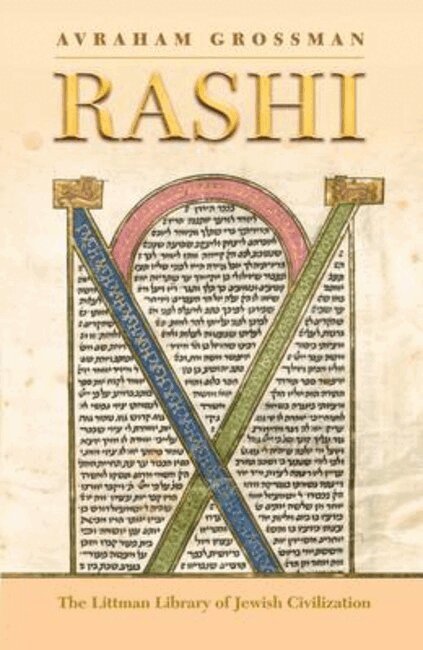
To this day, the commentaries on the Bible and Talmud written by the eleventh-century scholar known as Rashi remain unsurpassed. His influence on Jewish thinking was, and still is, significant. His commentary on the Pentateuch was the first Hebrew book to be printed, giving rise to hundreds of supercommentaries. Christian scholars, too, have relied heavily on his explanations of biblical texts. In this volume Avraham Grossman presents a masterly survey of the social and cultural background to Rashi’s work and pulls together the strands of information available on his life, his personality, his reputation during his lifetime, and his influence as a teacher. He discusses each of his main commentaries in turn, including such aspects as his sources, his interpretative method, his innovations, and his style and language. Attention is also given to his halakhic monographs, responsa, and liturgical poems.Despite Rashi’s importance as a scholar and the vast literature published about him, two central questions remain essentially unanswered: what was Rashi’s world-view, and was he a conservative or a revolutionary? Professor Grossman considers these points at length, and his in-depth analysis of Rashi’s world-view—particularly his understanding of Jewish uniqueness, Jewish values, and Jewish society—leads to conclusions that are likely to stimulate much debate.
Carmi Sheli
Studies on Aggadah and its Interpretation Presented to Professor Carmi Horowitz
Inbunden, Engelska, 2011
953 kr
Skickas inom 5-8 vardagar
This volume contains fifteen articles, many in Hebrew, by leading scholars. The articles cover a broad range of subjects, from an analysis of biblical narratives as expounded in the midrash and by medieval commentators, through a discussion of Maimonides’ attitude towards midrash and an analysis of talmudic aggadah as expounded by oriental scholars, to polemics concerning the attitude to aggadah in the thirteenth and sixteenth centuries, and culminating with an analysis of interpretation of aggadah by latter-day talmudic scholars. There are also articles about the essence of aggadah, its literary conventions and its relation to law, and two articles which deal with a passage in the Passover Haggadah. The participants include: E. Eizenman, N. Ilan, G. Blidstein, Y. Blau, M. Bregman, A. Grossman, H. Davidson, C. Horowitz, O. Viskind-Elper, H. Mak, A. Atzmon, A. Kadari, A. Rozenak, M. Shmidman, and J. Tabory.