B. R. Deepak - Böcker
Visar alla böcker från författaren B. R. Deepak. Handla med fri frakt och snabb leverans.
12 produkter
12 produkter
782 kr
Skickas inom 3-6 vardagar
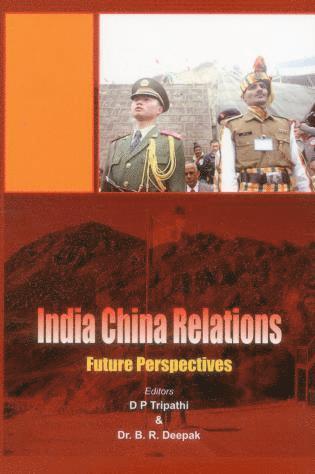
India and China had a glorious history of cultural and material exchanges, which developed into friendship and subsequently into camaraderie during first half of the twentieth century when both India and China fought western imperialism. Owing to serious misconceptions and misjudgements the relations remained under the shadow of animosities and mutual distrust for over three decades until Rajiv Gandhi's China visit in 1988. After 62 years of diplomatic relations between the two, there is a certain maturity in the relations, as both are sharing new responsibilities in the stupendously changing global architecture. India-China Relations: Future Perspectives is a collection of eighteen essays by eminent Indian and Chinese scholars, diplomats and political personalities, who look at the complex and multi-layered relationship from different perspectives covering various domains such as civilizational dialogue through history, the 1950s brotherhood, the border, and various other issues pertaining to education, agriculture, security, defense and economic complementarities etc.The complex and multi-layered character of the relationship makes it difficult to define as an adversarial or competitive, for there has been cooperation at various levels between the two, such as climate change and many other multilateral forums like G20 and BRICS. Notwithstanding the cooperation, there have been incremental yet cautious approaches towards cooperation in various fields from both the sides. As the global economic and political scenario is undergoing a tremendous change, and its shift to Asia is visible, the contributors feel that India and China need to handle the hypersensitive issues with care and tap the existing complementarities appropriately, or else the Asian century would not only be a distant dream, but could also endanger the peace and stability of the region and the world.
782 kr
Skickas inom 3-6 vardagar
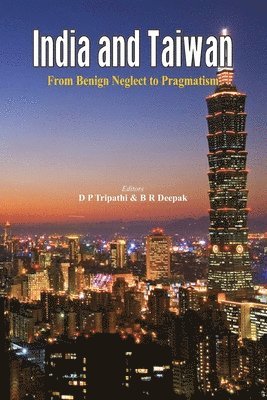
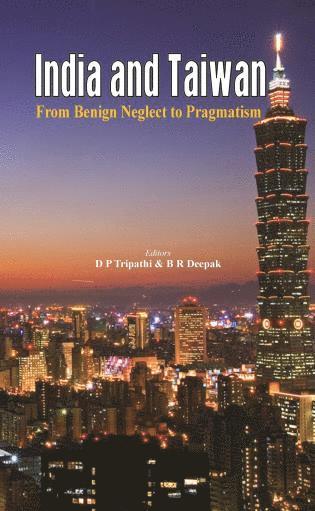
India and China, the 'cultural cousins' of the past were reduced to 'colonial cousins' during the 19th century by the British colonialists. If the colonial connections strengthened the bonds between the Indian and Chinese people during the 19th century, the same sowed the seeds of conflict during the 20th century. India wished to forge alliance with the nationalist as well as the communist China; however, the colonial legacy denied that alliance with both the parties. India's hobnobbing with Taiwan in the wake of the 1962 hostilities did not go unnoticed in Beijing, however, after the relations were restored between India and China in mid 1970s, India became cautious and remains so developing more intimate relations with Taiwan, albeit there is a momentum as far as cultural and educational ties are concerned. India and Taiwan: From Benign Neglect to Pragmatism is a collection of eleven essays by eminent Indian and Taiwanese scholars, as well as research scholars who look at the multifaceted relationship between India and the Republic of China and contemporary Taiwan from strategic, trade, economics, educational and cultural perspectives.This has been a multilayered relationship where there are shades of support and sympathy, cooperation and conflict, attempts to befriend enemy's enemy briefly, and now seeking more depth as regards security, trade, cultural and educational etc. arenas are concerned. However, China remains a factor, and both are not willing to cross the red line when we talk about relations between the two. Major areas covered in this volume pertain to India and the ROC prior to the establishment of the People's Republic of China, which includes perceptions on Tibet issue, quest for alliance, Chiang Kai-shek and the India-China-Burma theatre of war, the then ROC ambassador to India, Luo Jialun paying his last respect to Gandhi in 1948; India-Taiwan security and trade relations; experiences of developmental states in India and Taiwan; educational and cultural cooperation between India and Taiwan; Taiwan studies in India, the future direction of the India-China relations, and if Taiwan could play a bit of its role here. The collected essays are pertinent, as they help us to understand the past as well as present scenarios between India and the ROC on one hand and India and Taiwan on the other.These are also relevant to any researcher delving into the India-China relations.
501 kr
Skickas inom 3-6 vardagar
829 kr
Skickas inom 3-6 vardagar
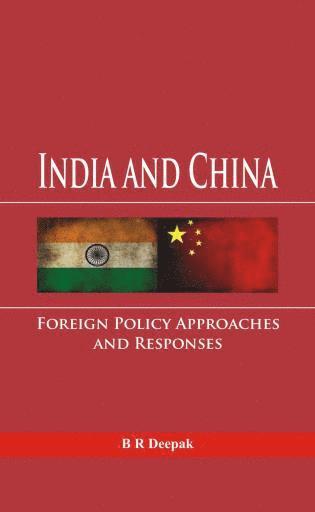
During the deep globalization of the 1990s and early 2000s when China adapted well to the global changes by making various structural adjustments, India's ambivalence to undertake similar revolutionary changes made her to muddle through the forces of globalization. Now, when new forces of globalization in the form of Trans Pacific Partnership (TPP), Transatlantic Trade and Investment Partnership (TTIP), One Belt One Road, and various economic unions or communities throughout the globe are taking shape, will India's own initiative adapt well to these processes and reap maximum benefits? Or will India muddle through again and lose yet another opportunity and remain as an onlooker to these global geopolitical and economic restructuring? Will India recalibrate its foreign, defense and trade policies and align it to these changes? Will India continue to let the weak domestic drivers determine its foreign and economic policies?India and China: Foreign Policy Priorities, a collection of 50 essays looks into Indian and Chinese foreign policy approaches towards various bilateral and multilateral issues, which include the border, Brahmaputra water, maritime security, defense diplomacy, South China Sea, 'One Belt One Road' , BRICS, terrorism, joint military exercises, New Development Bank, Asia Infrastructure Investment Bank etc. issues. Besides, there are essays focusing on US's 'rebalancing to Asia', Chinese responses to US reconnaissance close to Chinese island reclamation activities in the South China Sea, China's spat with Japan over Senkaku/Diaoyu Island and TPP have been looked into from the perspectives of various stakeholders. Besides, the volume also covers some other major areas of India-China relations such as trade and investment, high level visits, people to people exchanges, historical ties etc. The essays are of particularly significant, for they help to understand some of the recent foreign policy approaches and responses from India and China towards some of the extremely important issues concerning bilateral and multilateral engagement.
548 kr
Skickas inom 3-6 vardagar
During the deep globalization of the 1990s and early 2000s when China adapted well to the global changes by making various structural adjustments, India's ambivalence to undertake similar revolutionary changes made her to muddle through the forces of globalisation. Now, when new forces of globalisation in the form of Trans Pacific Partnership (TPP), Transatlantic Trade and Investment Partnership (TTIP), One Belt One Road, and various economic unions or communities throughout the globe are taking shape, will India's own initiative adapt well to these processes and reap maximum benefits? Or will India muddle through again and lose yet another opportunity and remain as an onlooker to these global geopolitical and economic restructuring? Will India recalibrate its foreign, defence and trade policies and align it to these changes? Will India continue to let the weak domestic drivers determine its foreign and economic policies?India and China: Foreign Policy Priorities, a collection of 50 essays looks into Indian and Chinese foreign policy approaches towards various bilateral and multilateral issues, which include the border, Brahmaputra water, maritime security, defence diplomacy, South China Sea, 'One Belt One Road' , BRICS, terrorism, joint military exercises, New Development Bank, Asia Infrastructure Investment Bank etc. issues. Besides, there are essays focussing on US's 'rebalancing to Asia', Chinese responses to US reconnaissance close to Chinese island reclamation activities in the South China Sea, China's spat with Japan over Senkaku/Diaoyu Island and TPP have been looked into from the perspectives of various stakeholders. Besides, the volume also covers some other major areas of India-China relations such as trade and investment, high level visits, people to people exchanges, historical ties etc. The essays are of particularly significant, for they help to understand some of the recent foreign policy approaches and responses from India and China towards some of the extremely important issues concerning bilateral and multilateral engagement.
1 166 kr
Skickas inom 10-15 vardagar
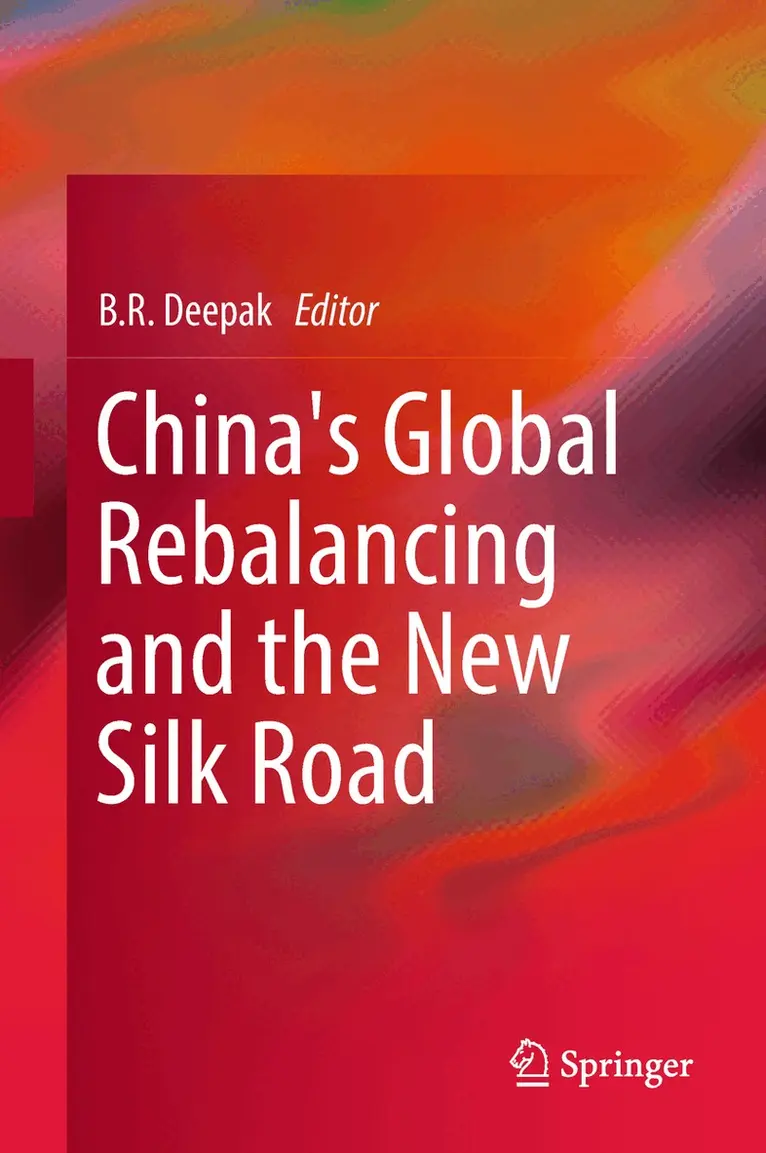
This collaborative volume discusses the One Belt One Road, or the New Silk Road, initiative of Chinese President Xi Jinping from the perspectives of the Belt and Road countries. This initiative has been viewed as a re-globalization drive by China in the backdrop of financial crisis of the West and the latter’s increasingly protectionist tendencies of late. Rather than ‘rebalancing’ towards a certain region, this is supposed to be China’s ‘global rebalancing’ aimed at inclusiveness and a win-win partnership. The initiative has raised hopes as well as suspicions about China's goals and intentions; that is, whether this is in sync with China’s foreign policy goals, such as multipolarity, no hegemonic aspirations, and common security, or if this is an antidote to the U.S. foreign policy goals in the region, and China’s ambition to realizing its long-term vision for Asian regional and global order. In this volume, a galaxy of eminent academics from India, China, Pakistan,Uzbekistan, Germany and Southeast Asia have critically analysed every aspect of this mammoth project, including the six major economic corridors identified by China for policy coordination, infrastructure connectivity, unimpeded trade, monetary circulation, and people to people exchanges. The authors have interpreted China’s peripheral, regional as well as global diplomacy both over land and sea. This topical volume is of interest to scholars and students of Asian studies, China studies, Asian history, development studies, international relations and international trade.
850 kr
Skickas inom 10-15 vardagar
This collaborative volume discusses the One Belt One Road, or the New Silk Road, initiative of Chinese President Xi Jinping from the perspectives of the Belt and Road countries. This initiative has been viewed as a re-globalization drive by China in the backdrop of financial crisis of the West and the latter’s increasingly protectionist tendencies of late. Rather than ‘rebalancing’ towards a certain region, this is supposed to be China’s ‘global rebalancing’ aimed at inclusiveness and a win-win partnership. The initiative has raised hopes as well as suspicions about China's goals and intentions; that is, whether this is in sync with China’s foreign policy goals, such as multipolarity, no hegemonic aspirations, and common security, or if this is an antidote to the U.S. foreign policy goals in the region, and China’s ambition to realizing its long-term vision for Asian regional and global order. In this volume, a galaxy of eminent academics from India, China, Pakistan,Uzbekistan, Germany and Southeast Asia have critically analysed every aspect of this mammoth project, including the six major economic corridors identified by China for policy coordination, infrastructure connectivity, unimpeded trade, monetary circulation, and people to people exchanges. The authors have interpreted China’s peripheral, regional as well as global diplomacy both over land and sea. This topical volume is of interest to scholars and students of Asian studies, China studies, Asian history, development studies, international relations and international trade.
1 061 kr
Skickas inom 10-15 vardagar
This book examines the changing dynamics of the issues between India and China in the wake of extensive globalisation, economic slowdown, the trade wars, Covid 19, Galwan and the undercurrents in the emerging new global order.
1 061 kr
Skickas inom 10-15 vardagar
This book examines the changing dynamics of the issues between India and China in the wake of extensive globalisation, economic slowdown, the trade wars, Covid 19, Galwan and the undercurrents in the emerging new global order.
Rising India and China
Strategic Rivalry in the Himalayas and the Indo-Pacific, Volume 1
Inbunden, Engelska, 2025
1 377 kr
Skickas inom 10-15 vardagar
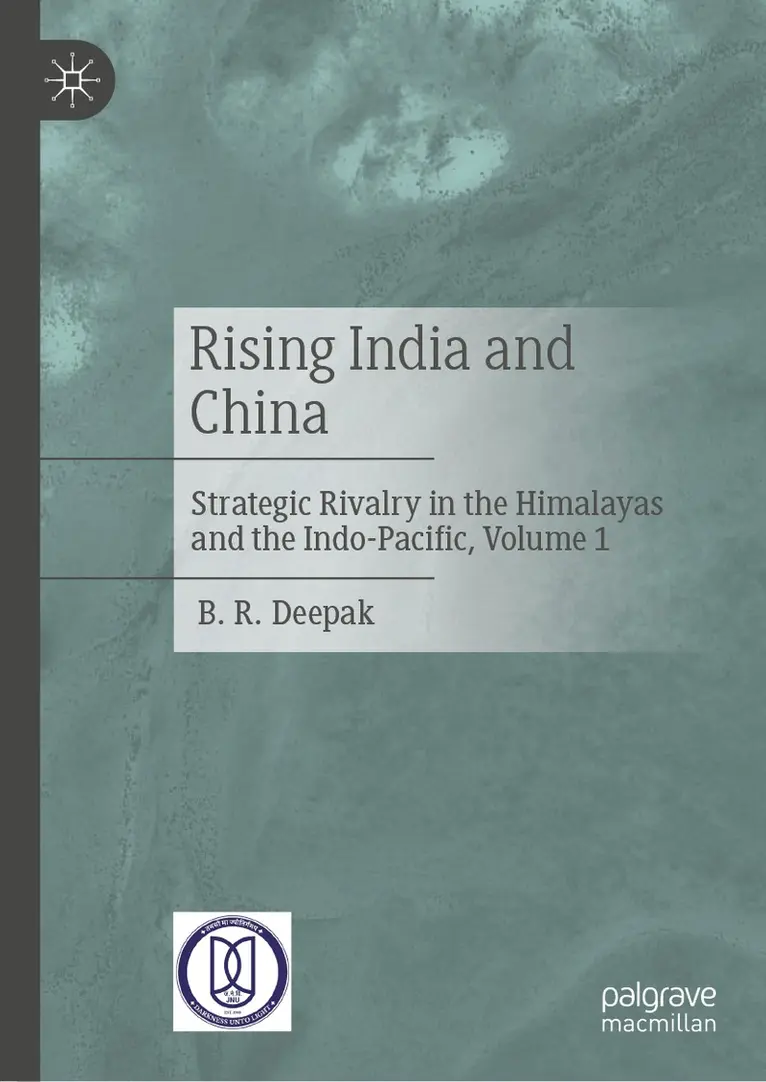
Relying on vast Chinese, Indian, as well as western sources, the study provides a detailed exegesis of the nature of conflict covering over a century of political contours in the British India, Manchu China, Republican China and finally the Republic of India and Peoples Republic of China.
Rising India and China: Strategic Rivalry in the Himalayas and the Indo-Pacific, Volume 1
Häftad, Engelska, 2026
1 377 kr
Skickas inom 10-15 vardagar
Rising India and China
Strategic Rivalry in the Himalayas and the Indo- Pacific, Volume 2
Inbunden, Engelska, 2025
1 377 kr
Skickas inom 7-10 vardagar
This book, part of a two-volume exploration, examines the trajectory of Sino-Indian relations, spanning from the aftermath of 1962 war in the Himalayas to the growing rivalries in the Indo-Pacific. It scrutinizes the decade-long diplomatic freeze post-1962, analysing China’s propaganda, collusion with Pakistan, and supporting insurgency in India’s northeast. It delves into the rebalancing approaches starting from Rajiv Gandhi’s pivotal 1988 China visit to finding an equilibrium with China and then losing it after three decades owing to widening asymmetries with China, resulting in the crisis of confidence building and a prolonged military standoff in the Western Sector in the aftermath of the Galwan face off. Furthermore, it explores the Indian choices for finding a new equilibrium with China navigating China’s discourse on the Indo-Pacific strategy, India’s equations with major powers, and makes enquiries into China’s military modernization and implications to India in a complex security environment influenced by internal and external factors, economic considerations, and global power dynamics. This book, part of a two-volume exploration, examines the trajectory of Sino-Indian relations, spanning from the aftermath of 1962 war in the Himalayas to the growing rivalries in the Indo-Pacific. It scrutinizes the decade-long diplomatic freeze post-1962, analysing China’s propaganda, collusion with Pakistan, and supporting insurgency in India’s northeast. It delves into the rebalancing approaches starting from Rajiv Gandhi’s pivotal 1988 China visit to finding an equilibrium with China and then losing it after three decades owing to widening asymmetries with China, resulting in the crisis of confidence building and a prolonged military standoff in the Western Sector in the aftermath of the Galwan face off. Furthermore, it explores the Indian choices for finding a new equilibrium with China navigating China’s discourse on the Indo-Pacific strategy, India’s equations with major powers, and makes enquiries into China’s military modernization and implications to India in a complex security environment influenced by internal and external factors, economic considerations, and global power dynamics.