Babak Falsafi - Böcker
Visar alla böcker från författaren Babak Falsafi. Handla med fri frakt och snabb leverans.
7 produkter
7 produkter
1 472 kr
Skickas inom 10-15 vardagar
This book provides readers with an overview of the architectures, programming frameworks, and hardware accelerators for typical cloud computing applications in data centers. The authors present the most recent and promising solutions, using hardware accelerators to provide high throughput, reduced latency and higher energy efficiency compared to current servers based on commodity processors. Readers will benefit from state-of-the-art information regarding application requirements in contemporary data centers, computational complexity of typical tasks in cloud computing, and a programming framework for the efficient utilization of the hardware accelerators.
271 kr
Skickas inom 10-15 vardagar
Since the 1970’s, microprocessor-based digital platforms have been riding Moore’s law, allowing for doubling of density for the same area roughly every two years. However, whereas microprocessor fabrication has focused on increasing instruction execution rate, memory fabrication technologies have focused primarily on an increase in capacity with negligible increase in speed. This divergent trend in performance between the processors and memory has led to a phenomenon referred to as the “Memory Wall.” To overcome the memory wall, designers have resorted to a hierarchy of cache memory levels, which rely on the principal of memory access locality to reduce the observed memory access time and the performance gap between processors and memory. Unfortunately, important workload classes exhibit adverse memory access patterns that baffle the simple policies built into modern cache hierarchies to move instructions and data across cache levels. As such, processors often spend much time idling upon a demand fetch of memory blocks that miss in higher cache levels. Prefetching—predicting future memory accesses and issuing requests for the corresponding memory blocks in advance of explicit accesses—is an effective approach to hide memory access latency. There have been a myriad of proposed prefetching techniques, and nearly every modern processor includes some hardware prefetching mechanisms targeting simple and regular memory access patterns. This primer offers an overview of the various classes of hardware prefetchers for instructions and data proposed in the research literature, and presents examples of techniques incorporated into modern microprocessors.
1 472 kr
Skickas inom 10-15 vardagar
This book provides readers with an overview of the architectures, programming frameworks, and hardware accelerators for typical cloud computing applications in data centers. The authors present the most recent and promising solutions, using hardware accelerators to provide high throughput, reduced latency and higher energy efficiency compared to current servers based on commodity processors. Readers will benefit from state-of-the-art information regarding application requirements in contemporary data centers, computational complexity of typical tasks in cloud computing, and a programming framework for the efficient utilization of the hardware accelerators.
Power-Aware Computer Systems
Second International Workshop, PACS 2002 Cambridge, MA, USA, February 2, 2002, Revised Papers
Häftad, Engelska, 2003
535 kr
Skickas inom 10-15 vardagar
WelcometotheproceedingsofthePower-AwareComputerSystems(PACS2002) workshopheld in conjunction with the 8th InternationalSymposium on High PerformanceComputerArchitecture(HPCA-8). Improvementsincomputers- temperformancehavebeenaccompaniedbyanalarmingincreaseinpowerand energydissipation,leading tohigher costandlowerreliabilityinallcomputer systemsmarketsegments. Thehigherpower/energydissipationhasalsosign- icantlyreducedbatterylife inportablesystems. Whilecircuit-leveltechniques continuetoreducepowerandenergy,alllevelsofcomputersystemsarebeing usedtoaddresspowerandenergyissues. PACS2002wasthesecondworkshopin itsseriestoaddresspower-/energy-awarenessatalllevelsofcomputersystems andbroughttogetherexpertsfromacademiaandindustry. Theseproceedingsincluderesearchpapersspanningawidespectrumof- eas in power-aware systems. We have grouped the papers into the following categories:(1)power-awarearchitectureandmicroarchitecture,(2)power-aware real-time systems, (3) power modeling and monitoring, and (4) power-aware operatingsystemsandcompilers. The?rstgroupofpapersproposepower-awaretechniquesfortheprocessor pipeline using adaptiveresizing of power-hungrymicroarchitecturalstructures andclockgating,andpower-awarecachedesignbyavoidingtagchecksin- riodswhenthetagshavenotchanged.Thisgroupalsoincludesideastoadapt energyandperformancedynamicallybydetectingregionsofapplicationatr- timewherethesupplyvoltagemaybescaledtoreducepowerwithabounded decrease in performance. Lastly, a paper on multiprocessor designs trades o? computingcapacityandfunctionalityforimprovedenergypercyclebysched- ing simple tasks on low-end and low-energy processorsand complex tasks on high-endprocessors. Thesecondgroupofpaperstargetreal-timesystemsincludingideasonal- complexityheuristicwhichschedulesreal-timetaskssuchthatnotaskmissesits deadlineandthetotalenergysavingsaremaximized. Theotherpapersinthis group(1)tunethesystem-levelparallelismtothecurrent-levelofpower/energy availabilityandoptimizethesystempowerutilization,and(2)performadaptive texturemappinginreal-time3Dgraphicssystemsbasedonamodelofhuman visualperceptiontoachievesigni?cantpowersavingswithoutnoticeableimage qualitydegradation. Thethirdgroupofpapersfocusonpowermodelingandmonitoringincluding statisticalpro?lingtodetectsoftwarehotspotsofpower,andusingPetriNetsto modelDRAMpowerpolicies. Thisgroupalsoincludesasimulatorforevaluating theperformanceandpowerofdynamicvoltagescalingalgorithms.Thelast groupconcentratesonOS and compilersfor lowpower. The ?rst paperproposesapplication-issueddirectivestosetthepowermodesindevices suchasadiskdrive. Thesecondpaperproposespoliciesforcluster-widepower VI Preface management. Thepoliciesemploycombinationsofdynamicvoltagescalingand turningonando?toreduceoverallclusterpower. PACS2002wasahighlysuccessfulforumduetothehigh-qualitysubmissions, theenormouse?ortsoftheprogramcommitteeandthekeynotespeaker,andthe attendees. WewouldliketothankRonnyRonenforanexcellentkeynotespeech, showingthetechnologicalscalingtrendsandtheirimpactonenergy/powerc- sumption in general-purposemicroprocessors,and pinpointing recentmicro- chitecturalstrategiestoachievemorepower-e?cientmicroprocessors. Wewould like to also thank Antonio Gonzalez, Andreas Moshovos,John Kalamatianos, andothermembersoftheHPCA-8organizingcommitteewhohelpedarrange forlocalaccomodationandpublicizetheworkshop. February2002 BabakFalsa?andT. N. Vijaykumar PACS2002 Program Committee BabakFalsa?,CarnegieMellonUniversity(co-chair) T. N.Vijaykumar,PurdueUniversity(co-chair) DaveAlbonesi,UniversityofRochester KrsteAsanovic,MassachusettsInstituteofTechnology IrisBahar,BrownUniversity LucaBenini,UniversityofBologna DougCarmean,Intel Yuen Chan,IBM KeithFarkas,CompaqWRL MaryJaneIrwin,PennsylvaniaStateUniversity StefanosKaxiras,AgereSystems PeterKogge,UniversityofNotreDame UliKremer,RutgersUniversity AlvinLebeck,DukeUniversity AndreasMoshovos,UniversityofToronto RajRajkumar,CarnegieMellonUniversity KaushikRoy,PurdueUniversity Table of Contents Power-Aware Architecture/Microarchitecture Early-StageDe?nitionofLPX:ALowPowerIssue-ExecuteProcessor ...1 P. Bose,D. Brooks,A. Buyuktosunoglu,P. Cook,K. Das,P. Emma, M. Gschwind,H. Jacobson,T. Karkhanis,P. Kudva,S. Schuster, J. Smith,V. Srinivasan,V. Zyuban,D. Albonesi,andS. Dwarkadas DynamicTag-CheckOmission: ALowPowerInstructionCacheArchitecture ExploitingExecutionFootprints ...18 KojiInoue,VasilyMoshnyaga,andKazuakiMurakami AHardwareArchitecture forDynamicPerformanceandEnergyAdaptation...33 PhillipStanley-Marbell,MichaelS. Hsiao,andUlrichKremer Multi-processorComputerSystemHavingLowPowerConsumption ...53 C. MichaelOlsenandL.AlexMorrow Power-Aware Real-TimeSystems AnIntegratedHeuristicApproach toPower-AwareReal-TimeScheduling...68 PedroMejia,EugeneLevner,andDanielMoss'e Power-AwareTaskMotionforEnhancingDynamicRange ofEmbeddedSystemswithRenewableEnergySources ...84 JinfengLiu,PaiH. Chou,andNaderBagherzadeh ALow-PowerContent-AdaptiveTextureMappingArchitecture forReal-Time3DGraphics ...99 JeongseonEuh,JeevanChittamuru,andWayneBurleson Power Modelingand Monitoring Energy-DrivenStatisticalSampling:DetectingSoftwareHotspots ...110 FayChang,KeithI. Farkas,andParthasarathyRanganathan ModelingofDRAMPowerControlPolicies UsingDeterministicandStochasticPetriNets ...130 XiaoboFan,CarlaS. Ellis,andAlvinR. Lebeck SimDVS:AnIntegratedSimulationEnvironment forPerformanceEvaluationofDynamicVoltageScalingAlgorithms ...
Power-Aware Computer Systems
Third International Workshop, PACS 2003, San Diego, CA, USA, December 1, 2003, Revised Papers
Häftad, Engelska, 2004
535 kr
Skickas inom 10-15 vardagar
This book contributes the thoroughly refereed post-proceedings of the Third International Workshop on Power-Aware Computer Systems, PACS 2003, held in San Diego, CA, USA in December 2003.The 14 revised full papers presented were carefully selected during two rounds of reviewing and improvement from 43 submissions. The papers span a wide spectrum of topics in power-aware systems; they are organized in topical sections on compilers, embedded systems, microarchitectures, and cache and memory systems.
Power-Aware Computer Systems
4th International Workshop, PACS 2004, Portland, OR, USA, December 5, 2004, Revised Selected Papers
Häftad, Engelska, 2005
535 kr
Skickas inom 10-15 vardagar
Welcome to the proceedings of the Power-Aware Computer Systems (PACS 2004) workshop held in conjunction with the 37th Annual International Sym- sium on Microarchitecture (MICRO-37). The continued increase of power and energy dissipation in computer systems has resulted in higher cost, lower re- ability, and reduced battery life in portable systems. Consequently, power and energy have become ?rst-class constraints at all layers of modern computer s- tems. PACS 2004 is the fourth workshop in its series to explore techniques to reduce power and energy at all levels of computer systems and brings together academic and industry researchers. The papers in these proceedings span a wide spectrum of areas in pow- aware systems. We have grouped the papers into the following categories: (1) microarchitecture- and circuit-level techniques, (2) power-aware memory and interconnect systems, and (3) frequency- and voltage-scaling techniques. The ?rst paper in the microarchitecture group proposes banking and wri- back ?ltering to reduce register ?le power. The second paper in this group - timizes both delay and power of the issue queue by packing two instructions in each issue queue entry and by memorizing upper-order bits of the wake-up tag. The third paper proposes bit slicing the datapath to exploit narrow width operations, and the last paper proposes to migrate application threads from one core to another in a multi-core chip to address thermal problems.
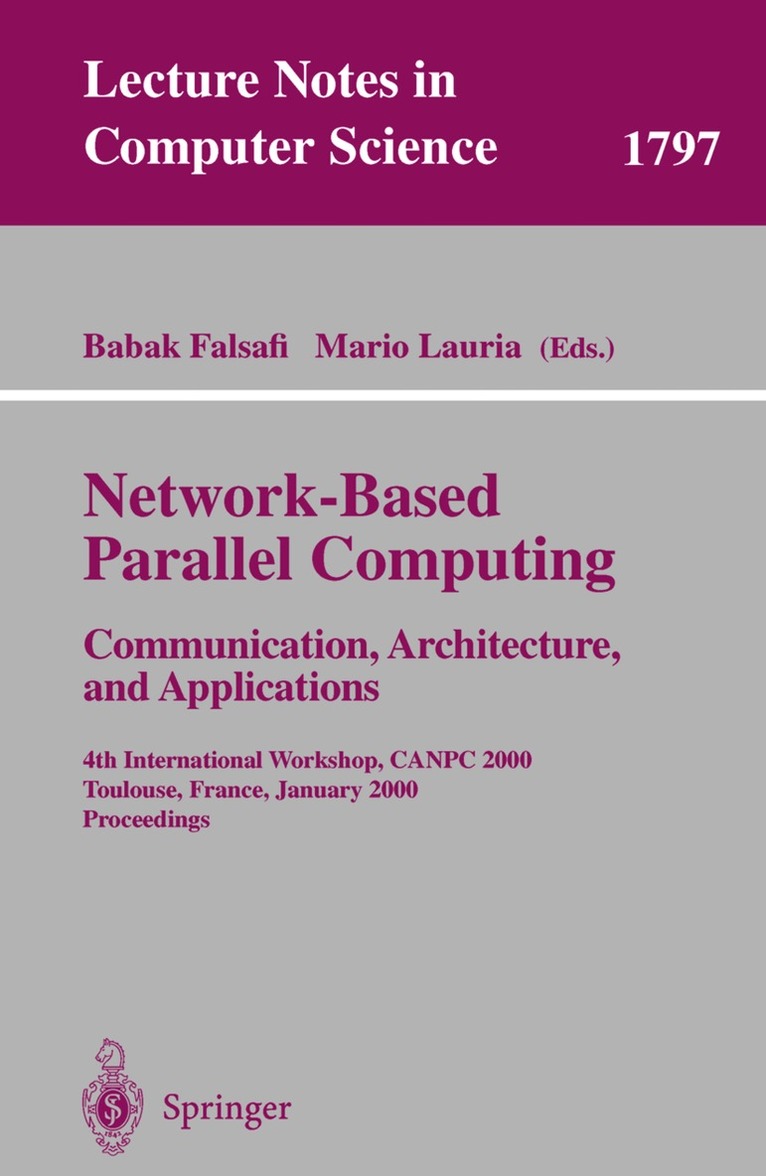
Network-Based Parallel Computing - Communication, Architecture, and Applications
4th International Workshop, CANPC 2000 Toulouse, France, January 8, 2000 Proceedings
Häftad, Engelska, 2000
551 kr
Skickas inom 10-15 vardagar
Clusters of workstations/PCs connected by o?-the-shelf networks have become popular as platforms for cost-e?ective parallel computing. Technological - vances in both hardware and software have made such a network-based parallel computingplatform an a?ordable alternative to commercial supercomputers for an increasing number of scienti?c applications. Continuing in the tradition of the three previously successful workshops, this fourth Workshop on Communication, Architecture and Applications for Network-basedParallelComputing(CANPC 2000)broughttogetherresearchers and practitioners working in architecture, system software, applications, and performance evaluation to discuss state-of-the-art solutions for network-based parallel computing. This year, the workshop was held in conjunction with the sixth International Symposium on High-Performance Computer Architecture (HPCA-6). As in prior editions, the papers presented here are representative of a sp- trum of research e?orts from groups in academia and industry to further - prove cluster computing's viability, performance, cost-e?ectiveness, and usab- ity. Speci?cally, we have arranged the contributions in this edition into four groups: (1) program development and execution support, (2) network router - chitecture, (3) system support for communication abstractions, and (4) network software and interface architecture.