Barbara Epstein - Böcker
Visar alla böcker från författaren Barbara Epstein. Handla med fri frakt och snabb leverans.
3 produkter
3 produkter
Political Protest and Cultural Revolution
Nonviolent Direct Action in the 1970s and 1980s
Häftad, Engelska, 1993
274 kr
Skickas inom 7-10 vardagar
From her perspective as both participant and observer, Barbara Epstein examines the nonviolent direct action movement which, inspired by the civil rights movement, flourished in the United States from the mid-seventies to the mid-eighties. Disenchanted with the politics of both the mainstream and the organized left, and deeply committed to forging communities based on shared values, activists in this movement developed a fresh, philosophy and style of politics that shaped the thinking of a new generation of activists. Driven by a vision of an ecologically balanced, nonviolent, egalitarian society, they engaged in political action through affinity groups, made decisions by consensus, and practiced mass civil disobedience. The nonviolent direct action movement galvanized originally in opposition to nuclear power, with the Clamshell Alliance in New England and then the Abalone Alliance in California leading the way. Its influence soon spread to other activist movements--for peace, non-intervention, ecological preservation, feminism, and gay and lesbian rights.Epstein joined the San Francisco Bay Area's Livermore Action Group to protest the arms race and found herself in jail along with a thousand other activists for blocking the road in front of the Lawrence Livermore Laboratory. She argues that to gain a real understanding of the direct action movement it is necessary to view it from the inside. For with its aim to base society as a whole on principles of egalitarianism and nonviolence, the movement sought to turn political protest into cultural revolution.
695 kr
Skickas inom 7-10 vardagar
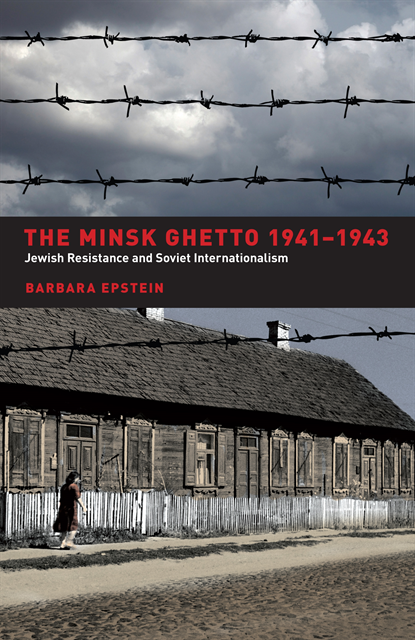
Drawing from engrossing survivors' accounts, many never before published, "The Minsk Ghetto 1941-1943" recounts a heroic yet little-known chapter in Holocaust history. In vivid and moving detail, Barbara Epstein chronicles the history of a Communist-led resistance movement inside the Minsk ghetto, which, through its links to its Belarussian counterpart outside the ghetto and with help from others, enabled thousands of ghetto Jews to flee to the surrounding forests where they joined partisan units fighting the Germans.Telling a story that stands in stark contrast to what transpired across much of Eastern Europe, where Jews found few reliable allies in the face of the Nazi threat, this book captures the texture of life inside and outside the Minsk ghetto, evoking the harsh conditions, the life-threatening situations, and the friendships that helped many escape almost certain death. Epstein also explores how and why this resistance movement, unlike better known movements at places like Warsaw, Vilna, and Kovno, was able to rely on collaboration with those outside ghetto walls.She finds that an internationalist ethos fostered by two decades of Soviet rule, in addition to other factors, made this extraordinary story possible.
379 kr
Skickas inom 5-8 vardagar
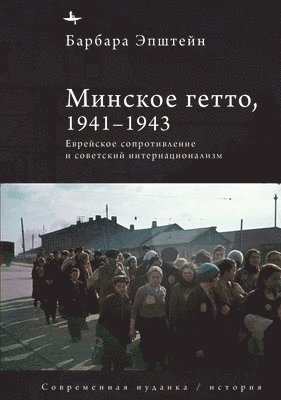
ENG:Drawing from engrossing survivors' accounts, many never before published, The Minsk Ghetto 1941-1943 recounts a heroic yet little-known chapter in Holocaust history. In vivid and moving detail, Barbara Epstein chronicles the history of a Communist-led resistance movement inside the Minsk ghetto, which, through its links to its Belarussian counterpart outside the ghetto and with help from others, enabled thousands of ghetto Jews to flee to the surrounding forests where they joined partisan units fighting the Germans. Telling a story that stands in stark contrast to what transpired across much of Eastern Europe, where Jews found few reliable allies in the face of the Nazi threat, this book captures the texture of life inside and outside the Minsk ghetto, evoking the harsh conditions, the life-threatening situations, and the friendships that helped many escape almost certain death. Epstein also explores how and why this resistance movement, unlike better known movements at places like Warsaw, Vilna, and Kovno, was able to rely on collaboration with those outside ghetto walls. She finds that an internationalist ethos fostered by two decades of Soviet rule, in addition to other factors, made this extraordinary story possible.RUS:Опираясь на свидетельства выживших, Барбара Эпштейн рассказывает о героической, но малоизвестной главе в истории Холокоста — о возглавляемом коммунистами движении сопротивления в Минском гетто, которое позволило тысячам евреев бежать в окрестные леса, где они присоединились к партизанским отрядам, сражавшимся с немцами. Автор также показывает, как и почему это движение сопротивления, в отличие от более известных движений групп в таких местах, как Варшава, Вильно и Ковно, нашло поддержку у тех, кто находился за стенами гетто. Автор приходит к выводу, что интернационалистская этика, воспитанная двумя десятилетиями советской власти, сделала возможной эту необычную историю.