Benjamin DeMott - Böcker
Visar alla böcker från författaren Benjamin DeMott. Handla med fri frakt och snabb leverans.
6 produkter
6 produkter
398 kr
Skickas inom 5-8 vardagar
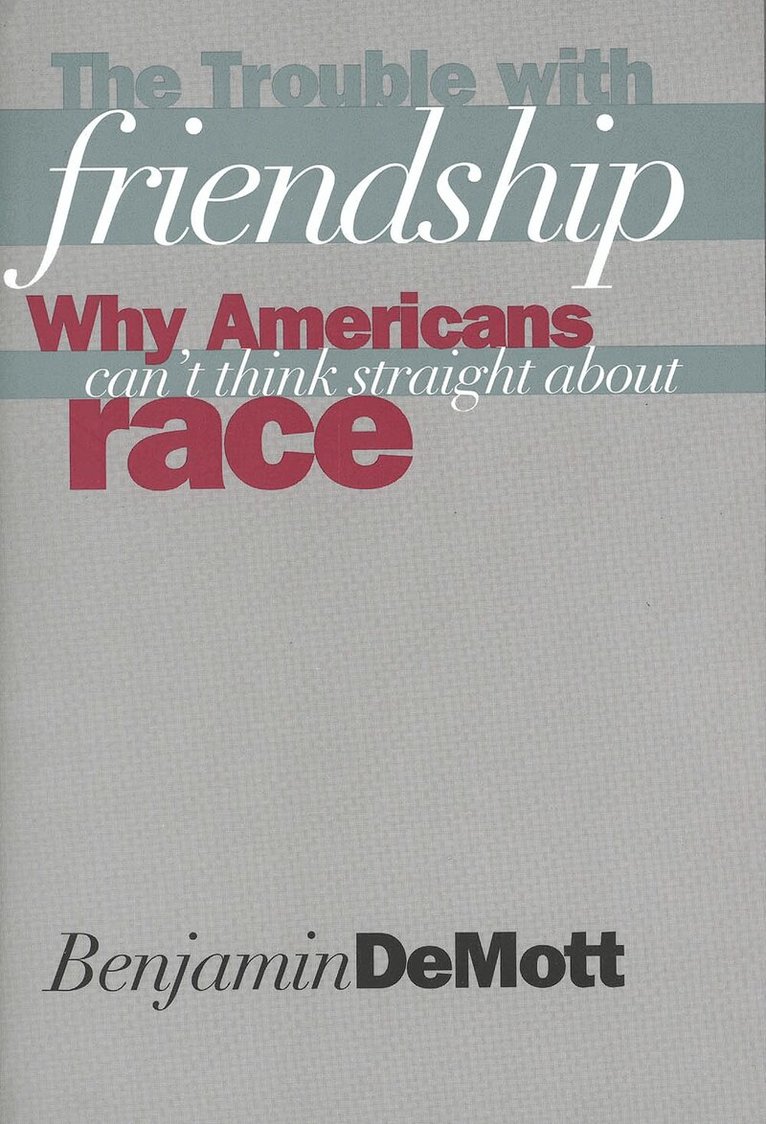
In this lively book, a well-known social critic draws on evidence from movies, TV, literature, and advertising to argue that many Americans have been lulled by the media into believing that racial problems can be substantially mitigated, even vanquished, by blacks and whites working together, one on one, to reconcile their differences. Benjamin DeMott believes that this position of "friendship orthodoxy" oversimplifies the causes of racism and allows us to ignore the harsh socioeconomic realities faced by many blacks in this country. "A fresh, witty and pertinent essay on race in America. . . . DeMott advances his simple yet subtle argument in graceful, nuanced writing."—Edward T. Chase, Nation "DeMott draws carefully and intelligently from the well of cultural evidence and delivers the boldest contribution to America's ongoing racial dialogue to come along in years."—Quinn Eli, Philadelphia Inquirer "A refreshingly original assessment of the state of black-white relationships in the United States."—George M. Fredrickson, New York Review of Books "DeMott argues his case persuasively in this important book, a clarion call to those still willing to consider the lessons of history before TV and advertising erase them completely."—Kirkus Reviews "Critical reading for anyone interested in the intersections of culture, race, and policy."—Kristal Brent Zook, LA Weekly "A uniquely fine book . . . on race relations in America. . . . A powerfully crafted call for a revolution in the way we see ourselves."—Courtland Milloy, Quarterly Black Review of Books
90 kr
Skickas inom 7-10 vardagar
686 kr
Skickas inom 10-15 vardagar
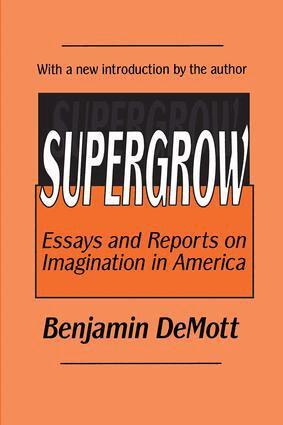
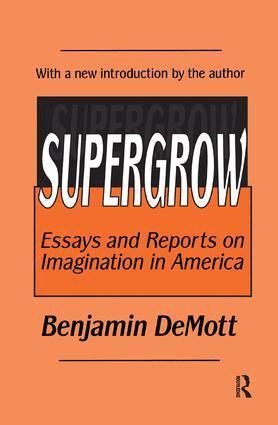
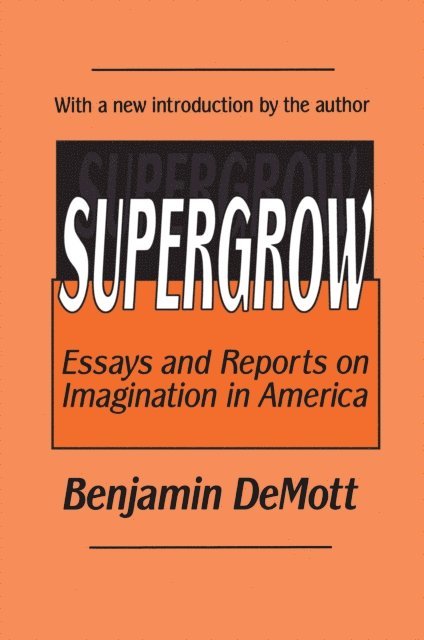
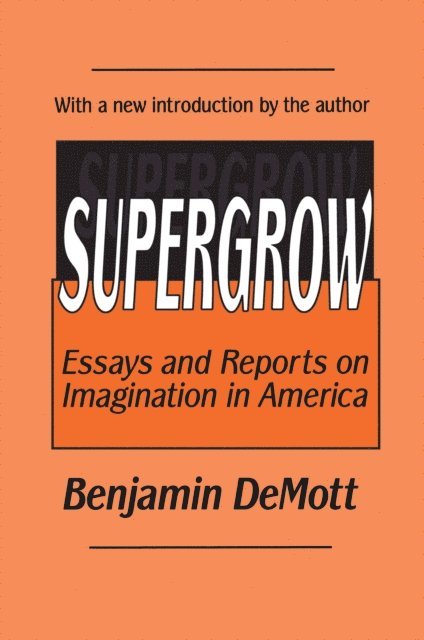
Supergrow is a collection of fifteen essays that appeared between 1966 and 1969 in publications such as the American Scholar, the New York Times, Antioch Review, Esquire, and the Saturday Review. Author Benjamin DeMott discusses everything under the sun--music, improving one's sex life, violence in Mississippi, theater, student revolts--but a single theme unifies the material: people ought to use their imaginations more. The book starts from the assumption that our troubles stem from failures of the imagination. Overcome by mass media, we are often too oblivious to fresh and original ideas. As DeMott states, "àthe right use of the constructive imagination increases the effectiveness of our energies, enables people to anticipate moves and countermoves, prevents them from becoming frozen into postures of intransigence or martyrdom which, though possessing a æterrible beauty,' have as their main consequence the stiffening of resistance and the slowing of change." Supergrow is a sociological and political critique of various aspects of everyday life in America, one informed by a powerful moral sensibility and an Emersonian sense of self-reliance. DeMott takes pop culture seriously, but exhibits a refreshing unwillingness to "go with the flow" and get caught up in fashionable intellectual fads. Graced with a new introduction by the author, Supergrow is an insightful work that is not afraid to tackle difficult subject matter. Whether discussing homosexuality, racism, popular music, or child rearing, Supergrow is well-reasoned, perceptive, and entertaining. As DeMott would hope, it will stimulate the imagination. "Devastating, sustained, profoundly witty, resounding." --New York Times Book Review "I didn't think it possible for a long time to come for any writer to say anything about black-and-white relations or lack of them that had freshness and pertinence. I was wrong."--Nat Hentoff, Village Voice Benjamin DeMott is an essayist, novelist, and journalist. He was professor of English at Amherst College, and a consultant and writer for National Educational Television. He is the author of The Body's Cage, Killer Blues: Why Americans Can't Think Straight about Gender and Power, and You Don't Say, available from Transaction.
333 kr
Skickas inom 10-15 vardagar
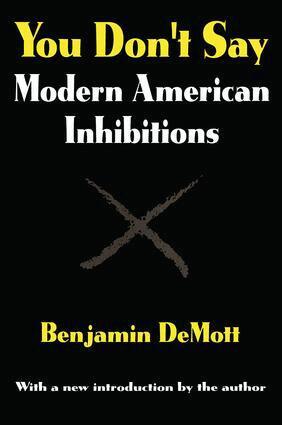
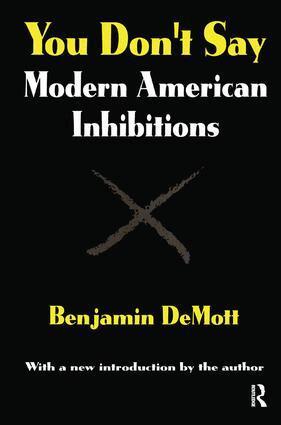
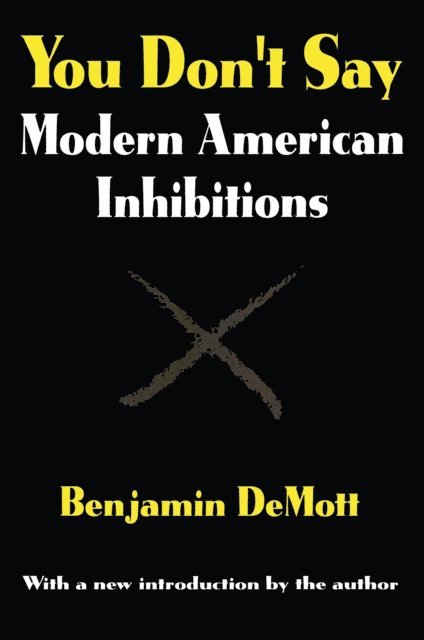
In this era of political correctness, it is often impossible to say things as one would like. Indeed, certain ways of feeling and talking that were once acceptable are now, in effect, forbidden. Of course, taboos extend further than speech. Social and sexual inhibitions are also evident. Benjamin DeMott argues that the very least a society should do is to try to understand the meaning of its own inhibitions. As he writes in this new edition of You Don't Say, "a supple awareness of the effective censorship of the day can toughen resistance to clich and stereotype, and is absolutely indispensable to the survival of sharp minds."At the center of You Don't Say is the proposition that the present age of personal liberation has created as many inhibitions as it has abolished. Some of our new-found freedoms could be employed with a sharper sense of tact. And some freedoms we have lost are worth remembering-or even recovering. In the essays that comprise You Don't Say DeMott reflects on the use of language, how modern man has claimed to be free of repression though the opposite is true, and how people who object to certain types of language and prefer verbal ambiguity do so possibly to assert their moral dignity and intelligence. The book is full of sharp observations, witty commentary, and empathetic description of the contemporary social and cultural scene.In an essay entitled "The Anatomy of Playboy," DeMott correlates the magazine's popularity with its reductionist tendencies: the world becomes reduced to the realities of sexual need and deprivation. In "The Passionate Mutes," the author reflects on the changing language of the greeting card throughout the years. "Dirty Words?" is a meditation on language itself, and on how mastery of the word was at one time a key to power. And in "Oyiemu-O?" DeMott considers the writing of "native" African and Indian authors in an age during which the colonialist viewpoint was considered authoritative. The author's new introduction discusses the essays in their historical context and how they are relevant to the present day, and describes how the book came into being."[A] book distinguished by its beauty as by its wisdom for-although we may feel the pressure of inhibition against admitting it-intellectual courage can be as beautiful as bodies swayed to music. The intelligence of hope can be as passionate as sexual hunger."-New York Times Book ReviewBenjamin DeMott is an essayist, novelist, and journalist. He was professor of English at Amherst College, and a consultant and writer for National Education Television. He is the author of The Body's Cage, Hells & Benefits, a collection of essays, and Killer Woman Blues: Why Americans Can't Think Straight About Gender and Power.
2 113 kr
Skickas inom 10-15 vardagar
Supergrow is a collection of fifteen essays that appeared between 1966 and 1969 in publications such as the American Scholar, the New York Times, Antioch Review, Esquire, and the Saturday Review. Author Benjamin DeMott discusses everything under the sun--music, improving one's sex life, violence in Mississippi, theater, student revolts--but a single theme unifies the material: people ought to use their imaginations more. The book starts from the assumption that our troubles stem from failures of the imagination. Overcome by mass media, we are often too oblivious to fresh and original ideas. As DeMott states, "àthe right use of the constructive imagination increases the effectiveness of our energies, enables people to anticipate moves and countermoves, prevents them from becoming frozen into postures of intransigence or martyrdom which, though possessing a æterrible beauty,' have as their main consequence the stiffening of resistance and the slowing of change." Supergrow is a sociological and political critique of various aspects of everyday life in America, one informed by a powerful moral sensibility and an Emersonian sense of self-reliance. DeMott takes pop culture seriously, but exhibits a refreshing unwillingness to "go with the flow" and get caught up in fashionable intellectual fads. Graced with a new introduction by the author, Supergrow is an insightful work that is not afraid to tackle difficult subject matter. Whether discussing homosexuality, racism, popular music, or child rearing, Supergrow is well-reasoned, perceptive, and entertaining. As DeMott would hope, it will stimulate the imagination. "Devastating, sustained, profoundly witty, resounding." --New York Times Book Review "I didn't think it possible for a long time to come for any writer to say anything about black-and-white relations or lack of them that had freshness and pertinence. I was wrong."--Nat Hentoff, Village Voice Benjamin DeMott is an essayist, novelist, and journalist. He was professor of English at Amherst College, and a consultant and writer for National Educational Television. He is the author of The Body's Cage, Killer Blues: Why Americans Can't Think Straight about Gender and Power, and You Don't Say, available from Transaction.
917 kr
Skickas inom 10-15 vardagar
In this era of political correctness, it is often impossible to say things as one would like. Indeed, certain ways of feeling and talking that were once acceptable are now, in effect, forbidden. Of course, taboos extend further than speech. Social and sexual inhibitions are also evident. Benjamin DeMott argues that the very least a society should do is to try to understand the meaning of its own inhibitions. As he writes in this new edition of You Don't Say, "a supple awareness of the effective censorship of the day can toughen resistance to clich and stereotype, and is absolutely indispensable to the survival of sharp minds."At the center of You Don't Say is the proposition that the present age of personal liberation has created as many inhibitions as it has abolished. Some of our new-found freedoms could be employed with a sharper sense of tact. And some freedoms we have lost are worth remembering-or even recovering. In the essays that comprise You Don't Say DeMott reflects on the use of language, how modern man has claimed to be free of repression though the opposite is true, and how people who object to certain types of language and prefer verbal ambiguity do so possibly to assert their moral dignity and intelligence. The book is full of sharp observations, witty commentary, and empathetic description of the contemporary social and cultural scene.In an essay entitled "The Anatomy of Playboy," DeMott correlates the magazine's popularity with its reductionist tendencies: the world becomes reduced to the realities of sexual need and deprivation. In "The Passionate Mutes," the author reflects on the changing language of the greeting card throughout the years. "Dirty Words?" is a meditation on language itself, and on how mastery of the word was at one time a key to power. And in "Oyiemu-O?" DeMott considers the writing of "native" African and Indian authors in an age during which the colonialist viewpoint was considered authoritative. The author's new introduction discusses the essays in their historical context and how they are relevant to the present day, and describes how the book came into being."[A] book distinguished by its beauty as by its wisdom for-although we may feel the pressure of inhibition against admitting it-intellectual courage can be as beautiful as bodies swayed to music. The intelligence of hope can be as passionate as sexual hunger."-New York Times Book ReviewBenjamin DeMott is an essayist, novelist, and journalist. He was professor of English at Amherst College, and a consultant and writer for National Education Television. He is the author of The Body's Cage, Hells & Benefits, a collection of essays, and Killer Woman Blues: Why Americans Can't Think Straight About Gender and Power.