Benjamin L. Huggins - Böcker
Visar alla böcker från författaren Benjamin L. Huggins. Handla med fri frakt och snabb leverans.
6 produkter
6 produkter
478 kr
Skickas inom 5-8 vardagar
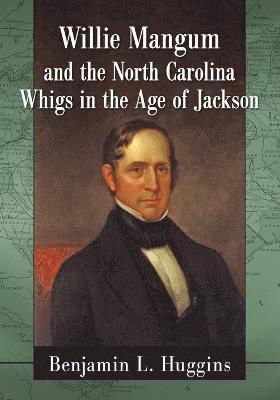
In the 1820s, young congressman Willie Mangum imbibed the political philosophy of North Carolina's senior senator Nathaniel Macon, the "prophet of pure republicanism." From his election in 1824, Mangum was at the epicenter of national and state government. In the 1830s, he emerged as leader of an opposition party--the Whigs--and became an opponent of Andrew Jackson and his Democratic Party.Mangum's career offers insight into the ideology and politics of North Carolina's Whigs. Opposition to executive power was fundamental to the Whig platform but in North Carolina the party was a coalition that melded the Old Republicans' creed with the National Republican economic agenda touted by Henry Clay, a combination that enabled them to dominate. Mangum and the Carolina Whigs have received little attention from scholars. This book traces their rapid rise to power and their even more rapid fall in the years prior to the Civil War.
1 291 kr
Skickas inom 11-20 vardagar
Volume 22 of the Revolutionary War Series covers 1 Aug. through 21 Oct. 1779. As it begins, Washington is focused on expanding and strengthening the fortifications at West Point, N.Y., in the wake of the British attack in June that had captured King's Ferry, New York. Although he had to concentrate his army on the defence of West Point, Washington sought to launch whatever strikes he could against the British forts on the Hudson River and bring his operations on the western frontier to a successful conclusion. To follow up the successful assault on Stony Point, N.Y., Washington planned a surprise attack on Paulus Hook, New Jersey. Maj. Henry Lee carried out the assault on 19 Aug. and succeeded in capturing the garrison and effecting a retreat back to the American lines in New Jersey. During the weeks covered by this volume, Maj. Gen. John Sullivan successfully completed his devastating expedition against the hostile tribes of the Six Nations. Though not in tactical command of the expedition, Washington, particularly in August, had to dedicate a substantial portion of his time to supervising logistical support for the expedition and defending himself against Sullivan's charges of failing to properly support the campaign.Washington's overriding concern in August, other than strengthening the defences of West Point, was the long anticipated arrival of British army reinforcements that would enable the enemy to renew their attack up the Hudson. After he received information confirming arrival of the reinforcements in late August, Washington pushed his defensive preparations into high gear, issuing orders designed to concentrate the main army near West Point and gather information about the reinforcements and British intentions.But within two weeks, Washington's assessment of his intelligence reports had convinced him that the British reinforcements were too few to enable the enemy to launch an offensive. When intelligence reports of a large French fleet on the coast began to arrive in September, he turned to planning his own offensive operations.The prospect of the arrival of the powerful French fleet of Vice Admiral d'Estaing on the American coast promised an opportunity to overcome British naval superiority. Washington first designed a limited attack on the British outposts surrounding New York City. Then, after receiving official confirmation from Congress of the arrival of the French admiral on the American coast, Washington planned a major attack on New York itself; an attack, as the letters in this volume show, which Washington designed to be decisive, to drive the British from North America, and potentially end the war.
1 331 kr
Skickas inom 11-20 vardagar
With volume 24 of the Revolutionary War Series, the conflict enters a new decade. New Year's Day 1780 finds Washington in winter quarters at Morristown, N.J., having established his headquarters at the Ford mansion there one month earlier.During the weeks covered by this volume, the Continental army experienced the harshest winter of the war. But the severity of the winter did not prevent Washington from mounting an offensive against British forces. Ice had formed a natural bridge to Staten Island, and Washington decided to use the situation to launch a major attack on the enemy's forts there. He assigned Major General Stirling to command the strike and assigned him 2,600 troops. Stirling launched the assault as planned in the early morning of 15 January, but the next day he had to report to Washington that the operation had failed. Although the attack was fruitless, it provides evidence of Washington's aggressive generalship: a major winter attack designed to cut off and capture enemy garrisons.Washington's enemy was not idle either. In addition to several raids on New Jersey towns and surprise attacks on outlying detachments, the British launched one operation with a far more ambitious goal: to seize Washington at the Ford mansion and carry him into New York City as a prisoner. The attack failed, but it was the deep snow--and not American bullets--that stopped the cavalry force sent to capture Washington.Enemy operations, however, were not the greatest threat to the survival of Washington's army. The harshness of the winter, the precarious state of Continental finances, and the resulting lack of provisions threatened his forces with starvation. To feed his troops, Washington implemented an emergency ""requisition"" of provisions throughout New Jersey.As usual, administration of the army consumed much of Washington's time. In addition to obtaining supplies, he had to oversee recruiting the army, obtaining clothing for his men, negotiating for the exchange of prisoners, and conducting inspections, as well as attending to the professionalism and discipline of the army. His burden became so heavy that in February he felt it would be ""impossible"" for him to execute the duties of commander in chief unless he received more support from his senior officers.Several letters to or from well-known figures of the Revolution appear in this volume, including Benedict Arnold, Benjamin Franklin, and Robert Morris. Washington's letter to Morris gives rare insight into the general's personal life. The commander in chief expressed his inclination to accept Morris's invitation to spend some of the winter with him, but he lamented that ""public duty"" necessitated remaining with the army at Morristown. He would, he explained to Morris, have to forgo such ""social enjoyments"" until the end of the war.
1 259 kr
Skickas inom 7-10 vardagar
Bad weather plagued Gen. George Washington's army during its winter encampment near Morristown, N.J., far into the spring of 1780. Finances caused further woes. Commissaries lacked both cash and credit to obtain provisions, and food shortages meant restless troops. Only vigorous exertions b largely anonymous supply officers kept Washington's army intact. Recognizing these grave financial needs, Congress passed reform legislation in March, but any benefit from the new system lay in the future. Washington tried to be optimistic as he tackled present challenges. Numerous officer resignations worried the general, who felt the loss of such experienced men undercut the army's effectiveness. Sensitive about morale, he pursued negotiations for a general prisoner exchange. Talks broke down quickly, however, because British negotiators acted only on local military authority rather than on the authority of the king. To Washington, that approach failed to recognize the legitimacy of the United States as a nation. Armed conflict as well as administrative perplexities occupied Washington's thoughts. At no point could he escape the reality that soldiers fought, soldiers died, and survivors - both comrades and loved ones - grieved. Raids into the patrol areas generally east of Morristown caused significant casualties on 22 March and 16 April. A larger confrontation unfolded around Charleston, S.C., where a British expedition from New York City encircled the city and its defenders under Maj. Gen. Benjamin Lincoln. Washington sent additional reinforcements and encouraged the beleaguered Lincoln, but Charleston's surrender on 12 May eventually came as no surprise. Washington hoped for better things from a congressional ""Committee at Headquarters,"" appointed to deal directly with the principal army officers to solve vexing supply questions. Such an approach promised some good after previous verbal sniping. Additionally, Major General Lafayette returned to the United States from France to announce the coming of a French expeditionary army. The king wanted this force to serve under Washington. The possibilities for this allied command undoubtedly excited the general, who openly recently had extended himself to pay proper respect to French minister La Luzerne during that official's visit to Morristown. Army responsibilities left Washington little opportunity to address his personal business, but he doted over a carriage purchase and offered the usual futile financial advice to his stepson John Parke Custis. Legal engagements undertaken years earlier for George William Fairfax and George Mercer provoked headaches. Despite Washington's conscientious efforts, these entanglements persisted until after the war. Washington never quailed form a personal or public obligation. Very much the realist, he knew that his army faced steep odds. Determined to overcome al obstacles, he strode ahead, fully aware that he shouldered the heaviest burdens of the revolutionary cause.
1 259 kr
Skickas inom 7-10 vardagar
Three major themes dominate George Washington’s correspondence in volume 27 of the Revolutionary War Series: the arrival of a French expeditionary army and navy, the urgent need to prepare the Continental army for a joint Franco-American offensive to take New York City, and the cultivation of Washington’s relationship with Lieutenant General Rochambeau, the commander of the French army. Urgency and vigor typified Washington’s planning throughout, as he raised new Continental troops, obtained militia reinforcements, increased Stocks of ammunition, gathered wagons and horses, and recognized that he and Rochambeau possessed similar views on campaign plans and other matters—a development that would ultimately prove essential to victory at Yorktown and the successful conclusion of the war.
1 259 kr
Skickas inom 7-10 vardagar
This volume 30 of the Revolutionary War series opens in January 1781 with a mutiny in the Continental army’s Pennsylvania regiments, presenting Gen. George Washington with one of the most formidable crises of the war. Although a negotiated settlement resolved the problem, he feared the implications for discipline in the rest of the army. Washington’s concerns were well founded, as news reached him that the New Jersey troops had followed suit. He sent a detachment of New England troops to put down the rebellion. In the meantime, a coastal storm that damaged British ships offered Washington an opportunity to defeat and capture Benedict Arnold, now in command of British and Loyalist troops in Virginia. The subsequent joint naval and land offensive with the French shifted the main theater of war from New York to the southern states, foreshadowing the coming campaign of Yorktown.