Benjamin Lazier - Böcker
Visar alla böcker från författaren Benjamin Lazier. Handla med fri frakt och snabb leverans.
2 produkter
2 produkter
297 kr
Skickas inom 7-10 vardagar
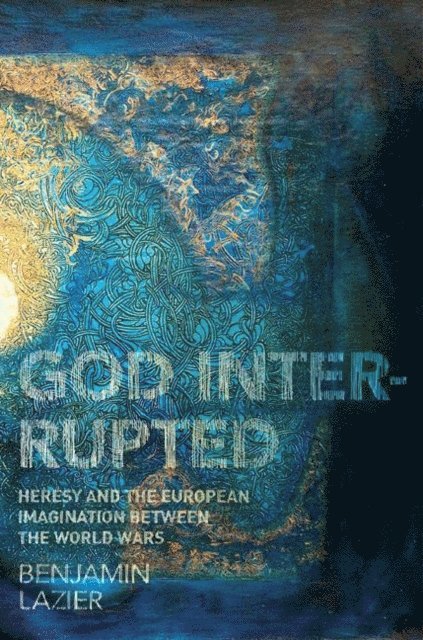
Could the best thing about religion be the heresies it spawns? Leading intellectuals in interwar Europe thought so. They believed that they lived in a world made derelict by God's absence and the interruption of his call. In response, they helped resurrect gnosticism and pantheism, the two most potent challenges to the monotheistic tradition. In God Interrupted, Benjamin Lazier tracks the ensuing debates about the divine across confessions and disciplines. He also traces the surprising afterlives of these debates in postwar arguments about the environment, neoconservative politics, and heretical forms of Jewish identity. In lively, elegant prose, the book reorients the intellectual history of the era. God Interrupted also provides novel accounts of three German-Jewish thinkers whose ideas, seminal to fields typically regarded as wildly unrelated, had common origins in debates about heresy between the wars. Hans Jonas developed a philosophy of biology that inspired European Greens and bioethicists the world over. Leo Strauss became one of the most important and controversial political theorists of the twentieth century.Gershom Scholem, the eminent scholar of religion, radically recast what it means to be a Jew. Together they help us see how talk about God was adapted for talk about nature, politics, technology, and art. They alert us to the abiding salience of the divine to Europeans between the wars and beyond--even among those for whom God was long missing or dead.

659 kr
Skickas inom 7-10 vardagar
This volume provides a cross-disciplinary examination of fear, that most unruly of our emotions, by offering a broad survey of the psychological, biological, and philosophical basis of fear in historical and contemporary contexts. The contributors, leading figures in clinical psychology, neuroscience, the social sciences, and the humanities, consider categories of intentionality, temporality, admixture, spectacle, and politics in evaluating conceptions of fear.Individual chapters treat manifestations of fear in the mass panic of the stock market crash of 1929, as spectacle in warfare and in horror films, and as a political tool to justify security measures in the wake of terrorist acts. They also describe the biological and evolutionary roots of fear, fear as innate versus learned behavior in both humans and animals, and conceptions of human \u201cpassions\u201d and their self-mastery from late antiquity to the early modern era. Additionally, the contributors examine theories of intentional and non-intentional reactivity, the process of fear-memory coding, and contemporary psychology’s emphasis on anxiety disorders.Overall, the authors point to fear as a dense and variable web of responses to external and internal stimuli. Our thinking about these reactions is just as complex. In response, this volume opens a dialogue between science and the humanities to afford a more complete view of an emotion that has shaped human behavior since time immemorial.