Benjamin Weissman - Böcker
Visar alla böcker från författaren Benjamin Weissman. Handla med fri frakt och snabb leverans.
3 produkter
3 produkter
855 kr
Skickas inom 10-15 vardagar
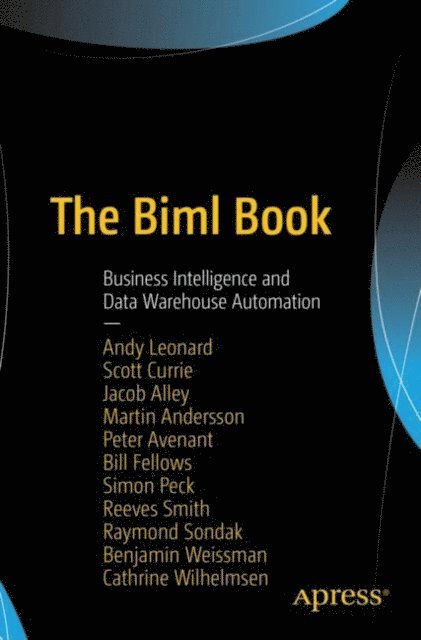
Learn Business Intelligence Markup Language (Biml) for automating much of the repetitive, manual labor involved in data integration. We teach you how to build frameworks and use advanced Biml features to get more out of SQL Server Integration Services (SSIS), Transact-SQL (T-SQL), and SQL Server Analysis Services (SSAS) than you ever thought possible.The first part of the book starts with the basics—getting your development environment configured, Biml syntax, and scripting essentials.Whether a beginner or a seasoned Biml expert, the next part of the book guides you through the process of using Biml to build a framework that captures both your design patterns and execution management. Design patterns are reusable code blocks that standardize the approach you use to perform certain types of data integration, logging, and other key data functions. Design patterns solve common problems encountered when developing data integration solutions.Because you do not have to build the code from scratch each time, design patterns improve your efficiency as a Biml developer.In addition to leveraging design patterns in your framework, you will learn how to build a robust metadata store and how to package your framework into Biml bundles for deployment within your enterprise.In the last part of the book, we teach you more advanced Biml features and capabilities, such as SSAS development, T-SQL recipes, documentation autogeneration, and Biml troubleshooting.The Biml Book:Provides practical and applicable examplesTeaches you how to use Biml to reduce development time while improving qualityTakes you through solutions to common data integration and BI challengesWhat You'll LearnMaster the basics of Business Intelligence Markup Language (Biml)Study patterns for automating SSIS package generationBuild a Biml FrameworkImport and transform database schemasAutomate generation of scripts and projectsWho This Book Is ForBI developers wishing to quickly locate previously tested solutions, Microsoft BI specialists, those seeking more information about solution automation and code generation, and practitioners of Data Integration Lifecycle Management (DILM) in the DevOps enterprise
556 kr
Skickas inom 10-15 vardagar
Use this guide to one of SQL Server 2019’s most impactful features—Big Data Clusters. You will learn about data virtualization and data lakes for this complete artificial intelligence (AI) and machine learning (ML) platform within the SQL Server database engine. You will know how to use Big Data Clusters to combine large volumes of streaming data for analysis along with data stored in a traditional database. For example, you can stream large volumes of data from Apache Spark in real time while executing Transact-SQL queries to bring in relevant additional data from your corporate, SQL Server database. Filled with clear examples and use cases, this book provides everything necessary to get started working with Big Data Clusters in SQL Server 2019. You will learn about the architectural foundations that are made up from Kubernetes, Spark, HDFS, and SQL Server on Linux. You then are shown how to configure and deploy Big Data Clusters in on-premises environments or in the cloud. Next, you are taught about querying. You will learn to write queries in Transact-SQL—taking advantage of skills you have honed for years—and with those queries you will be able to examine and analyze data from a wide variety of sources such as Apache Spark. Through the theoretical foundation provided in this book and easy-to-follow example scripts and notebooks, you will be ready to use and unveil the full potential of SQL Server 2019: combining different types of data spread across widely disparate sources into a single view that is useful for business intelligence and machine learning analysis. What You Will LearnInstall, manage, and troubleshoot Big Data Clusters in cloud or on-premise environmentsAnalyze large volumes of data directly from SQL Server and/or Apache SparkManage data stored in HDFS from SQL Server as if it wererelational dataImplement advanced analytics solutions through machine learning and AIExpose different data sources as a single logical source using data virtualizationWho This Book Is ForData engineers, data scientists, data architects, and database administrators who want to employ data virtualization and big data analytics in their environments
319 kr
Skickas inom 3-6 vardagar