Bernard C. Perley - Böcker
Visar alla böcker från författaren Bernard C. Perley. Handla med fri frakt och snabb leverans.
7 produkter
7 produkter
Defying Maliseet Language Death
Emergent Vitalities of Language, Culture, and Identity in Eastern Canada
Inbunden, Engelska, 2011
636 kr
Skickas inom 7-10 vardagar
Published through the Recovering Languages and Literacies of the Americas initiative, supported by the Andrew W. Mellon Foundation Today, indigenous communities throughout North America are grappling with the dual issues of language loss and revitalization. While many communities are making efforts to bring their traditional languages back through educational programs, for some communities these efforts are not enough or have come too late to stem the tide of language death, which occurs when there are no remaining fluent speakers and the language is no longer used in regular communication. The Maliseet language, as spoken in the Tobique First Nation of New Brunswick, Canada, is one such endangered language that will either be revitalized and survive or will die off. Defying Maliseet Language Death is an ethnographic study by Bernard C. Perley, a member of this First Nation, that examines the role of the Maliseet language and its survival in Maliseet identity processes. Perley examines what is being done to keep the Maliseet language alive, who is actively involved in these processes, and how these two factors combine to promote Maliseet language survival. He also explores questions of identity, asking the important question: “If Maliseet is no longer spoken, are we still Maliseet?” This timely volume joins the dual issues of language survival and indigenous identity to present a unique perspective on the place of language within culture.
Defying Maliseet Language Death
Emergent Vitalities of Language, Culture, and Identity in Eastern Canada
Häftad, Engelska, 2012
367 kr
Skickas inom 10-15 vardagar
Published through the Recovering Languages and Literacies of the Americas initiative, supported by the Andrew W. Mellon Foundation Today, indigenous communities throughout North America are grappling with the dual issues of language loss and revitalization. While many communities are making efforts to bring their traditional languages back through educational programs, for some communities these efforts are not enough or have come too late to stem the tide of language death, which occurs when there are no remaining fluent speakers and the language is no longer used in regular communication. The Maliseet language, as spoken in the Tobique First Nation of New Brunswick, Canada, is one such endangered language that will either be revitalized and survive or will die off. Defying Maliseet Language Death is an ethnographic study by Bernard C. Perley, a member of this First Nation, that examines the role of the Maliseet language and its survival in Maliseet identity processes. Perley examines what is being done to keep the Maliseet language alive, who is actively involved in these processes, and how these two factors combine to promote Maliseet language survival. He also explores questions of identity, asking the important question: “If Maliseet is no longer spoken, are we still Maliseet?” This timely volume joins the dual issues of language survival and indigenous identity to present a unique perspective on the place of language within culture.
1 898 kr
Skickas inom 10-15 vardagar
Language, whether spoken, written, or signed, is a powerful resource that is used to facilitate social justice or undermine it. The first reference resource to use an explicitly global lens to explore the interface between language and social justice, this volume expands our understanding of how language symbolizes, frames, and expresses political, economic, and psychic problems in society, thus contributing to visions for social justice.Investigating specific case studies in which language is used to instantiate and/or challenge social injustices, each chapter provides a unique perspective on how language carries value and enacts power by presenting the historical contexts and ethnographic background for understanding how language engenders and/or negotiates specific social justice issues. Case studies are drawn from Africa, Asia, Europe, North and South America and the Pacific Islands, with leading experts tackling a broad range of themes, such as equality, sovereignty, communal well-being, and the recognition of complex intersectional identities and relationships within and beyond the human world.Putting issues of language and social justice on a global stage and casting light on these processes in communities increasingly impacted by ongoing colonial, neoliberal, and neofascist forms of globalization, Language and Social Justice is an essential resource for anyone interested in this area of research.
541 kr
Skickas inom 10-15 vardagar
Language, whether spoken, written, or signed, is a powerful resource that is used to facilitate social justice or undermine it. The first reference resource to use an explicitly global lens to explore the interface between language and social justice, this volume expands our understanding of how language symbolizes, frames, and expresses political, economic, and psychic problems in society, thus contributing to visions for social justice.Investigating specific case studies in which language is used to instantiate and/or challenge social injustices, each chapter provides a unique perspective on how language carries value and enacts power by presenting the historical contexts and ethnographic background for understanding how language engenders and/or negotiates specific social justice issues. Case studies are drawn from Africa, Asia, Europe, North and South America and the Pacific Islands, with leading experts tackling a broad range of themes, such as equality, sovereignty, communal well-being, and the recognition of complex intersectional identities and relationships within and beyond the human world.Putting issues of language and social justice on a global stage and casting light on these processes in communities increasingly impacted by ongoing colonial, neoliberal, and neofascist forms of globalization, Language and Social Justice is an essential resource for anyone interested in this area of research.
988 kr
Skickas inom 7-10 vardagar
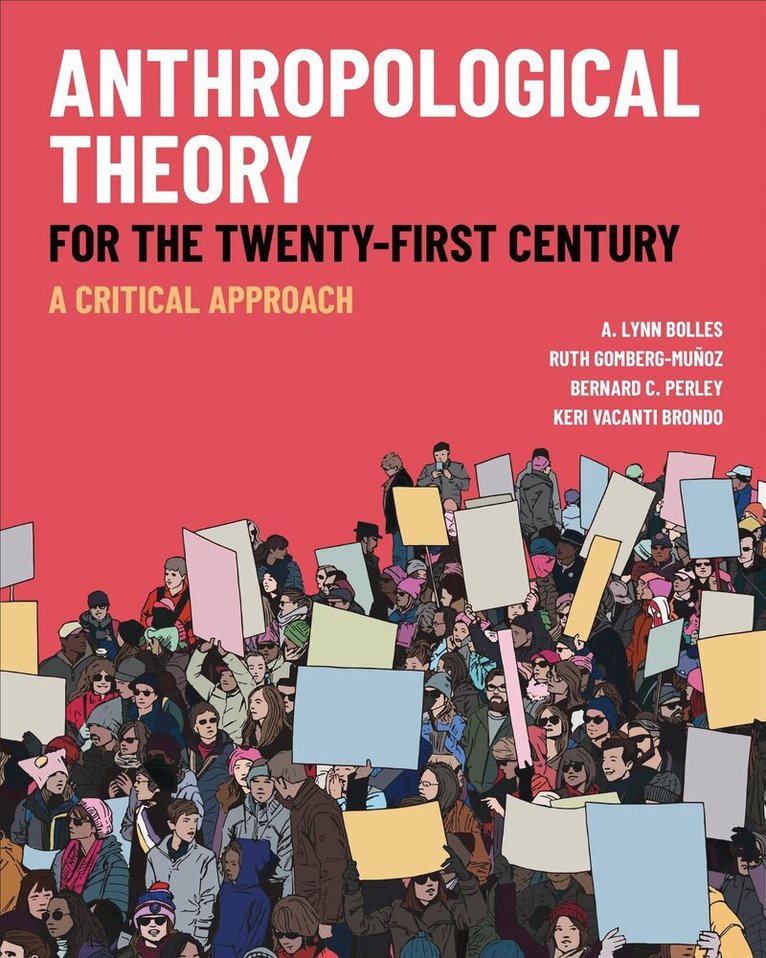
Anthropological Theory for the Twenty-First Century presents a critical approach to the study of anthropological theory for the next generation of aspiring anthropologists. Through a carefully curated selection of readings, this collection reflects the diversity of scholars who have long contributed to the development of anthropological theory, incorporating writings by scholars of color, non-Western scholars, and others whose contributions have historically been under-acknowledged. The volume puts writings from established canonical thinkers, such as Marx, Boas, and Foucault, into productive conversations with Du Bois, Ortiz, Medicine, Trouillot, Said, and many others. The editors also engage in critical conversations surrounding the "canon" itself, including its colonial history and decolonial potential.Updating the canon with late twentieth-century and early twenty-first-century scholarship, this reader includes discussions of contemporary theories such as queer theory, decolonial theory, ontology, and anti-racism. Each section is framed by clear and concise editorial introductions that place the readings in context and conversation with each other, as well as questions and glossaries to guide reader comprehension. A dynamic companion website features additional resources, including links to videos, podcasts, articles, and more.
634 kr
Skickas inom 5-8 vardagar
Anthropological Theory for the Twenty-First Century presents a critical approach to the study of anthropological theory for the next generation of aspiring anthropologists. Through a carefully curated selection of readings, this collection reflects the diversity of scholars who have long contributed to the development of anthropological theory, incorporating writings by scholars of color, non-Western scholars, and others whose contributions have historically been under-acknowledged. The volume puts writings from established canonical thinkers, such as Marx, Boas, and Foucault, into productive conversations with Du Bois, Ortiz, Medicine, Trouillot, Said, and many others. The editors also engage in critical conversations surrounding the "canon" itself, including its colonial history and decolonial potential.Updating the canon with late twentieth-century and early twenty-first-century scholarship, this reader includes discussions of contemporary theories such as queer theory, decolonial theory, ontology, and anti-racism. Each section is framed by clear and concise editorial introductions that place the readings in context and conversation with each other, as well as questions and glossaries to guide reader comprehension. A dynamic companion website features additional resources, including links to videos, podcasts, articles, and more.
Remediating Cartographies of Erasure
Anthropology, Indigenous Epistemologies, and the Global Imaginary
Inbunden, Engelska, 2025
718 kr
Skickas inom 10-15 vardagar
Remediating Cartographies of Erasure brings together leading sociocultural and linguistic anthropologists to explore the moral imperatives of anthropology as a discipline to contribute to the self-determination and equality of Indigenous peoples around the globe. This engaged collaboration highlights the partnerships between Indigenous communities and anthropology as a mutually respectful and emancipatory practice of Indigenous and anthropological epistemologies.Indigenous scholars from New Zealand, the United States, and Canada and non-Indigenous scholars from Australia, the United States, and Canada each provide concrete examples of how researchers actualize the moral imperative to work with Indigenous peoples in ways that foster their human rights and self-determination. The contributors discuss anthropological work done in Canada, the United States, Brazil, Peru, Bolivia, Honduras, Australia, Sardinia, and New Zealand.In laying out a world anthropology, this volume demonstrates the rectification practices of Indigenous peoples and continues anthropology’s long-standing advocacy for social justice and human rights around the globe.