• Fri frakt över 249 kr
  • •
  • Snabba leveranser
  • •
  • Billiga böcker
Kundservice

Du är på sajten för privatpersoner.

Företag, bibliotek eller offentlig verksamhet?

Du handlar på classic.bokus.com, där alla dina funktioner finns intakta.
Till classic.bokus.com
Bokus logotyp. Gå till startsidan.
  • Erbjudanden
  • Nyheter
  • Student
  • Topplistor
  • Barn & ungdom
  • Bokus Play
  • E-böcker
  • Pocketböcker
  • Spel & pussel

10% rabatt på allt med kod: NYSTART10 →

Sidfot

Mina sidor

    Hjälp

    • Kundservice
    • Vanliga frågor och svar
    • Frakt och leverans
    • Retur vid ångerrätt
    • Reklamera vara
    • Betalning
    • Köpvillkor
    • Allmänna villkor
    • Information om webbplatsens tillgänglighet

    Om Bokus

    • Om oss
    • Pressrum
    • För studenter
    • För företag
    • För bibliotek och offentlig verksamhet
    • För leverantörer
    • Hållbarhet

    Populärt

    • Aktuella erbjudanden
    • Presentkort
    • Studentlitteratur
    • Nya böcker
    • Topplistor
    • Signerade böcker
    • Engelska böcker

    Inspiration

    • Boktips
    • BookTok
    • Populära bokserier
    • Barnbokskaraktärer
    • Populära författare
    Logotyp för Bokus
    Följ oss på Facebook (extern länk)Följ oss på Instagram (extern länk)Följ oss på YouTube (extern länk)Följ oss på TikTok (extern länk)
    bokus @ CookiesAnpassa cookiesIntegritetspolicyKöpvillkor
    Till Citymail hemsida (extern länk)Till Budbee hemsida (extern länk)Till Postnord hemsida (extern länk)Till Schenker hemsida (extern länk)Till Early Bird hemsida (extern länk)Till Walleys hemsida (extern länk)
    1. Samhälle och politik
    2. Samhälle och kultur
    3. Sociala grupper och identitet
    4. Genusvetenskap

    Anthropological Theory for the Twenty-First Century

    A Critical Approach

    AvA. Lynn Bolles,Ruth Gomberg-Muñoz

    Inbunden, Engelska, 2022

    1 033 kr

    Beställningsvara. Skickas inom 5-8 vardagar. Fri frakt över 249 kr.

    Fler format och utgåvor

    Häftad

    646 kr

    Häftad

    Kommande

    E-bok

    504 kr

    E-bok

    521 kr

    Beskrivning

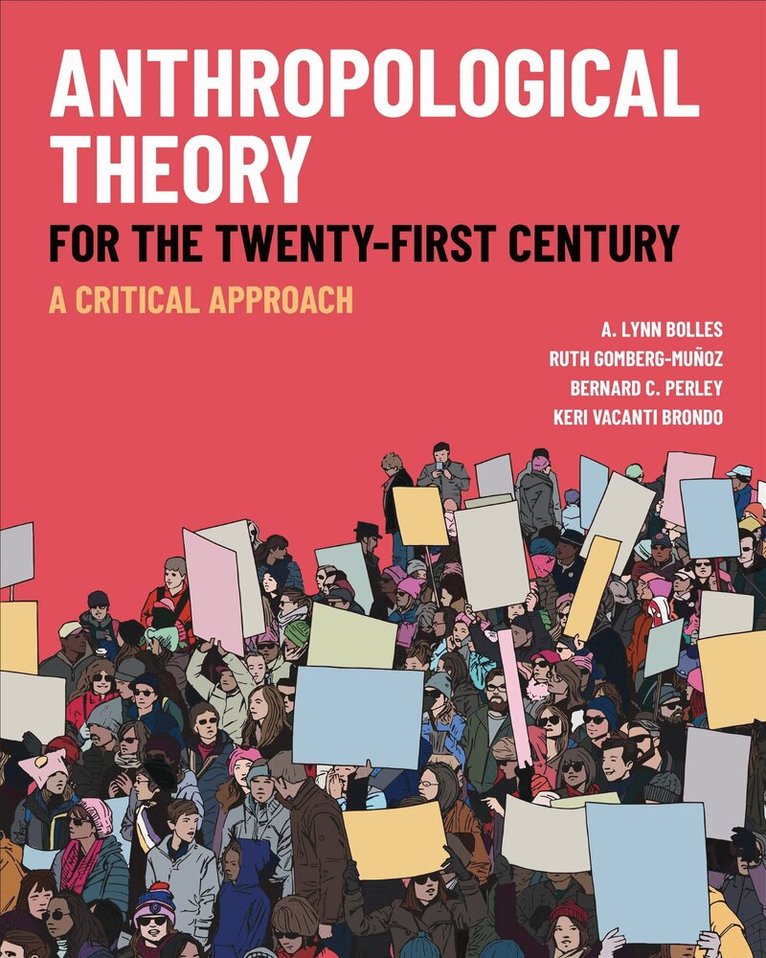
    Anthropological Theory for the Twenty-First Century presents a critical approach to the study of anthropological theory for the next generation of aspiring anthropologists. Through a carefully curated selection of readings, this collection reflects the diversity of scholars who have long contributed to the development of anthropological theory, incorporating writings by scholars of color, non-Western scholars, and others whose contributions have historically been under-acknowledged. The volume puts writings from established canonical thinkers, such as Marx, Boas, and Foucault, into productive conversations with Du Bois, Ortiz, Medicine, Trouillot, Said, and many others. The editors also engage in critical conversations surrounding the "canon" itself, including its colonial history and decolonial potential.Updating the canon with late twentieth-century and early twenty-first-century scholarship, this reader includes discussions of contemporary theories such as queer theory, decolonial theory, ontology, and anti-racism. Each section is framed by clear and concise editorial introductions that place the readings in context and conversation with each other, as well as questions and glossaries to guide reader comprehension. A dynamic companion website features additional resources, including links to videos, podcasts, articles, and more.

    Produktinformation

    • Utgivningsdatum:2022-03-07
    • Mått:210 x 260 x 28 mm
    • Vikt:1 160 g
    • Format:Inbunden
    • Språk:Engelska
    • Antal sidor:472
    • Förlag:University of Toronto Press
    • ISBN:9781487508845

    Utforska kategorier

    • Genusvetenskap inom Samhälle och politik
    • Etnicitet inom Samhälle och politik

    Mer om författaren

    A. Lynn Bolles is a professor emerita in the Department of Women’s Studies at the University of Maryland. Ruth Gomberg-Muñoz is an associate professor in the Department of Anthropology at Loyola University Chicago.Bernard C. Perley is an associate professor and director of the Institute for Critical Indigenous Studies at the University of British Columbia.Keri Vacanti Brondo is a professor and chair of the Department of Anthropology at the University of Memphis.

    Innehållsförteckning

    • INTRODUCTION: A Contested CanonSECTION ONE: On Roots of Social DifferenceEditors’ Introduction 1. William Apess. 1833. An Indian’s Looking Glass for the White Man. 2. Frederick Douglass. 1854. The Claims of the Negro, Ethnologically Considered.3. Karl Marx and Frederick Engels. 1872. Bourgeois and Proletarians. 4. Lewis Henry Morgan. 1877. Ethnical Periods. 5. Lucy Parsons. 1905. Afternoon Session, June 29th, Speeches at the Founding Convention of the Industrial Workers of the World.6. Max Weber. 1905. Excerpt from The Protestant Ethic and the Spirit of CapitalismSECTION TWO: On Methods of Fieldwork Editors’ Introduction 1. Edward Sapir. 1912. Language and Environment 1. 2. Arthur Caswell Parker. 1916. The Origin of the Iroquois As Suggested by their Archaeology. 3. Franz Boas. 1920. Methods of Ethnology. 4. Margaret Mead. 1926. The Methodology of Racial Testing: Its Significance for Sociology.5. Zora Neale Hurston. 1935. Excerpt from Mules and Men. SECTION THREE: On Hidden Logics of CultureEditors’ Introduction1. Bronisław Malinowski. 1922. The Essentials of the Kula. 2. Marcel Mauss. 1925. Excerpt from The Gift. 3. Ruth Benedict. 1935. The Science of Custom. 4. Jomo Kenyatta. 1938. Excerpt from Facing Mt. Kenya. 5. Claude Lévi-Strauss. 1951. Language and the Analysis of Social Laws. SECTION FOUR: On Power, History, and InequalityEditors’ Introduction 1. W.E.B DuBois. 1935. The White Worker. 2. Fernando Ortiz. 1940. On the Social Phenomenon of "Transculturation" and Its Importance in Cuba. 3. Eric Wolf. 1982. The World in 1400. 4. Ann L. Stoler. 1989. Making Empire Respectable: The Politics of Race and Sexual Morality in 20th-Century Colonial Cultures. 5. Paul Farmer. 2004. An Anthropology of Structural Violence. SECTION FIVE: On Writing Cultures Editors’ Introduction1. Katherine Dunham. 1946. Twenty-Seventh Day.2. Clifford Geertz. 1973. Notes on the Balinese Cockfight. 3. Renato Rosaldo. 1989. Grief and the Headhunters Rage. 4. Lila Abu-Lughod. 1991. Writing Against Culture. 5. Rosabelle Boswell. 2017. Sensuous Stories in the Indian Ocean Islands. SECTION SIX: On Colonialism and Anthropological "Others" Editors’ Introduction1. Beatrice Medicine. 1978. Learning to Be an Anthropologist and Remaining "Native." 2. Edward W. Said. 1979. Knowing the Oriental.  3. Esteban Krotz. 1997. Anthropologies of the South: Their Rise, Their Silencing, Their Characteristics. 4. Rolph-Michel Trouillot. 2003. Anthropology and the Savage Slot: The Poetics and Politics of Otherness. 5. Epeli Hau’ofa. 2008. Our Sea of Islands.SECTION SEVEN: On Anthropology and GenderEditors’ Introduction 1. Eleanor Burke Leacock. 1972. Introduction to The Origin of the Family, Private Property and the State: In the Light of the Researches of Lewis H. Morgan, by Frederick Engels.2. Sylvia Junko Yanagisako and Jane Fishburne Collier. 1987. Toward a Unified Analysis of Gender and Kinship. 3. Ifi Amadiume. 1987. Excerpt from Male Daughters, Female Husbands: Gender and Sex in an African Society. 4. Gloria Anzaldúa. 1987. La conciencia de la mestiza/Towards a new consciousness. 5. Philippe Bourgois. 1996. In Search of Masculinity: Violence, Respect and Sexuality among Puerto Rican Crack Dealers in East Harlem. SECTION EIGHT: On Queering Anthropological Knowledge Production Editors’ Introduction 1. Michel Foucault. 1976. Excerpt from The History of Sexuality, Vol. I2. Evan B. Towle and Lynn M. Morgan. 2002. Romancing the Transgender Native: Rethinking the Use of the "Third Gender" Concept. 3. Susan Stryker. 2008. Transgender History, Homonormativity, and Disciplinarity. 4. Jafari Allen. 2012. One Way or Another: Erotic Subjectivity in Cuba.5. Savannah Shange. 2019. Play Aunties and Dyke Bitches: Gender, Generation, and the Ethics of Black Queer Kinship. SECTION NINE: On Social Position and Ethnographic AuthorityEditors’ Introduction 1. Donna Haraway. 1988. Situated Knowledges: The Science Question in Feminism and the Privilege of Partial Perspective.2. Delmos Jones. 1995. Anthropology and the Oppressed: A Reflection on "Native" Anthropology. 3. Dana-Ain Davis. 2003. What Did You Do Today? Notes From a Politically Engaged Anthropologist.4. Heike Becker, Emile Boonzaier, and Joy Owen. 2005. Fieldwork in Shared Spaces: Positionality, Power and Ethics of Citizen Anthropologists in Southern Africa. 5. Bernard Perley. 2013. "Gone Anthropologist": Epistemic Slippage, Native Anthropology, and the Dilemmas of Representation. SECTION TEN: On Theorizing GlobalizationEditors’ Introduction 1. Arjun Appadurai. 1986. Theory in Anthropology: Center and Periphery.2. Akhil Gupta and James Ferguson. 1992. Beyond "Culture": Space, Identity, and the Politics of Difference.3. Aihwa Ong. 2006. Mutations in Citizenship. 4. Faye Harrison. 2008. Global Apartheid at Home and Abroad.5. Gustavo Lins Ribeiro. 2009. Non-Hegemonic Globalizations: Alter-Native Transnational Processes and Agents.SECTION ELEVEN: On Environment, Pluriverse, and PowerEditors’ Introduction1. Julian Steward. 1955. The Concept and Method of Cultural Ecology.2. Paige West. 2005. Translation, Value, and Space: Theorizing an Ethnographic and Engaged Environmental Anthropology.  3. Zöe Todd. 2015. Indigenizing the Anthropocene.  4. Arturo Escobar. 2018. Excerpt from Designs for a Pluriverse: Radical Interdependence, Autonomy and the Making of Worlds.5. Alaka Wali. 2020. Complicity and Resistance in the Indigenous Amazon: Economía Indígena Under Siege.  SECTION TWELVE: On State PowerEditors’ Introduction1. Pierre Bourdieu. 1977. Symbolic Power2. Begoña Aretxaga. 1998. What the Border Hides: Partition and Gender Politics of Irish Nationalism3. Katherine Verdery. 2002. Seeing like a mayor. Or, how local officials obstructed Romanian land restitution4. Achille Mbembé. 2003. Necropolitics.5. Christen Smith. 2013. Strange Fruit: Brazil, Necropolitics, and the Transnational Resonance of Torture and Death. SECTION THIRTEEN: On Agency and Social StruggleEditors’ Introduction 1. Saba Mahmood. 2005. The Subject of Freedom. 2. Shalini Shankar. 2008. Speaking like a Model Minority: "FOB" Styles, Gender, and Racial Meanings among Desi Teens in Silicon Valley. 3. Victoria Redclift. 2013. Abjects or Agents? Camps, Contests, and the Creation of "Political Space."4. Yarimar Bonilla and Jonathan Rosa. 2015. #Ferguson: Digital Protest, Hashtag Ethnography, and the Racial Politics of Social Media in the United States. 5. Audra Simpson. 2016. Consent’s Revenge.SECTION FOURTEEN: On Critical Theory for the 21st CenturyEditors’ Introduction1. Lynn Bolles. 2001. Seeking the Ancestors: Forging a Black Feminist Tradition in Anthropology.2. Leith Mullings. 2005. Interrogating Racism: Toward an Antiracist Anthropology.3. Ghassan Hage. 2016. Towards an Ethics of the Theoretical Encounter.4. Jeff Maskovsky. At Home in the End Times.5. Kim TallBear. 2019. Caretaking Relations, Not American Dreaming.PROVOCATION: Going Native: A Satirical "End" to Anthropology Theory