Bernard M. W. Knox - Böcker
Visar alla böcker från författaren Bernard M. W. Knox. Handla med fri frakt och snabb leverans.
7 produkter
7 produkter
407 kr
Skickas inom 7-10 vardagar
An anthology of classical literature features more than three hundred selections, including pieces on the origins of the Greek language, worksby Homer, discussion on the fall of Rome and St. Augustine, and more.
225 kr
Skickas inom 5-8 vardagar
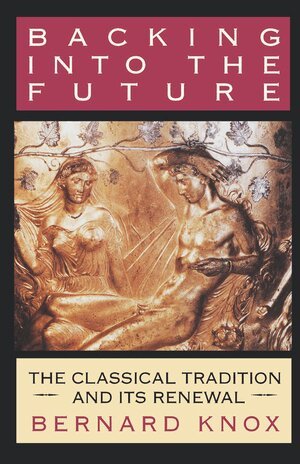
Should the ancient Greeks—"the oldest dead white European males"—be kept alive in our collective memory? Why study them at all if, by passing their destructive ideas to the Romans and eventually to the rest of Europe, they may ultimately be responsible for much of what’s wrong with American society? In this “supremely lucid and elegant” book (The New Yorker), Bernard Knox poses and answers such fundamental questions, helping us to remember the astonishing originality of the ancient Greeks and all that we have learned—and continue to learn—from them.
344 kr
Skickas inom 5-8 vardagar
"Prospective readers puzzled by the somewhat enigmatic title Backing into the Future may well come to the conclusion that it is a reference to the amusing film produced in 1985, called Back to the Future. But in fact the source of the title is much older. The phrase is based on a number of expressions found in ancient Greek literary texts: the chorus's description of its bewilderment in Sophocles's Oedipus the King, for example -- 'not seeing what is here nor what is behind' -- or the characterization of an older man in Homer's Odyssey as 'the one who sees what is in front and what is behind.' The natural reaction of the modern reader is to understand the first of these expressions as 'not seeing the present nor the past,' and the second as 'who sees the future and the past.' But the Greek word opiso, which means literally 'behind' or 'back,' refers not to the past but to the future. The early Greek imagination envisaged the past and the present as in front of us – we can see them. The future, invisible, is behind us. Only a few very wise men can see what is behind them; some of these men, like the blind prophet Tiresias, have been given this privilege by the gods. The rest of us, though we have our eyes, are walking blind, backwards into the future." --from the Foreword
297 kr
Skickas inom 7-10 vardagar
The first two chapters of this book isolate and describe the literary phenomenon of the Sophoclean tragic hero. In all but one of the extant Sophoclean dramas, a heroic figure who is compounded of the same literary elements faced a situation which is essentially the same. The demonstration of this recurrent pattern is made not through character-analysis, but through a close examination of the language employed by both the hero and those with whom he contends. The two chapters attempt to present what might, with a slight exaggeration, be called the 'formula' of Sophoclean tragedy. A great artist may repeat a structural pattern but he never really repeats himself. In the remaining four chapters, a close analysis of three plays, the Antigone, Philoctetes, and Oedipus at Colonus, emphasizes the individuality and variety of the living figures Sophocles created on the same basic armature.This approach to Sophoclean drama is (as in the author's previous work on the subject) both historical and critical; the universal and therefore contemporary appeal of the plays is to be found not by slighting or dismissing their historical context, but by an attempt to understand it all in its complexity. 'The play needs to be seen as what it was, to be understood as what it is'.
The Cambridge History of Classical Literature: Volume 1, Greek Literature, Part 1, Early Greek Poetry
Häftad, Engelska, 1989
772 kr
Skickas inom 7-10 vardagar
The period from the eighth to the fifth centuries B.C. was one of extraordinary creativity in the Greek-speaking world. Poetry was a public and popular medium, and its production was closely related to developments in contemporary society. At the time when the city states were acquiring their distinctive institutions epic found the greatest of all its exponents in Homer, and lyric poetry for both solo and choral performance became a genre which attracted poets of the first rank, writers of the quality of Sappho, Alcaeus and Pindar, whose influence on later literature was to be profound. This volume covers the epic tradition, the didactic poems of Hesiod and his imitators, and the wide-ranging work of the iambic, elegiac and lyric poets of what is loosely called the archaic age. The contributors make use of recent papyrus finds (particularly in the case of Archilochus and Stesichorus) to fill out the picture of a cosmopolitan and highly sophisticated literary culture which had not yet found its intellectual centre in Athens.
The Cambridge History of Classical Literature: Volume 1, Greek Literature, Part 2, Greek Drama
Häftad, Engelska, 1989
554 kr
Skickas inom 7-10 vardagar
This series provides individual textbooks on early Greek poetry, on Greek drama, on philosophy, history and oratory, and on the literature of the Hellenistic period and of the Empire. A chapter on books and readers in the Greek world concludes Part IV. Each part has its own appendix of authors and works, a list of works cited, and an index.
The Cambridge History of Classical Literature: Volume 1, Greek Literature, Part 3, Philosophy, History and Oratory
Häftad, Engelska, 1989
741 kr
Skickas inom 7-10 vardagar
This volume ranges in time over a very long period and covers the Greeks' most original contributions to intellectual history. It begins and ends with philosophy, but it also includes major sections on historiography and oratory. Although each of these areas had functions which in the modern world would not be considered 'Literary', the ancients made a less sharp distinction between intellectual and artistic production, and the authors included in this volume are some of Europe's most powerful stylists: Plato, Herodotus, Thucydides and Demosthenes.