Berry Eggen – författare
Visar alla böcker från författaren Berry Eggen. Handla med fri frakt och snabb leverans.
6 produkter
6 produkter
Häftad, Engelska, 2004
561 kr
Skickas inom 10-15 vardagar
This book constitutes the refereed proceedings of the Second European Symposium on Ambient Intelligence, EUSAI 2004, held in Eindhoven, The Netherlands in November 2004. The 36 revised full papers presented were carefully reviewed and selected from 90 submissions. The papers are organized in topical sections on ubiquitous computing: sofware architectures, communication, and distribution; context sensing and machine perception; human computer interaction in ambient intelligence environments; and algorithms, ontologies, and architectures for learning and adaptation.
E-bok
PDF, Engelska, 2004708 kr
Läs direkt efter köp
This volume of the LNCS is the formal proceedings of the 2nd European Symposium on Ambient Intelligence, EUSAI 2004. This event was held on November 8–10, 2004 at the Eindhoven University of Technology, in Eindhoven, the Netherlands. EUSAI 2004 followed a successful first event in 2003, organized by Philips Research. This turned out to be a timely initiative that created a forum for bringing together European researchers, working on different disciplines all contributing towards the human-centric technological vision of ambient intelligence. Compared to conferences working on similar and overlapping fields, the first EUSAI was characterized by a strong industrial focus reflected in the program committee and the content of the program. As program chairs of EUSAI 2004 we tried to preserve the character for this event and its combined focus on the four major thematic areas: ubiquitous computing, context awareness, intelligence, and natural interaction. Further, we tried to make EUSAI 2004 grow into a full-fledged double-track conference, with surrounding events like tutorials and specialized workshops, a poster and demonstration exhibition and a student design competition. The conference program included three invited keynotes, Ted Selker from MIT, Tom Rodden from the University of Nottingham and Tom Erickson from IBM.
Häftad, Engelska, 2006
529 kr
Skickas inom 10-15 vardagar
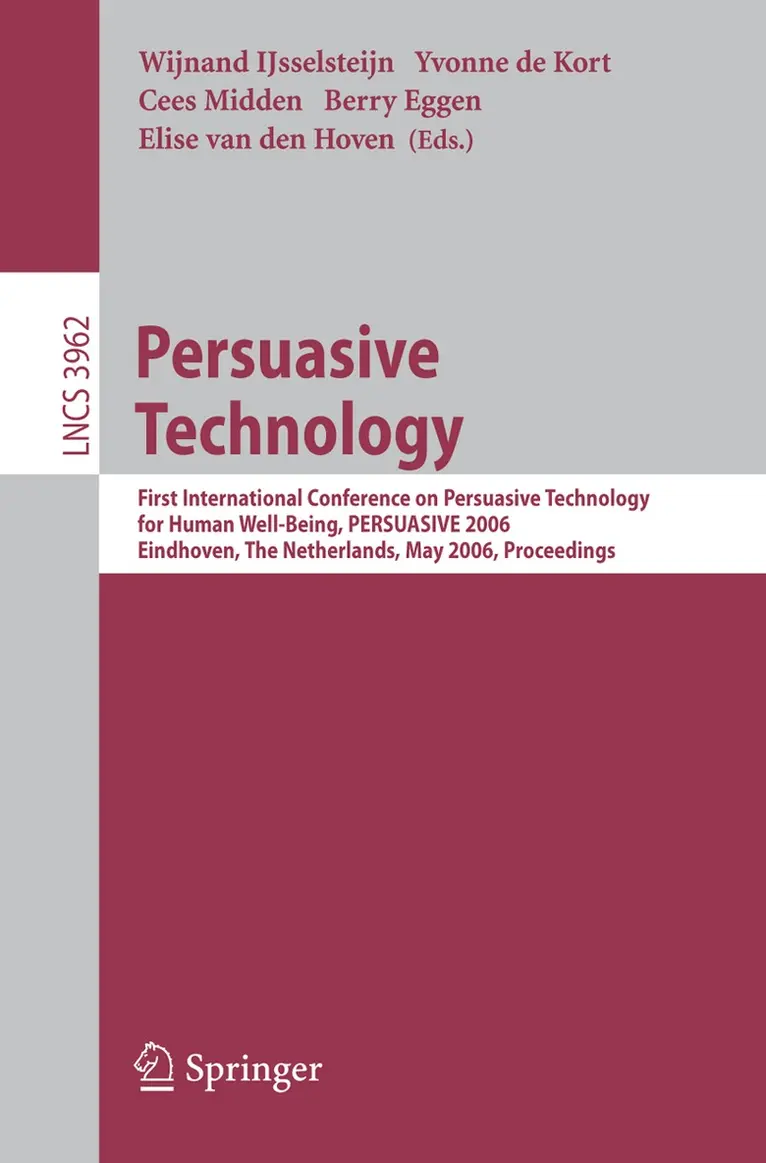
Persuasive technology is the general class of technology that has the explicit purpose of changing human attitudes and behaviours. Persuasive technologies apply principles of social psychology in influencing people; principles of credibility, trust, reciprocity, authority and the like. Social psychologists have spent a great deal of effort over many years in trying to understand how attitude and behaviour change comes about, focusing on the effectiveness of human persuaders, and the persuasive power of messages delivered through non-interactive mass-media, such as newspapers or television. Harnessing the persuasive power of current interactive media, persuasive technology was recently identified as a separate research field, as evidenced by B.J. 1 Fogg’s first discussion of the domain. Fogg characterises computers designed to 2 persuade as the 5th major wave in computing . The scope of technologies that hold persuasive potential is broader than ICT alone, and includes persuasive product design and architectural design, yet the interactive nature of computers uniquely enables user-sensitive and user-adaptive responding, allowing persuasive messages to be tailored to the specific user in question, presented at the right place and at the right time, thereby heightening their likely persuasive impact.
E-bok
PDF, Engelska, 2006687 kr
Läs direkt efter köp
Persuasive technology is the general class of technology that has the explicit purpose of changing human attitudes and behaviours. Persuasive technologies apply principles of social psychology in influencing people; principles of credibility, trust, reciprocity, authority and the like. Social psychologists have spent a great deal of effort over many years in trying to understand how attitude and behaviour change comes about, focusing on the effectiveness of human persuaders, and the persuasive power of messages delivered through non-interactive mass-media, such as newspapers or television. Harnessing the persuasive power of current interactive media, persuasive technology was recently identified as a separate research field, as evidenced by B.J. 1 Fogg’s first discussion of the domain. Fogg characterises computers designed to 2 persuade as the 5th major wave in computing . The scope of technologies that hold persuasive potential is broader than ICT alone, and includes persuasive product design and architectural design, yet the interactive nature of computers uniquely enables user-sensitive and user-adaptive responding, allowing persuasive messages to be tailored to the specific user in question, presented at the right place and at the right time, thereby heightening their likely persuasive impact.
Häftad, Engelska, 2007
529 kr
Skickas inom 10-15 vardagar
Persuasive technology is the general class of technologies that purposefully apply psychological principles of persuasion – principles of credibility, trust, reciprocity, authority and the like – in interactive media, in the service of changing their users’ attitudes and behavior. Only one year ago, in 2006, the first international conference in this area, PERSUASIVE 2006 was hosted in Eindhoven. The conference was entirely geared towards communicating the progress made in the area of persuasive technology, and towards presenting recent results in theory, design, technology and evaluation. It brought together a wide range of research fields, including social psychology, HCI, computer science, industrial design, engineering, game design, communication science, and human factors, and the formula worked: plans for a follow-up were made immediately upon its conclusion. PERSUASIVE 2007, the second international conference on persuasive technology, was hosted by Stanford University, April 26–27. The program featured a large number of presentations, both oral and in poster format, on new findings, new conceptualizations and designs, and new reflections on persuasion through technology. Sponsored by the National Science Foundation, this conference featured the best new insights into how video games, mobile phone applications, and Web sites can be designed to motivate and influence people.
E-bok
PDF, Engelska, 2007674 kr
Läs direkt efter köp
Persuasive technology is the general class of technologies that purposefully apply psychological principles of persuasion – principles of credibility, trust, reciprocity, authority and the like – in interactive media, in the service of changing their users’ attitudes and behavior. Only one year ago, in 2006, the first international conference in this area, PERSUASIVE 2006 was hosted in Eindhoven. The conference was entirely geared towards communicating the progress made in the area of persuasive technology, and towards presenting recent results in theory, design, technology and evaluation. It brought together a wide range of research fields, including social psychology, HCI, computer science, industrial design, engineering, game design, communication science, and human factors, and the formula worked: plans for a follow-up were made immediately upon its conclusion. PERSUASIVE 2007, the second international conference on persuasive technology, was hosted by Stanford University, April 26–27. The program featured a large number of presentations, both oral and in poster format, on new findings, new conceptualizations and designs, and new reflections on persuasion through technology. Sponsored by the National Science Foundation, this conference featured the best new insights into how video games, mobile phone applications, and Web sites can be designed to motivate and influence people.