Beryl Rawson - Böcker
Visar alla böcker från författaren Beryl Rawson. Handla med fri frakt och snabb leverans.
8 produkter
8 produkter
1 220 kr
Skickas inom 7-10 vardagar
The family continues to be seen as a central institution in Roman as well as modern, Western society. The Roman family is often used as a stereotype, sometimes of severity, sometimes of decadence, with its decline often cited as a cause of wider decline and fall. Definitions and concepts continue to be modified and nuanced, however, as the availability of new evidence and new methodologies make possible a much less simplistic picture. In this volume, the study of the family draws on a wide range of disciplines to develop the intertwined themes of status, sentiment, and space. For example, on status there are contributions about Junian Latins and a survey of senators' monuments, while sentiment is represented by a gloomy but convincing picture of old age, and a paper on the sentimental ideal which argues that conflict as well as concord is a feature of Roman life. One of the contributions on space examines who commemorates whom in Roman Italy, pointing up the regional variations in custom and the difficulties in tracing complete families. The final contributions focus on the house: how people lived in the Roman house, the use of the rooms, and the artefacts which might indicate this use.The book makes use of many types of evidence - from the legal and literary to the iconographical and archaeological. Visual and material evidence play an important role in reconstructing real lives in considerable colour and variety. The book moves beyond the city of Rome to the rest of Roman Italy and even into the provinces, just as Roman culture moved outwards and mingled with other cultures. Chronologically too there are new directions, towards the later Empire and Christianity. So, although the contributors do not abandon any of the territory already gained in Rome, literary and epigraphic sources, and the late Republic or early Empire, there is an exciting sense of new discovery.
1 420 kr
Skickas inom 5-8 vardagar
The family continues to be seen as a central institution in Roman as well as modern, Western society. The Roman family is often used as a stereotype, sometimes of severity, sometimes of decadence, with its decline often cited as a cause of wider decline and fall. Definitions and concepts continue to be modified and nuanced, however, as the availability of new evidence and new methodologies make possible a much less simplistic picture. In this volume, the study of family draws on a wide range of disciplines to develop the intertwined themes of status, sentiment, and space. For example, on status there are contributions about Junian Latins and a survey of senators' monuments, while sentiment is represented by a gloomy but convincing picture of old age and a paper on the sentimental ideal which argues that conflict as well as concord is a feature of family life. Space is represented, among others, by the contribution on who commemorates whom in Roman Italy, pointing up the regional variations in custom and the difficulties in tracing complete families. The final contributions focus on the house: how people lived in the Roman house, the use of rooms, and the artefacts that might indicate this use. The book makes use of many types of evidence from the legal and literary to the iconographical and archaeological. Visual and material evidence play an important role in reconstructing real lives in considerable colour and variety. The book moves beyond the city of Rome to the rest of Roman Italy and even into the provinces, just as Roman culture moved outwards and mingled with other cultures. Chronologically too there are new directions, towards the later Empire and Christianity. So, although the contributors do not abandon any of the territory already gained in Rome, nor literary and epigraphical sources, nor the late Republic or early Empire, there is an exciting sense of new discovery.
3 323 kr
Skickas inom 5-8 vardagar
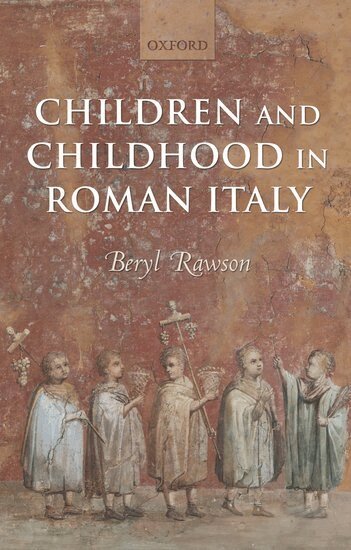
Concepts of childhood and the treatment of children are often used as a barometer of society's humanity, values, and priorities. Children and Childhood in Roman Italy argues that in Roman society children were, in principle and often in practice, welcome, valued and visible. There is no evidence directly from children themselves, but we can reconstruct attitudes to them, and their own experiences, from a wide variety of material - art and architecture, artefacts, funerary dedications, Roman law, literature, and public and private ritual. There are distinctively Roman aspects to the treatment of children and to children's experiences. Education at many levels was important. The commemoration of children who died young has no parallel, in earlier or later societies, before the twentieth century.This study builds on the dynamic work on the Roman family that has been developing in recent decades. Its focus on the period between the first century BCE and the early third century CE provides a context for new work being done on early Christian societies, especially in Rome.
1 119 kr
Skickas inom 5-8 vardagar
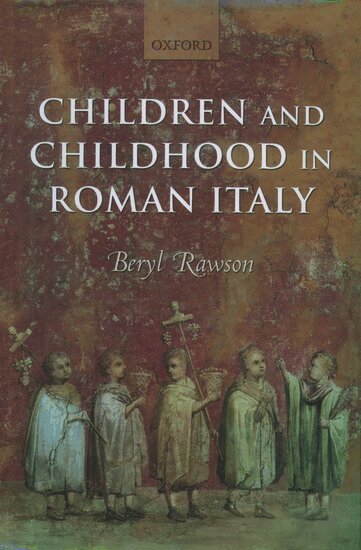
Concepts of childhood and the treatment of children are often used as a barometer of society's humanity, values, and priorities. Children and Childhood in Roman Italy argues that in Roman society children were, in principle and often in practice, welcome, valued and visible. There is no evidence directly from children themselves, but we can reconstruct attitudes to them, and their own experiences, from a wide variety of material - art and architecture, artefacts, funerary dedications, Roman law, literature, and public and private ritual. There are distinctively Roman aspects to the treatment of children and to children's experiences. Education at many levels was important. The commemoration of children who died young has no parallel, in earlier or later societies, before the twentieth century. This study builds on the dynamic work on the Roman family that has been developing in recent decades. Its focus on the period between the first century BCE and the early third century CE provides a context for new work being done on early Christian societies, especially in Rome.
719 kr
Skickas inom 10-15 vardagar
Little has been published on the Roman family, a subject of central importance to political as well as social history. It was the family that determined political power; it was within the family that the distinctive relationships of one citizen to another were forged and exemplified. The Family in Ancient Rome provides an overview of the state of research by presenting some of the most important work being done in this area.In addition to a survey of the literature on all aspects of the Roman family, the book begins with a general picture of the main features of the family. More specialized essays deal with the legal evidence, wills and property rights which were of particular importance for the position of women; with the link between property disposition, dowry, and divorce; with the authority of the male head of the household and its relation to political power; with the status of children born of unions between slaves and citizen; and with the rearing of, and attitudes toward, children.Contributors: Edyth Binkowski; Ian Blayney; Keith R. Bradley; J. A. Crook; Suzanne Dixon; W. K. Lacey; Beryl Rawson; P. R. C. Weaver
435 kr
Skickas inom 10-15 vardagar
Little has been published on the Roman family, a subject of central importance to political as well as social history. It was the family that determined political power; it was within the family that the distinctive relationships of one citizen to another were forged and exemplified. The Family in Ancient Rome provides an overview of the state of research by presenting some of the most important work being done in this area.In addition to a survey of the literature on all aspects of the Roman family, the book begins with a general picture of the main features of the family. More specialized essays deal with the legal evidence, wills and property rights which were of particular importance for the position of women; with the link between property disposition, dowry, and divorce; with the authority of the male head of the household and its relation to political power; with the status of children born of unions between slaves and citizen; and with the rearing of, and attitudes toward, children.Contributors: Edyth Binkowski; Ian Blayney; Keith R. Bradley; J. A. Crook; Suzanne Dixon; W. K. Lacey; Beryl Rawson; P. R. C. Weaver
509 kr
Kommande
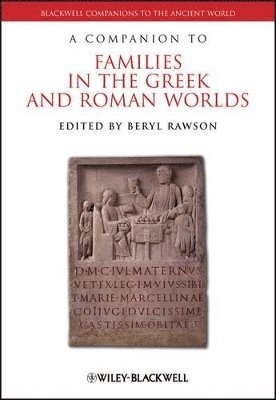
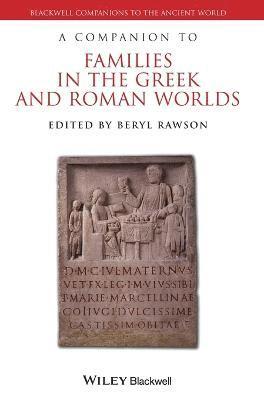
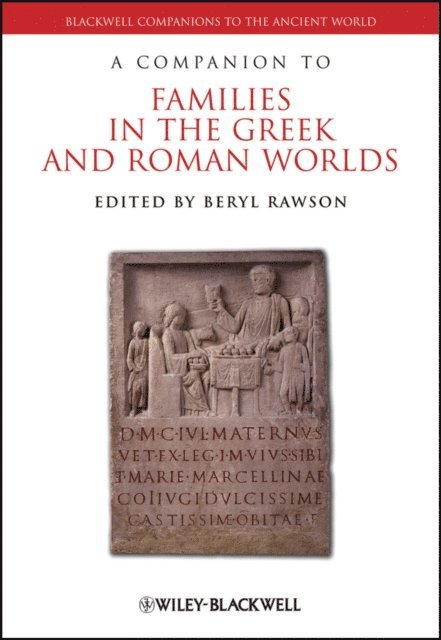
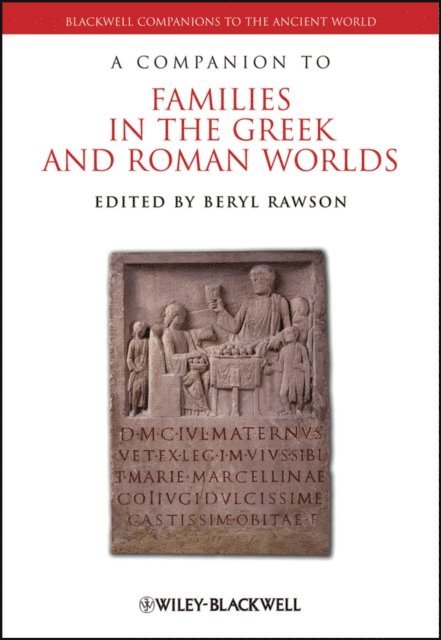
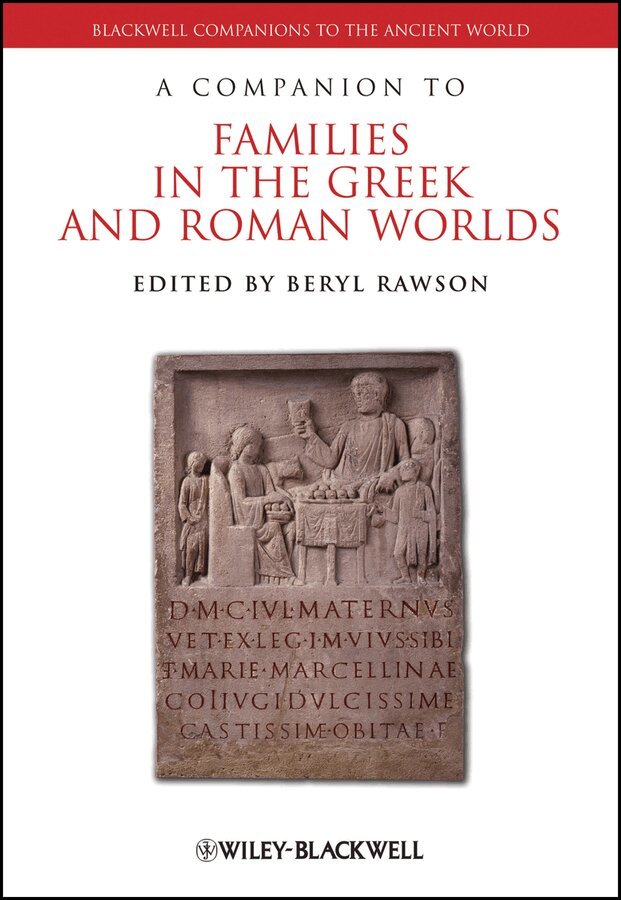
A Companion to Families in the Greek and Roman Worlds draws from both established and current scholarship to offer a broad overview of the field, engage in contemporary debates, and pose stimulating questions about future development in the study of families. Provides up-to-date research on family structure from archaeology, art, social, cultural, and economic history Includes contributions from established and rising international scholars Features illustrations of families, children, slaves, and ritual life, along with maps and diagrams of sites and dwellingsHonorable Mention for 2011 Single Volume Reference/Humanities & Social Sciences PROSE award granted by the Association of American Publishers
Del 71 - Blackwell Companions to the Ancient World
Companion to Families in the Greek and Roman Worlds
Inbunden, Engelska, 2010
2 052 kr
Skickas inom 7-10 vardagar
A Companion to Families in the Greek and Roman Worlds draws from both established and current scholarship to offer a broad overview of the field, engage in contemporary debates, and pose stimulating questions about future development in the study of families. Provides up-to-date research on family structure from archaeology, art, social, cultural, and economic historyIncludes contributions from established and rising international scholarsFeatures illustrations of families, children, slaves, and ritual life, along with maps and diagrams of sites and dwellingsHonorable Mention for 2011 Single Volume Reference/Humanities & Social Sciences PROSE award granted by the Association of American Publishers