Paul Weaver - Böcker
Visar alla böcker från författaren Paul Weaver. Handla med fri frakt och snabb leverans.
5 produkter
5 produkter
1 220 kr
Skickas inom 7-10 vardagar
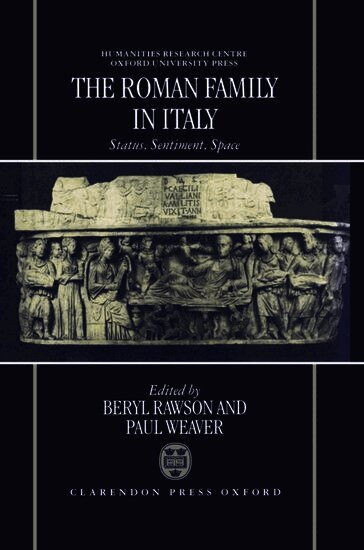
The family continues to be seen as a central institution in Roman as well as modern, Western society. The Roman family is often used as a stereotype, sometimes of severity, sometimes of decadence, with its decline often cited as a cause of wider decline and fall. Definitions and concepts continue to be modified and nuanced, however, as the availability of new evidence and new methodologies make possible a much less simplistic picture. In this volume, the study of the family draws on a wide range of disciplines to develop the intertwined themes of status, sentiment, and space. For example, on status there are contributions about Junian Latins and a survey of senators' monuments, while sentiment is represented by a gloomy but convincing picture of old age, and a paper on the sentimental ideal which argues that conflict as well as concord is a feature of Roman life. One of the contributions on space examines who commemorates whom in Roman Italy, pointing up the regional variations in custom and the difficulties in tracing complete families. The final contributions focus on the house: how people lived in the Roman house, the use of the rooms, and the artefacts which might indicate this use.The book makes use of many types of evidence - from the legal and literary to the iconographical and archaeological. Visual and material evidence play an important role in reconstructing real lives in considerable colour and variety. The book moves beyond the city of Rome to the rest of Roman Italy and even into the provinces, just as Roman culture moved outwards and mingled with other cultures. Chronologically too there are new directions, towards the later Empire and Christianity. So, although the contributors do not abandon any of the territory already gained in Rome, literary and epigraphic sources, and the late Republic or early Empire, there is an exciting sense of new discovery.
1 420 kr
Skickas inom 5-8 vardagar
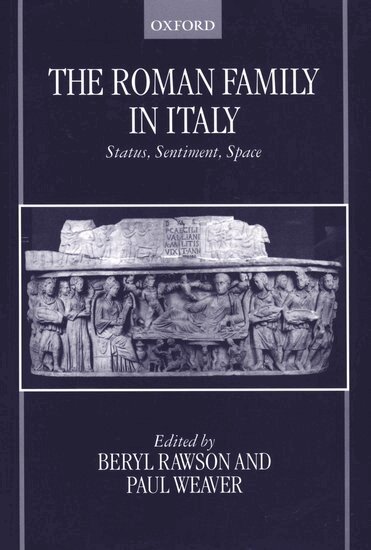
The family continues to be seen as a central institution in Roman as well as modern, Western society. The Roman family is often used as a stereotype, sometimes of severity, sometimes of decadence, with its decline often cited as a cause of wider decline and fall. Definitions and concepts continue to be modified and nuanced, however, as the availability of new evidence and new methodologies make possible a much less simplistic picture. In this volume, the study of family draws on a wide range of disciplines to develop the intertwined themes of status, sentiment, and space. For example, on status there are contributions about Junian Latins and a survey of senators' monuments, while sentiment is represented by a gloomy but convincing picture of old age and a paper on the sentimental ideal which argues that conflict as well as concord is a feature of family life. Space is represented, among others, by the contribution on who commemorates whom in Roman Italy, pointing up the regional variations in custom and the difficulties in tracing complete families. The final contributions focus on the house: how people lived in the Roman house, the use of rooms, and the artefacts that might indicate this use. The book makes use of many types of evidence from the legal and literary to the iconographical and archaeological. Visual and material evidence play an important role in reconstructing real lives in considerable colour and variety. The book moves beyond the city of Rome to the rest of Roman Italy and even into the provinces, just as Roman culture moved outwards and mingled with other cultures. Chronologically too there are new directions, towards the later Empire and Christianity. So, although the contributors do not abandon any of the territory already gained in Rome, nor literary and epigraphical sources, nor the late Republic or early Empire, there is an exciting sense of new discovery.
1 524 kr
Skickas inom 11-20 vardagar
Adaptive structures have the ability to adapt, evolve or change their properties or behaviour in response to the environment around them. The analysis and design of adaptive structures requires a highly multi-disciplinary approach which includes elements of structures, materials, dynamics, control, design and inspiration taken from biological systems. Development of adaptive structures has been taking place in a wide range of industrial applications, but is particularly advanced in the aerospace and space technology sector with morphing wings, deployable space structures; piezoelectric devices and vibration control of tall buildings.Bringing together some of the foremost world experts in adaptive structures, this unique text: includes discussions of the application of adaptive structures in the aerospace, military, civil engineering structures, automotive and MEMS.presents the impact of biological inspiration in designing adaptive structures, particularly the use of hierarchy in nature, which typically induces multi-functional behavior.sets the agenda for future research in adaptive structures in one distinctive single volume.Adaptive Structures: Engineering Applications is essential reading for engineers and scientists working in the fields of intelligent materials, structural vibration, control and related smart technologies. It will also be of interest to senior undergraduate and postgraduate research students as well as design engineers working in the aerospace, mechanical, electrical and civil engineering sectors.
165 kr
Skickas inom 11-20 vardagar
906 kr
Skickas inom 10-15 vardagar
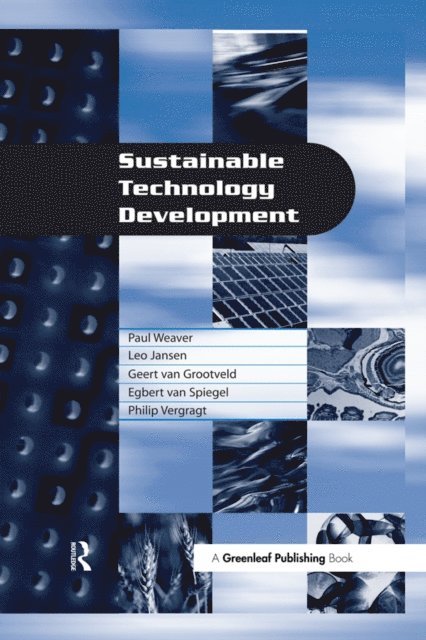
In the time it takes to read this sentence, about fifteen people will be added to the world's population. Read the sentence again, and there will be thirty. Tomorrow, each of these people will be demanding greater prosperity. Production and consumption are increasing fast but will have to grow even faster in the future to keep up with population growth and a world increasingly divided by inequality. How should we react to these trends? Certainly, many use growth figures to forecast disaster. But there is an alternative vision: one of a sustainable future, in which growth is seen not as a threat, but as the driving force behind innovation. This is the scenario worked out in the Netherlands by Sustainable Technology Development (STD), a five-year programme of research and "learning-by-doing" based on setting up new innovation networks and working with new methods to search for sustainable technological solutions. In order to make sustainability tangible, STD made a leap in time. What human needs will have to be satisfied fifty years from now? Taking a sustainable future vision as a starting point, STD demonstrated what steps we should take today for new technologies and systems to be in place in time. These results are now available for the first time in a comprehensive, specifically written English-language book, together with a description of the unique working method of STD and the results and key lessons from a set of the programme's illustrative case studies. This book serves as a manual for industry, governments and social leaders wanting to prepare themselves for a sustainable future. Sustainable Technology Development sets out the programme's underpinning philosophy and describes its approach, methods and findings. Delivering sustainability means finding ways to meet human needs using a fraction of the natural resources we use today. The world's richer nations would be wise to target at least ten-fold improvements by 2050 in the productivity with which conventional natural resources and environmental services are used. And they need to bring new, sustainable resources on-stream to augment the resource base and replace the use of unsustainable alternatives. Sustainable Technology Development marks a significant contribution to our understanding of innovation processes and how these might be influenced in favour of sustainable technology development. In principle, technology could play a pivotal role in sustainable development. Whether it does or not depends on whether innovators can be encouraged to make this an explicit goal, adopt long-term time-horizons and search for renewable technologies. Given the long lead-times involved, there is no time to waste in beginning the search. The STD programme has begun to make inroads into one of the most urgent of all needs concerning sustainable development: that for innovation in the innovation process itself.